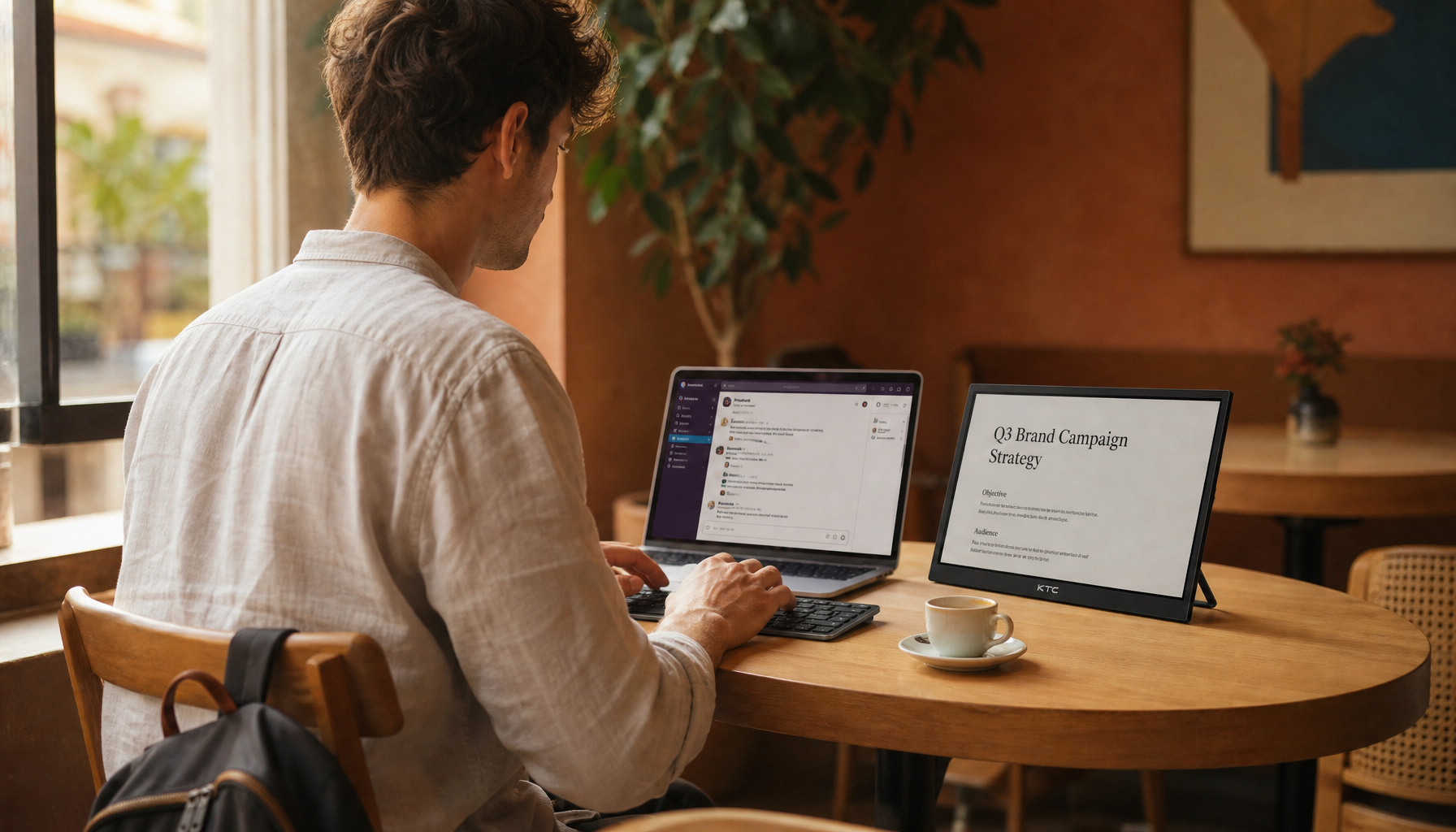
A rolling smart display meeting hub works best when hybrid meetings move fast and the room setup has to keep up. If your team switches rooms often, shares laptops frequently, or needs a temporary huddle space, start with mobility, casting, and power access before you think about screen size.
What Hybrid Teams Need First
For hybrid teams, the first question is not "Which display has the biggest spec sheet?" It is whether the screen fits the way meetings actually move between rooms. Conference rooms for hybrid work require mobile or flexible furniture and technology to support quick reconfiguration. AVIXA's guidance on small conference room AV puts the emphasis on quick sharing and flexible display use, which matches short standups and ad hoc collaboration better than a fixed-room mindset.
A good rolling smart display meeting hub should save time at the start of each meeting, not add another setup step. That means the team should check room flow, door clearance, and where power is available before buying. If the screen has to be wrestled through hallways or parked far from an outlet, the "mobile" part stops feeling useful.
What matters most in real use is whether people can start talking, casting, and annotating without a handoff ritual. If your team commonly opens a laptop, mirrors a deck, and captures ideas on the screen in the same few minutes, touch control and wireless sharing are not extras. They are the workflow.
Meeting Room Flow
In back-to-back meetings, the real bottleneck is often the transition, not the presentation itself. A mobile display helps when the team can roll it into place, wake it quickly, and resume work without waiting on a room reset.
A rolling smart display meeting hub is usually a better fit than a fixed screen when adjacent rooms share the same workflow. That is especially true for daily standups, client check-ins, and temporary project huddles. The setup breaks down when the display must stay in one room all day or when the route between rooms is tight enough to make moving it annoying.
Mobility and Storage
The AVIXA conference room design guidance is useful here because it highlights a simple rule: check the room before you buy the display, not after it arrives. Stable footing, a manageable footprint, and power access matter more than a flashy mobility claim.
For office managers, the practical test is simple. Can the display pass through doors, fit in a hallway turn, and park somewhere safe between meetings? If not, a smaller format or a different room plan may work better than forcing a large mobile screen into a cramped route.
Touch and Casting Use Cases
Touch and casting matter most when the team needs to capture ideas quickly. Wireless screen sharing reduces cable handoffs, and that is helpful when presenters change often. Type-C also remains useful because it can simplify a laptop connection when the source device supports the right output.
A rolling smart display meeting hub is not just about convenience. It is about removing small delays that eat into short hybrid windows. If your team spends time hunting for the right adapter or reconnecting a laptop every meeting, the room is probably asking for a different workflow.

Mobility Requirements That Actually Matter
When a mobile display is used between rooms, mobility is not a side feature. It is the main reason to choose this class of product. AVIXA-style room planning points toward a stable base, a clear path through the space, and verified power access before the screen becomes part of daily use.
For a rolling smart display meeting hub, built-in wheels are more practical than treating a fixed display like a cart project. The goal is to reduce friction, not create a new one. If the base feels wobbly, the setup becomes distracting during calls and people will hesitate to move it.
Battery runtime also matters, but only in context. It helps most when the display needs to move first and plug in later, or when the room layout does not make wall power easy to reach. A battery does not remove the need to plan charging, it just gives the team more room to move.
The Mobile Touch Screen collection is the most relevant browsing path if you want to compare mobile display formats by size and resolution rather than jumping straight to a single model.
A simple decision sentence applies here: if the screen needs to travel daily between nearby rooms, prioritize wheels, footprint, and power planning first; if it will stay parked in one place, mobility features matter less than image quality or fixed-room ergonomics.
Connectivity for Fast Screen Sharing
Connectivity is where many mobile meeting setups feel better on paper than in practice. Wireless casting is useful when different people present during the day, but Wi-Fi quality still needs to be tested in the rooms where the display will actually be used. If the network is uneven, wired input can be the calmer backup.
For hybrid teams, the best setup is often a two-path setup: wireless for convenience, wired for certainty. Type-C can simplify the laptop handoff, but only if the source device supports video over Type-C. Otherwise, the cable looks simple and still fails at the last step.
A useful check is to ask which device starts the meeting most often. If one team member always presents from the same laptop, a wired path may be enough. If the presenter changes constantly, wireless casting becomes more important, even if it is not the fastest method every time.

How a Rolling 4K Touch Display Fits the Workflow
This is where product fit becomes more specific. If the team needs sharper document review, clearer shared screens, and direct onscreen interaction, a rolling 4K touch display can make sense. The benefit is not abstract image quality. It is the difference between a cramped shared screen and a screen that is easier to read across a small room.
For that use case, the KTC MEGAPAD 32" 4K Android 13 Google EDLA Smart Touch Monitor with 9500mAh Battery fits the buyer condition more naturally than a smaller screen would. The manufacturer lists a 31.5-inch 4K panel, built-in wheels, a 9500mAh battery, Android 13 with Google EDLA, HDMI 2.0, USB 3.0, and Wi-Fi 6, which aligns with room-to-room hybrid use.
That does not make it the right answer for every office. The 4K model is a stronger fit when the screen has to carry a room visually and support shared review, but it is less compelling if the team mainly wants a smaller, easier-to-place mobile screen. In that case, a more compact format can be the better compromise.
The smaller KTC MEGAPAD 27" FHD Android 14 Google EDLA Smart Touch Monitor with 9500mAh Battery is the cleaner choice when footprint matters more than a larger shared canvas. Its 27-inch FHD size, built-in wheels, Type-C all-in-one input, Android 14, and 9500mAh battery make it easier to think about as a lighter workflow tool.
Decision sentence: choose the 32-inch 4K model when the team needs a bigger shared screen for documents and collaboration in adjacent rooms; choose the 27-inch model when portability and easier placement matter more than a larger display area.
Setup Checklist Before the First Meeting
Before the first live meeting, make the move from "works in theory" to "works in the room." This is the point where many mobile displays lose time if no one tested the route, the power plan, or the fallback input path.
- Roll the display through the actual path you will use, including doorways and turns.
- Park it in the intended room and check whether the base feels stable.
- Confirm the nearest power source and decide where the display will charge.
- Test wireless casting from at least one laptop and one backup device.
- Verify Type-C or HDMI fallback so one bad network day does not stop the meeting.
- Decide where the display will live between meetings so storage does not become a daily hassle.
- Wipe the screen, check visible cables, and make sure the base stays clear.
A practical rule applies here: if the display cannot be moved, powered, and connected quickly during a dry run, it is not ready for daily hybrid use yet. Solve that before you roll it into a real meeting.
Why a Rolling Setup Works Better for Some Teams
A rolling smart display meeting hub is most valuable when the meeting itself is mobile. That is why it fits hybrid team leads, office managers, and IT coordinators who are trying to reduce room-change friction instead of just upgrading a screen.
If your rooms are fixed, your cables are already standardized, and nobody needs to move the display, the benefit shrinks fast. But when short sessions, changing presenters, and temporary huddle spaces are the norm, mobility and quick sharing can save more time than a static setup ever will.
FAQs
Q1. How Much Room Do I Need for a Rolling Collaboration Display?
Plan for the full movement path, not just the meeting corner. Measure door widths, hallway turns, and the spot where the display will park. If the route is awkward, even a good screen can become a daily nuisance.
Q2. What Cables Should I Keep on Hand for Hybrid Meetings?
Keep at least one Type-C cable, one HDMI cable, and a spare adapter for older laptops. Type-C is the cleanest option when supported, but HDMI is still the safest fallback when a laptop or dock behaves unpredictably.
Q3. Can a Rolling Touch Display Replace a Dedicated Conference Room Screen?
It can, if the room is used for short, flexible sessions and the display is easy to move, power, and cast to. A fixed screen still makes more sense when the room is used heavily every day and almost never changes layout.
Q4. How Should Teams Maintain a Mobile Meeting Display?
Keep the screen dry, wipe it with a soft cloth, and inspect wheels and cables on a regular schedule. A quick weekly check usually catches loose connections, dirty surfaces, or base clutter before they interrupt a meeting.
Q5. Why Does Wireless Casting Sometimes Feel Slower Than Wired Input?
Wireless casting depends on room network quality, the source device, and the app path. Wired input usually feels steadier because it removes most of those variables. If casting is inconsistent, test the network in the actual meeting room before blaming the display.
What to Check Before You Buy
The best rolling smart display meeting hub is the one that matches how your team actually meets. Check the room route, the power plan, and the way people share screens before you compare features. If your workflow is short, frequent, and room-to-room, mobility and casting matter more than showroom specs. If not, a simpler fixed setup may be the better call.