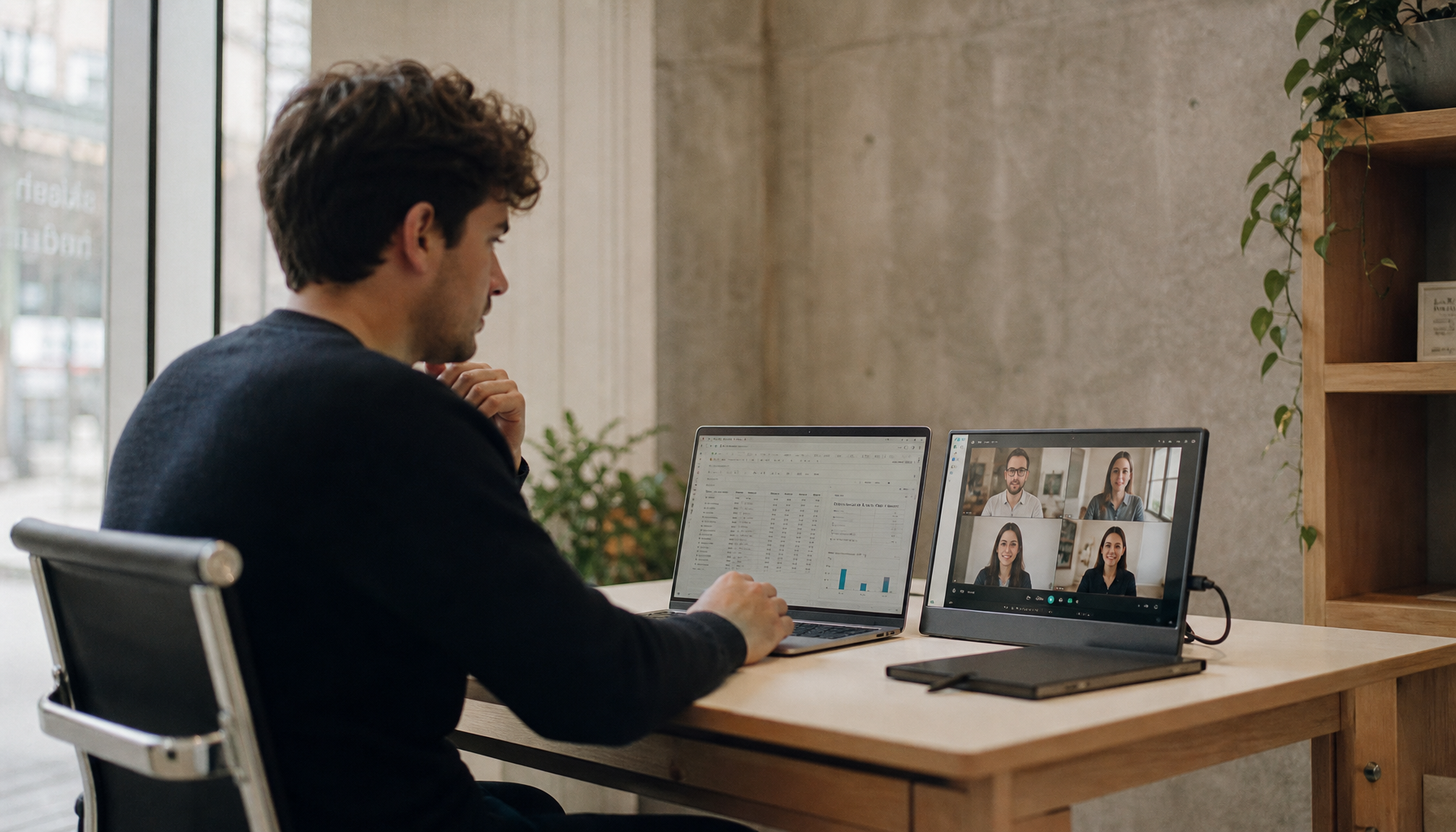
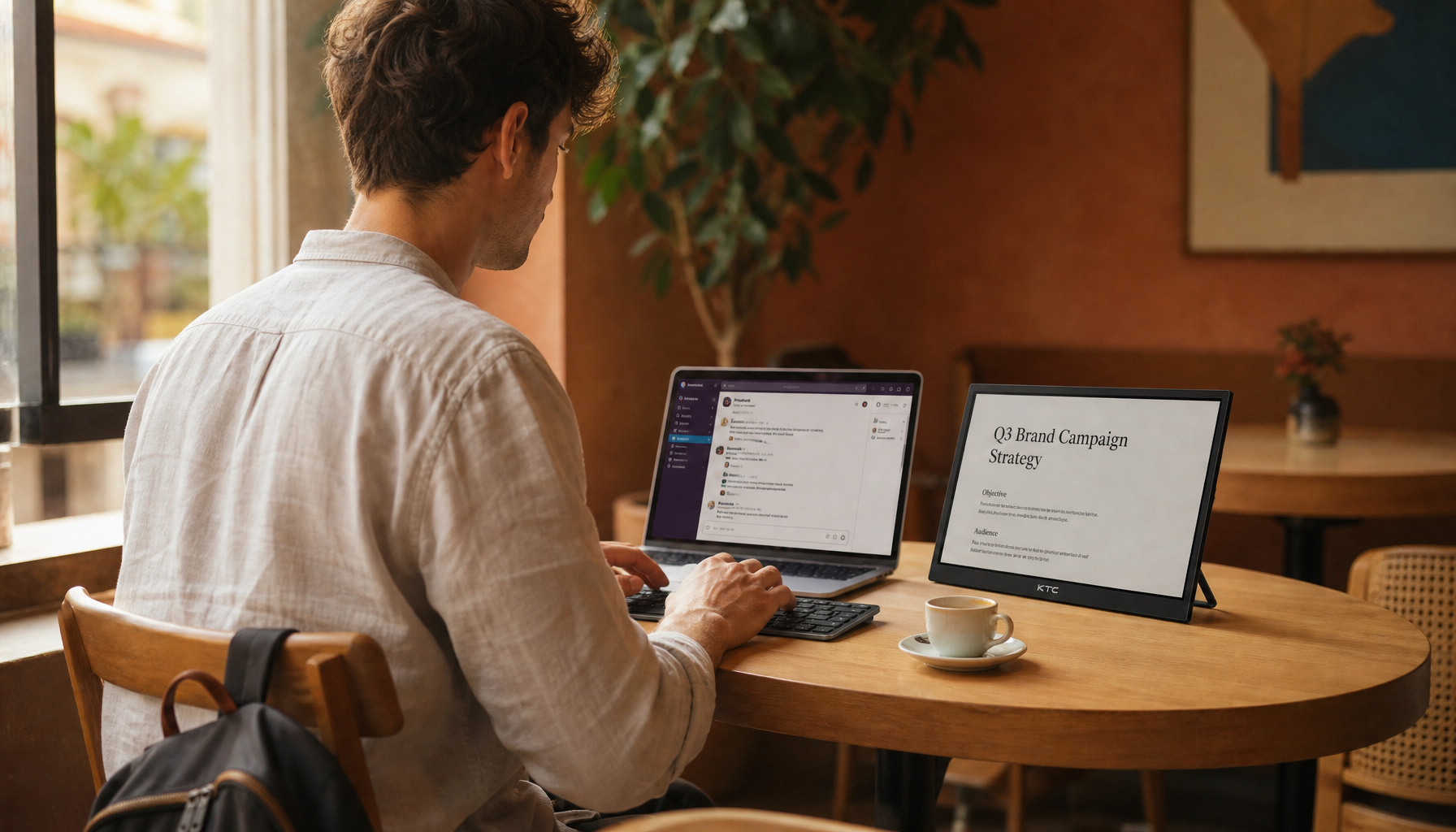
Portable monitor orientation flexibility helps legal professionals read long filings in portrait mode, compare drafts in landscape mode, and adapt between office, court, hotel, and client-site workflows.
Is your neck tightening after an hour of jumping between a 13-inch laptop, a PDF brief, a redline, and a case-management window? A portable second screen gives you a practical benefit immediately: it keeps the reference document visible while you review, annotate, or compare language on the main screen.
Why Orientation Matters in Legal Document Review

Legal work is unusually document-dense. Contracts, pleadings, discovery productions, deposition transcripts, exhibits, privilege logs, and regulatory filings are rarely designed for a cramped laptop view. Orientation flexibility means the same portable monitor can rotate between landscape and portrait layouts, usually through display settings or automatic rotation on select models.
A portable monitor is a lightweight external display that expands a laptop workspace without a full desktop setup, and extra screen space helps keep research or reference material visible while reducing tab switching. For a legal professional, that does not mean “more screen” in the abstract. It means the complaint stays open while the answer is drafted, the lease exhibit stays visible while the amendment is checked, and the redline remains stable while comments are resolved.
Portrait orientation is the decisive mode for long-form legal reading. A 14- to 16-inch portable display rotated vertically often shows more of a letter-size page at once than the same display in landscape mode. That reduces scrolling and makes it easier to maintain context across sections, definitions, footnotes, signature blocks, and exhibit labels.
Landscape orientation remains better for comparison. When reviewing a merger agreement against a markup, or checking a chart of discovery requests beside a response draft, a horizontal portable monitor can hold a spreadsheet, document-management window, or email thread while the laptop stays dedicated to drafting.
The Practical Workflow: Portrait for Reading, Landscape for Comparing

The strongest legal-review setup is not one fixed layout. It is a repeatable switch between two modes.
In portrait mode, use the portable monitor for the primary document. Put a PDF brief, transcript, exhibit packet, or scanned record on the vertical display, then keep your laptop screen for notes, search, citations, or the document management system. The practical result is simple: fewer scroll interruptions while you work through dense text.
In landscape mode, use the portable monitor as the comparison or control surface. Place the redline, prior draft, privilege log, or case chronology there. Keep the active draft on your main laptop. The legal reviewer’s goal is controlled attention: a stable second display lets the eye move between known zones instead of forcing constant app switching.
Review task |
Best orientation |
Why it helps |
Reading briefs, contracts, transcripts, exhibits |
Portrait |
More vertical document context with less scrolling |
Comparing redlines or clause libraries |
Landscape |
Easier side-by-side review and broader line visibility |
Checking document metadata, audit trails, or file names |
Landscape |
Better fit for tables, columns, and repository views |
Annotating PDFs with stylus or touch |
Portrait or landscape |
Depends on whether the document is page-like or table-heavy |
Better Screens Reduce Review Friction, But Specs Still Matter

Orientation flexibility only pays off if the monitor is readable, stable, and easy to connect. For legal professionals, the most important specs are not gaming refresh rate or cinematic color. They are text clarity, brightness, stand stability, aspect ratio, ports, and low setup friction.
A 15.6-inch 1080p portable monitor is often enough for mobile productivity, but higher-resolution 16:10 models can make PDFs and text feel more precise if scaling is handled well. Portable-monitor testing highlights the value of matching the monitor to the use case, including 16:10 aspect ratio for productivity, touch or stylus support for annotation, and USB-C or HDMI compatibility based on the source device in portable-monitor use cases. For legal review, 16:10 is especially useful because it provides a little more vertical room than 16:9 without making the device bulky.
Brightness matters more than many buyers expect. A dim portable panel may be tolerable in a home office but frustrating under conference-room lights or near a courthouse window. Testing notes show meaningful differences among portable monitors, with some budget models falling below typical brightness expectations and others performing far better. That gap is not cosmetic; low brightness can make scanned exhibits, faint signatures, and gray redline text harder to verify.
Stand design is equally important. A monitor that rotates but cannot hold its angle is a liability during document review. Buying guidance recommends favoring built-in kickstands or sturdy articulating stands because weak magnetic cover stands can hurt usability, a point reinforced in portable monitor stand recommendations. In a legal setting, a rigid stand also reduces the chance that a screen slips during client meetings, depositions, or travel work.
How Orientation Flexibility Supports Secure Document Management

Portable monitors do not replace a document management system. They make the system easier to use while reviewing files. A legal team still needs access permissions, audit trails, controlled file history, and a central record of truth.
The screen advantage appears when those controls need to be checked against the document itself. In landscape mode, the portable monitor can show metadata, file history, matter folders, or naming conventions while the laptop displays the document. In portrait mode, the monitor can hold the PDF while the laptop shows the document record, comments, or task list.
This matters in review workflows where mistakes are expensive. If a reviewer is checking whether “Final_Executed” is truly the signed file, a second oriented screen lets the signature page, file history, and email context stay visible at the same time. Best-practice guidance emphasizes a single record of truth, access controls, and document tracking to reduce duplication and support accountability in document management practices. Orientation flexibility makes those controls less hidden and more usable during the actual review moment.
Pros and Cons for Legal Professionals
The main advantage is cognitive stability. A portable monitor in portrait mode lets long documents behave more like paper while preserving digital search, zoom, annotations, and copyable text. In landscape mode, it supports comparison work without requiring a full office monitor. That combination is valuable for hybrid attorneys, contract managers, litigation support teams, paralegals, and in-house counsel who move between desks, conference rooms, and travel locations.
The second advantage is ergonomic control. Legal review often stretches for hours. A second screen can be raised, angled, or rotated so the reviewer is not hunched over a laptop. Productivity-monitor guidance stresses ergonomics such as height adjustment, tilt, swivel, and pivot because positioning affects comfort during long work sessions in monitor ergonomics. Portable setups have fewer adjustment options than desktop arms, so the stand and case design deserve close attention.
The tradeoffs are real. Portable monitors add weight, cables, and setup steps. Many are smaller and lower in picture quality than desktop monitors. Some require separate power. Touch features may behave differently across operating systems. Budget models can have weak stands, low brightness, or mediocre contrast. For review work, those weaknesses show up quickly in scanned PDFs, small footnotes, and long redlines.
What to Buy for Legal Review
For most legal professionals, the best value is a 14- to 16-inch portable IPS monitor with 1080p or 2560-by-1600 resolution, USB-C DisplayPort Alt Mode, mini HDMI as a fallback, a sturdy stand, and reliable portrait support. IPS panels are a strong default because they maintain readable viewing angles when the display is rotated or shared across a table.
If annotations matter, consider a touch or stylus-capable model, but verify operating-system support before buying. Portable-display guidance highlights touch and stylus support as a productivity feature in specific models, while other testing notes that touch behavior can be more limited on some laptops than on others. That distinction matters for attorneys who expect to mark up PDFs by hand during calls or client review sessions.
If you travel constantly, weight and cable simplicity should outrank premium specs. Portable-monitor coverage treats portability, connectivity, and stand usability as central buying factors, and portable monitor buying advice aligns with the practical reality of mobile work: the screen you can set up quickly is the one you will actually use.
Setup Tips That Prevent Review Mistakes
Set portrait mode intentionally in your operating system and confirm that text scaling is comfortable before opening confidential files in a meeting. Keep a consistent workflow: main laptop for drafting, portable portrait screen for the reference document, or portable landscape screen for comparison. Consistency reduces misclicks and helps you avoid editing the wrong file.
Keep the monitor slightly off-center and close enough that footnotes, exhibit labels, and line numbers remain readable without leaning forward. If you work with scanned records, increase PDF contrast or use OCR-enabled files when available. A document management workflow with searchable text, metadata, and file history is stronger when the reviewer can keep the original page and the control record visible together.
For courtroom, deposition, or client-site work, test the exact cable path before the session. USB-C one-cable setups are efficient when both devices support video and power, but HDMI may require separate power. A portable screen that supports both USB-C and HDMI gives you more resilience when moving between firm laptops, client devices, and conference-room equipment.
The Bottom Line
Portable monitor orientation flexibility improves legal document review because it turns a cramped laptop into a controlled review station. Portrait mode makes long documents easier to read, landscape mode improves comparison work, and a reliable stand with simple connectivity keeps the setup practical under real legal deadlines. Choose the screen around your review workflow, not the spec sheet, and the payoff is fewer context switches, clearer file control, and more confident document decisions.