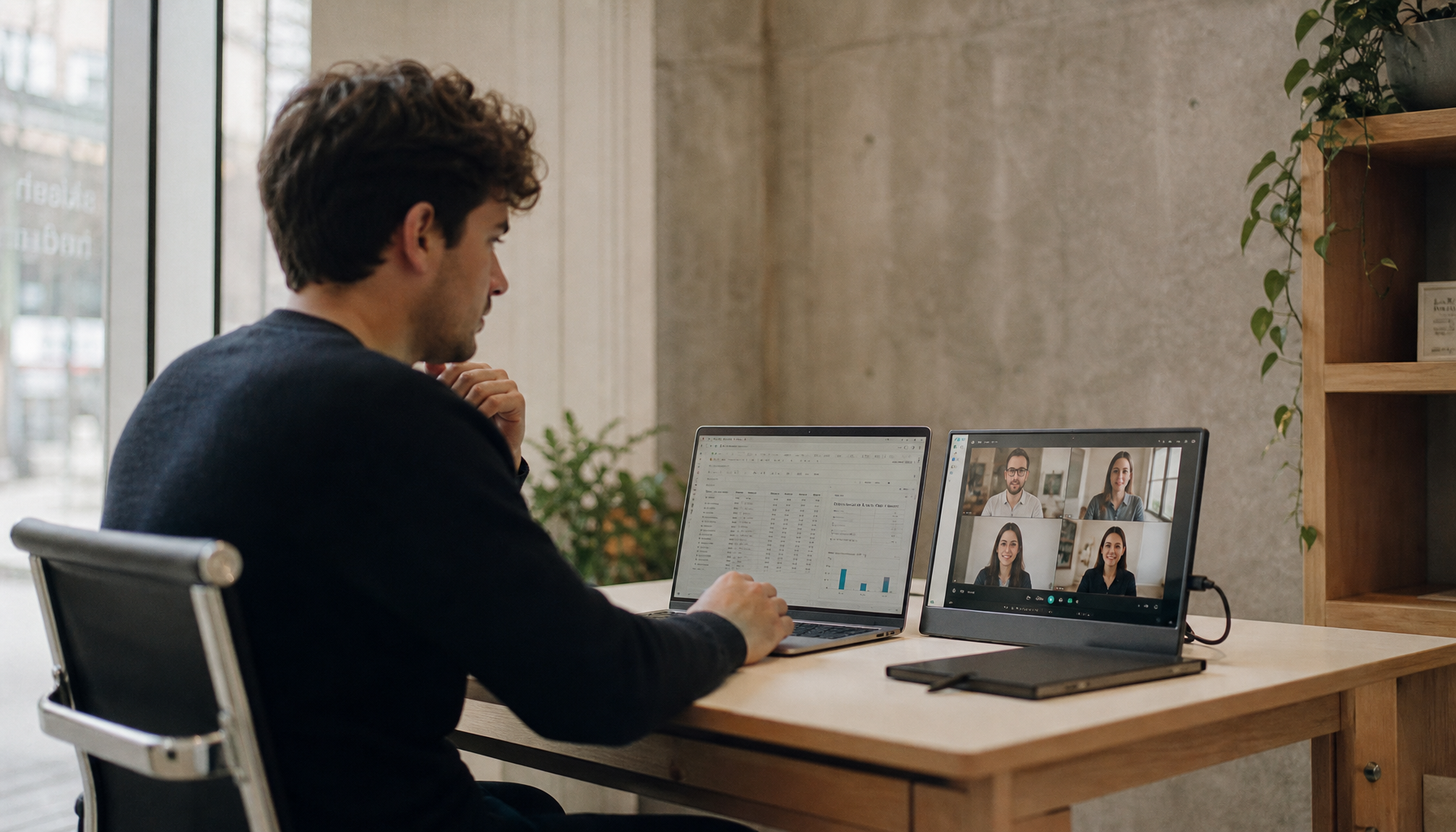
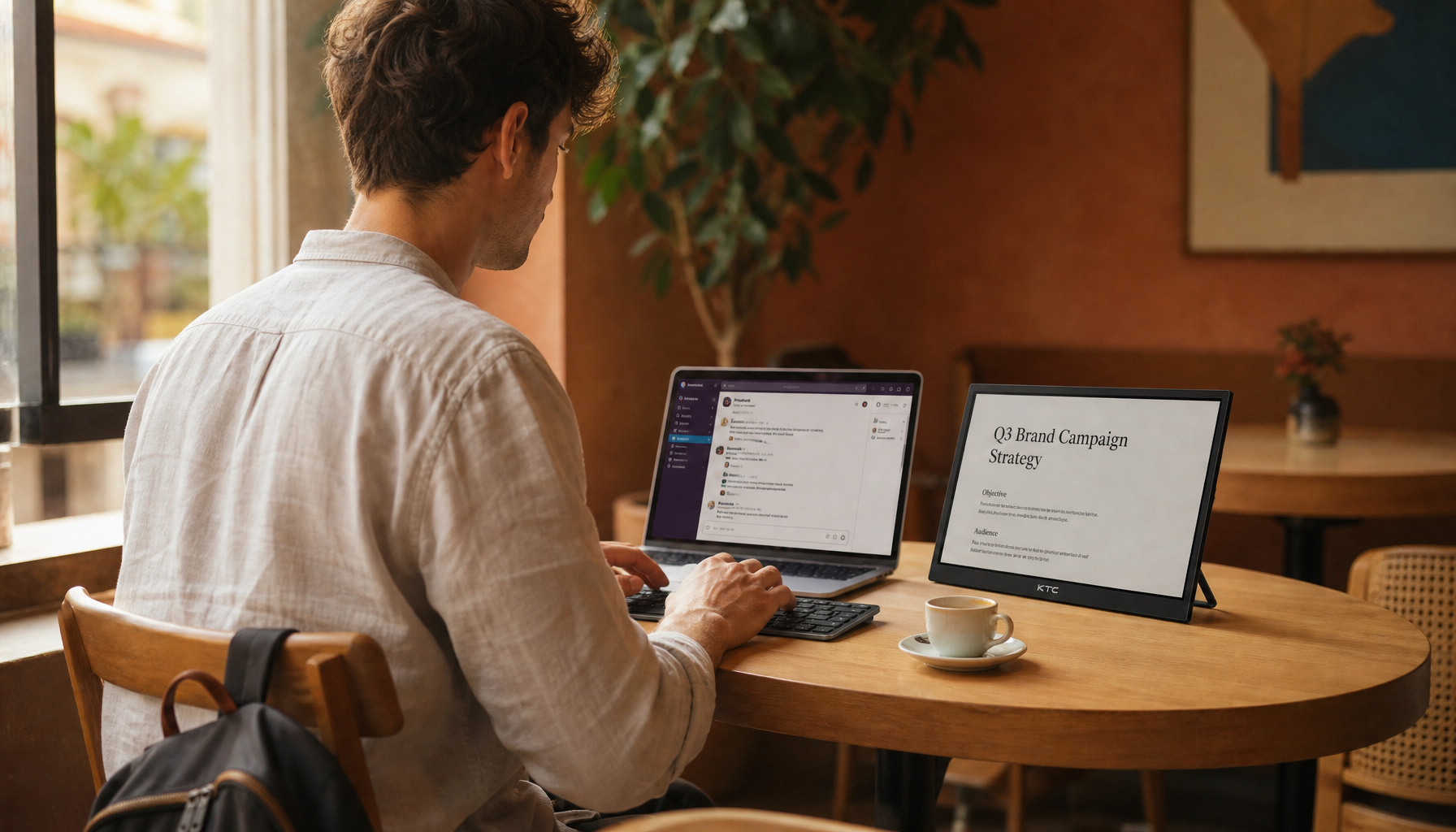
For a 43-inch 4K productivity monitor, start with your eyes about 3.5 to 4 feet from the screen, then fine-tune in 2-inch steps until text is sharp, the corners are visible without neck turning, and your posture stays neutral.
Is your giant screen making spreadsheets feel powerful for ten minutes, then turning into a neck-and-eye workout by lunch? A 43-inch 4K display can replace a multi-monitor layout and keep more tools visible at once, but only if distance, height, scaling, and window zones work together. Here is a practical setup path for making a 43-inch monitor feel like a command center instead of a wall of pixels.
The Best Starting Distance for a 43-Inch Productivity Monitor
A 43-inch monitor is large enough that the usual “arm’s length” rule is only a baseline, not the final answer. OSHA’s general monitor guidance supports arranging components to maintain neutral posture and reduce awkward head, neck, shoulder, arm, and back positions, while many office ergonomics references place typical monitor viewing somewhere around arm’s length or more for larger displays.
For a 43-inch 4K screen used as a desktop productivity display, 42 to 48 inches is the most reliable starting zone. That matches practical 43-inch desk setup guidance recommending 3.5 to 4 feet for this size, while large UHD productivity guidance treats 43 inches as close to ideal for users sitting roughly 2 to 4 feet from the screen.

The key is that “distance” means eye-to-screen distance, not desk depth. A 30-inch-deep desk may still put your eyes too close if the monitor stand pushes the panel forward. A monitor arm, wall mount, or rear-positioned stand can reclaim several inches, which matters because the comfort difference between 34 inches and 44 inches is obvious on a 43-inch panel.
Why 43 Inches Behaves Differently Than a Normal Office Monitor
A 43-inch 16:9 display is not just a bigger 27-inch monitor. It gives you a desktop surface closer to four 1080p screens when run at 3840 x 2160, because UHD contains about 8 million pixels versus about 2 million pixels on a standard 1920 x 1080 display.
That pixel space is the productivity advantage. You can keep an IDE, documentation, terminal, calendar, dashboard, spreadsheet, and chat visible without constantly switching apps. In a real work layout, the center zone becomes your active task, the left zone handles reference material, and the right zone holds communications or notes. One user report on a 43-inch 4K work monitor described similar benefits: fewer bezel problems, easier tiling, and an adjustment period of about one to two workdays when using grid-based window management.

The tradeoff is physical span. If you sit too close, the corners become peripheral territory and you start scanning with your neck instead of your eyes. If you sit too far back, the whole screen becomes visually calm, but text may need scaling and your 4K sharpness advantage starts to fade.
Use Field of View, Not Just Desk Depth
For productivity, the goal is not maximum cinematic immersion. It is controlled immersion: enough width to reduce window switching, but not so much that every task requires head movement. Display-distance research often points out that screen size and viewing distance determine whether extra resolution is useful, and one display-distance reference notes that for 4K displays around 50 inches or smaller, roughly 5 feet is a useful reference distance for appreciating extra resolution in many display contexts.
Desktop work is different from living-room viewing because you are reading menus, cells, code, and small interface text. That is why 5 feet may feel too far for productivity unless you use larger scaling. At 3.5 to 4 feet, a 43-inch 4K panel typically gives a strong balance: readable detail, manageable eye travel, and enough distance that the edges do not dominate your posture.
Eye Distance |
What It Feels Like on a 43-Inch 4K Display |
Best Use |
About 36 inches |
Very immersive, edges may require more head movement |
Short focused sessions, large fonts, design review |
About 42 inches |
Balanced and productive for most users |
Coding, spreadsheets, office multitasking |
About 48 inches |
Calmer field of view, may need 125% to 150% scaling |
Long writing, dashboards, mixed office work |
Over 54 inches |
Comfortable physically, but small text may lose value |
Presentation-style use or very large UI scaling |
Height Matters as Much as Distance
Once the distance is close, set the height before judging comfort. The top of the display should generally sit at or slightly below eye level, with your gaze falling slightly downward toward the center of the screen. Ergonomic guidance gives the same practical principle for monitor placement: keep the screen at about arm’s length and avoid leaning forward or squinting.

On a 43-inch screen, this often means the monitor must sit lower than people expect. A factory stand may place the panel too high, especially if the screen is sitting on a riser. If the top edge is above your eyes, you may end up tilting your chin upward to read browser tabs, menus, or the top row of a spreadsheet. OSHA also flags high monitor placement as a risk because it can make users tilt their heads back and strain back muscles.
A practical setup test is simple. Sit normally, relax your shoulders, and look straight ahead. Your eyes should land near the upper third of the panel, not at the bottom bezel and not above the top edge. If you wear progressive lenses, lower the monitor slightly more so you are not tipping your head back to find the right lens zone.
Scaling and Text Size Decide Whether the Distance Works
A 43-inch 4K monitor has enough pixel density for crisp productivity work, but the operating system must be configured correctly. Large UHD workflow recommendations commonly include running 3840 x 2160 and using display scaling around 125% or 150%, depending on visual preference.
At 42 to 48 inches, 100% scaling can feel efficient but harsh, especially in dense apps with small menus. At 125%, many users get the best compromise: strong workspace density with readable text. At 150%, the screen behaves more like a premium multi-window office display than a pixel-maximizing developer wall, which can be better for long writing, dashboards, email, and mixed business work.
Do not fix unreadable text by dragging the monitor closer. Ergonomic guidance makes the same point in practical terms: if you are leaning, squinting, getting headaches, or struggling to refocus after screen use, the distance and text size are working against you. Increase scaling, browser zoom, editor font size, or spreadsheet zoom first.
Desk Depth, Mounting, and the Real 43-Inch Setup
A 43-inch monitor usually needs a wider and deeper workstation than a normal office display. A 60-inch-wide desk is a sensible minimum because it leaves room for speakers, a laptop dock, notebooks, and a centered keyboard without making the setup feel cramped.
Depth is more complicated. A 30-inch-deep desk can work if the panel is mounted near the back edge, but it may feel too close with a bulky factory stand. KTC’s 32-inch desk-depth guidance explains the same mechanical issue at a smaller size: factory stands can consume 9 to 12 inches of desk depth, leaving much less actual eye-to-screen distance than the desk measurement suggests. With a 43-inch display, that loss is even more noticeable.
For the cleanest productivity setup, use a strong monitor arm rated for the display’s weight, a wall mount, or a deep desk with the stand placed as far back as safely possible. Avoid wobbly arms; a large panel amplifies vibration from typing. If the screen shakes every time you touch the desk, your eyes will work harder than they should.

The Best Window Layout for a 43-Inch Productivity Display
A 43-inch 4K monitor works best when treated like a grid, not like one giant maximized window. Full-screen email, full-screen browser tabs, and full-width documents waste the advantage. The productivity win comes from stable zones.

A strong layout puts the main work area in the center, reference material on one side, and communication or secondary tools on the other. For coding, that might mean editor in the center, documentation on the right, terminal and logs on the left, and chat minimized to a corner. For office productivity, it might mean spreadsheet center, source document left, and email or calendar right. Large-UHD productivity guidance highlights this advantage directly: more windows stay visible, which reduces time spent searching and switching.
The practical move is to use window snapping or a tiling utility. Once your zones are consistent, your eyes learn where things live. That reduces cognitive friction and makes the big display feel controlled rather than chaotic.
Pros and Cons of Sitting Farther Back
Sitting farther back, around 46 to 50 inches, makes a 43-inch screen easier on the neck because the corners fall into a more manageable visual field. It also reduces the sense that the display is looming over the desk. This is often the better choice for long writing, finance dashboards, operations work, or anyone who keeps the same screen on for hours.
The downside is that small UI text may need 125% or 150% scaling, and some of the raw workspace advantage is reduced. You still get a cleaner single-screen workflow, but not the same “four compact monitors” feel. Display-distance guidance is relevant here: higher resolution matters most when you sit close enough to perceive the extra detail.
Sitting closer, around 36 to 40 inches, gives more pixel-for-pixel control and stronger immersion. It can be excellent for timeline editing, detailed spreadsheets, and code-heavy work if your posture remains neutral. The risk is over-scanning. If you repeatedly turn your head to check the far left and right edges, move the display back, keep active apps closer to the center, or reduce how often you place critical tools in the corners.
Quick Calibration Method
Start with your eyes 44 inches from the screen. Set the resolution to 3840 x 2160, choose 125% scaling, and place the top edge at or slightly below eye level. Open your real work apps, not a blank desktop, because comfort is task-specific.
Now work for 20 minutes. If you lean forward, increase text size or move the screen slightly closer only after scaling is reasonable. If your neck rotates to reach the corners, move the monitor back by 2 inches or keep active windows closer to the center. If your eyes feel pulled upward, lower the panel. If glare makes you tilt your head, adjust lighting or screen angle before changing distance.
That last point matters. Monitor distance cannot compensate for poor lighting, a high screen, or a keyboard placed off-center. Ergonomic guidance consistently treats the monitor as part of the whole workstation, including chair height, keyboard reach, elbow angle, foot position, and lighting.
FAQ
Is a 43-inch monitor too big for office productivity?
No, but it is too big for a shallow, fixed-position setup. A 43-inch monitor becomes practical when you can sit around 3.5 to 4 feet back, keep the panel low enough, and use scaling plus window zones. Without those controls, a 32-inch monitor or dual smaller displays may feel easier.
Should I use a 43-inch TV as a monitor?
You can, but choose carefully. Dedicated monitors are usually safer for close-up text, while TVs may have higher input lag, different refresh behavior, or weaker text clarity. If using a TV, prioritize 4K at 60 Hz, full chroma clarity, and a PC-friendly input mode, because large-screen productivity guidance specifically calls out 4K at 60 Hz and Chroma 4:4:4 or RGB full-range output for clear text.
Is curved better for a 43-inch productivity monitor?
A curve can help if you sit closer, because it brings the edges into a more consistent viewing angle. It is not mandatory at 3.5 to 4 feet, especially if your work stays centered. For flat 43-inch screens, distance and window placement matter more than curvature.
Final Setup Recommendation
Treat 44 inches as your first serious test distance for a 43-inch 4K productivity monitor. From there, tune the screen like performance gear: lower the panel, use 125% or 150% scaling, keep primary work centered, and give the display enough depth to become expansive without becoming exhausting.