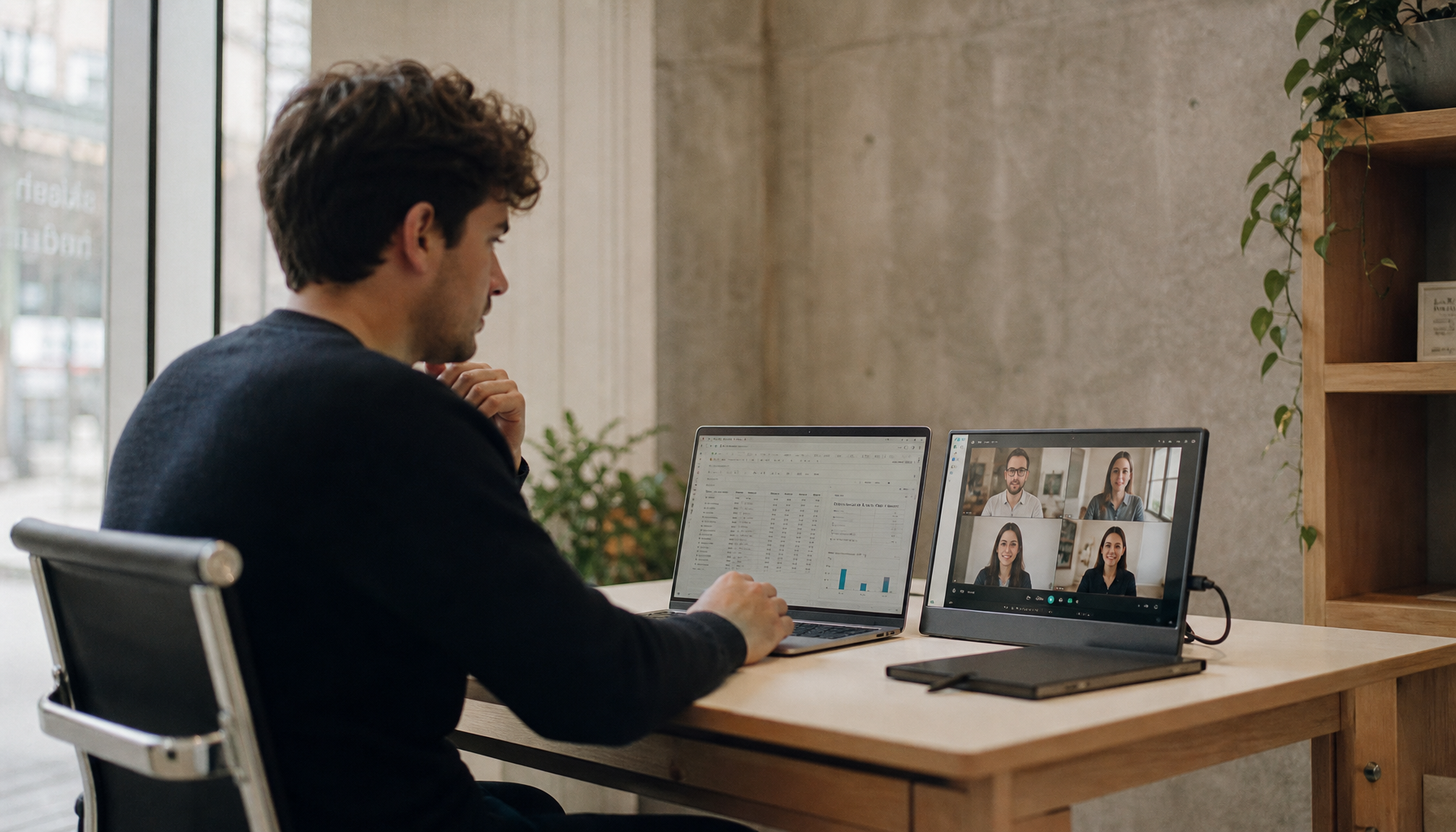
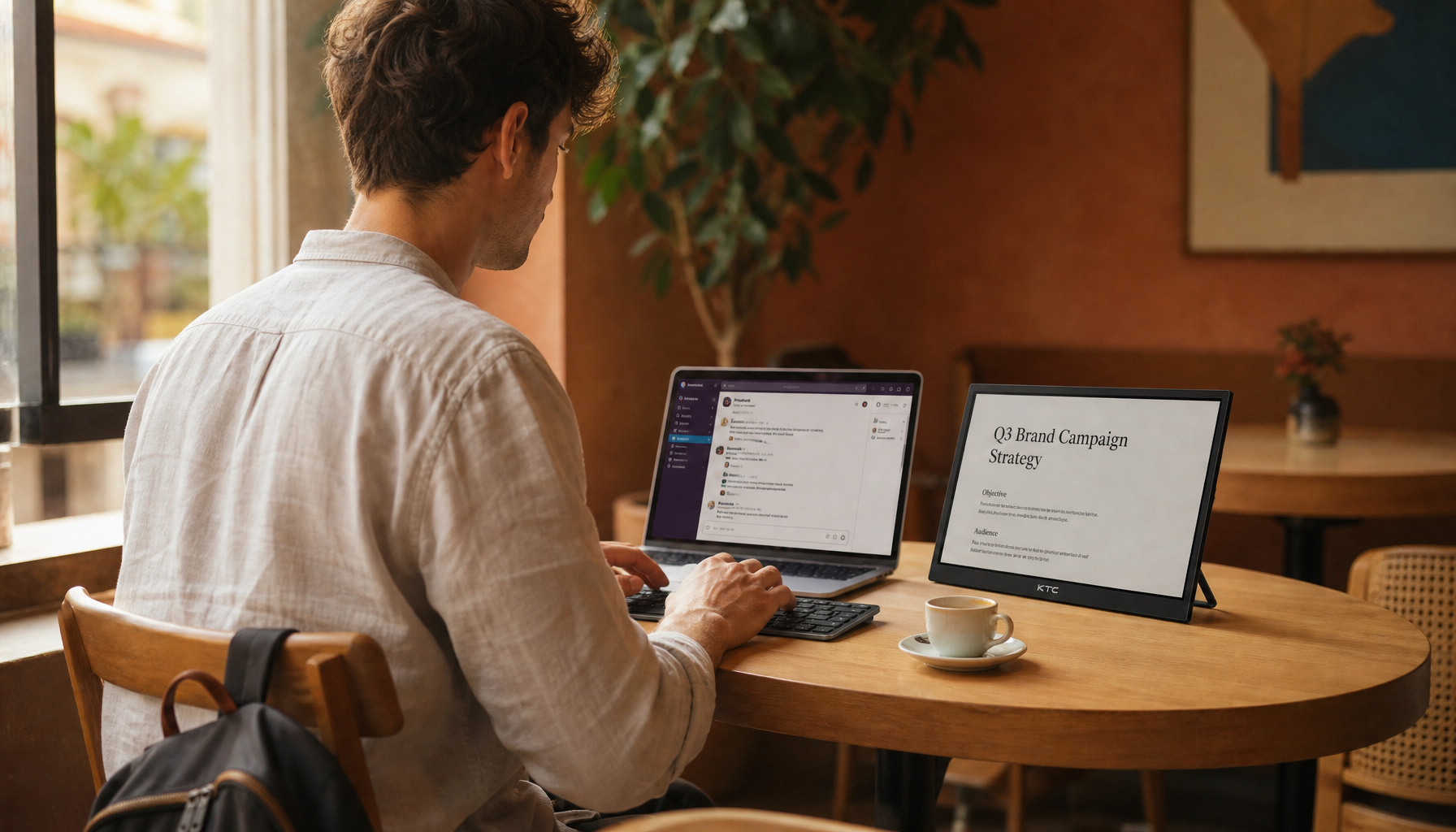
Many hybrid desks can get close to a true one cable MacBook and gaming PC setup, but only if the monitor, cable, and source devices all support the same mix of video, charging, and USB features. If the gaming PC needs the highest refresh rate, the cleanest setup is often a split path: the MacBook gets convenience through USB-C, while the desktop keeps the best direct video connection.

Why a One-Cable Desk Solves the Swap Problem
The main pain is not just plugging in a cable. It is doing that same routine for video, charging, keyboard, mouse, audio, and storage every time you switch between a MacBook and a gaming PC.
A single-cable workflow can make the desk feel shared instead of divided, and it can also reduce wear on ports over time. That said, the result depends on what your monitor and devices actually support, not on the connector shape alone.
For a plain-language overview of why USB-C can carry more than one kind of signal, the DisplayPort over USB-C guide from VESA is a useful baseline. It explains the one-cable idea behind video, data, and power over the same port.
Decision sentence: If your desk only needs occasional switching, a simpler two-cable setup may be easier to live with; if you switch every day, one-cable convenience usually becomes worth the compatibility check.
What Your USB-C Monitor Must Cover
For most buyers, the first question is not which monitor looks best, but whether the USB-C path can do the jobs you expect. A USB-C port on a monitor may support video only, video plus charging, or video plus data, and those are not interchangeable.

If you want the laptop side to run with one cable, the monitor needs USB-C video support and enough power delivery for the MacBook model you use. Apple's Mac charging guidance makes the basic point clearly: a USB-C or Thunderbolt display can charge a Mac, but the delivered wattage still has to match the model's needs.
On the cable side, do not assume every USB-C cable can move video. A USB-C + DP Alt Mode explainer is helpful here because it separates charge-only cables from full-featured ones that can carry display output too.
Decision sentence: If the monitor lacks USB-C video or underdelivers power, the "one cable" promise breaks down quickly; if it has both, the laptop side becomes much cleaner.
High refresh rate is the other trap. Gaming desktops often care more about preserving the best supported refresh mode than about cable minimalism, so a dock or adapter that is fine for office work may be the wrong choice for gaming. The VES A DisplayPort Alt Mode guidelines remind that the strongest results depend on the whole chain.
MacBook and Gaming PC Routing Compared
For a hybrid desk, the MacBook and the gaming PC usually should not be forced through the exact same path if that lowers the desktop's refresh rate. The MacBook usually benefits most from a simple USB-C route that handles display and charging together, while the gaming PC usually benefits most from whichever connection preserves its highest mode.
That is the hidden trade-off: convenience and maximum performance do not always point to the same cable path.
If your monitor includes a built-in KVM or a separate USB upstream switch, shared peripherals become easier because the keyboard and mouse can follow the active source without constant replugging.
Decision sentence: If the desktop loses refresh rate through the shared path, split the workflow; if both systems keep their expected modes, a shared monitor path is a good fit.
A Clean Setup Path That Actually Works
Start with the laptop first. Connect the MacBook directly through USB-C, confirm that it gets both video and charging, and make sure the cable is actually carrying the mode you need.
Next, test the gaming PC on its best direct video path before adding docks, adapters, splitters, or KVM steps. That order matters because many switching problems are really cable or mode problems that become harder to diagnose after extra hardware is added.
Only after both video paths are stable should you connect peripherals and check whether the keyboard, mouse, and audio stay attached when you switch inputs.
Decision sentence: If the desk is unstable while you are still trying to solve video, stop adding accessories; if video is solid, then peripherals and switching are the next problem to solve.
When a High-Refresh Monitor Makes Sense
A high-refresh USB-C monitor is the better fit when you want one desk for Mac productivity and PC gaming, but you still care about keeping a fast desktop mode available.
The KTC 27" 5K@60Hz 2K@120Hz Home&Office Monitor | H27P3 is worth checking when the buyer condition is mixed-use work and play with a strong preference for a cleaner Mac side. Its fact pack shows a 27-inch IPS panel with dual-mode 5K@60Hz or 2K@120Hz operation, USB-C PD 65W, HDMI 2.0, DP 1.4, and two USB 3.0 ports, which makes it easier to treat the monitor as the center of a shared desk.
The KTC 27" 4K 160Hz/320Hz 90W Gaming Monitor | H27P6 offers another route when the priority tilts toward desktop performance while still supporting USB-C input.
That kind of setup makes sense when the MacBook gets a simple USB-C path and the gaming PC can still use the monitor's faster mode or a better direct connection. It is less compelling if your main priority is one of the following:
- maximum desktop refresh at all costs,
- a very cheap desk upgrade,
- or a setup where the monitor must do everything without compromise.
Final Setup Checks Before You Commit
Before you call the desk finished, check the parts that usually cause regret later:
- Confirm that the MacBook gets the charging level and display mode it actually needs.
- Confirm that the gaming PC still reaches the refresh rate you wanted after any dock or adapter is added.
- Confirm that keyboard, mouse, and audio follow the active source without replugging.
- Confirm that the setup works in both directions, not just when the MacBook is attached.
The best one cable MacBook and gaming PC result is the one that keeps the desk simple without hiding a performance loss on the gaming side. If the shared path does that, you have a real hybrid setup; if it does not, the smarter move is usually to reserve convenience for the MacBook and preserve performance for the PC.
FAQs
Q1. Can One USB-C Cable Handle a MacBook and a Gaming PC?
Sometimes, but only if the monitor, cable, and source devices all support the needed mix of video, charging, and USB switching. The MacBook side is usually the easier half of the equation; the gaming PC side is where refresh-rate limits usually show up first.
Q2. Do I Need a Thunderbolt Cable for a MacBook Monitor Setup?
Not always. A full-featured USB-C cable can be enough if it supports the display mode and power delivery your MacBook needs, but Thunderbolt or USB4 cables are often the safer choice when you want fewer compatibility surprises.
Q3. Why Does My Gaming PC Lose Refresh Rate Through a Dock or KVM?
Because the bottleneck is often the weakest link in the chain, not the GPU alone. The cable, dock, KVM, or monitor input may limit the available mode, so it helps to test the desktop on a direct connection first.
Q4. Can the Monitor Charge the MacBook While Switching to the PC?
Usually yes, if the monitor's USB-C port supports power delivery and the MacBook model accepts that wattage. The key is to verify the actual charging level, because "USB-C charging" does not mean every device gets the same power.
Q5. Is a KVM Monitor Better Than a Separate KVM Switch?
A monitor with built-in KVM can be simpler for a shared desk because it reduces extra boxes and keeps switching closer to the display itself. A separate KVM may still be useful if you need more ports, different video standards, or a setup the monitor cannot handle cleanly.
Hybrid Desk Decision Map For MacBook And Gaming PC
A simple way to decide whether to share one path or split the workflow by device.
Show comparison table
| Scenario | MacBook path | Gaming PC path | Best choice |
|---|---|---|---|
| Mostly laptop work | USB-C video plus charging | Optional secondary path | Shared path is usually fine |
| Mostly gaming with occasional Mac use | USB-C convenience | Direct high-refresh video | Split workflow |
| Equal work and play on one desk | USB-C with PD | Direct connection if refresh matters | Shared peripherals, split video if needed |
| Simple switching above all | USB-C one-cable path | Use the best supported direct input | Choose by device priority |
Related Resources
Compare these options when building a shared desk:
- Organizing a 3-Laptop Hot-Desking Station with One Monitor
- Gaming Monitor
- Office Monitor
- Software vs Hardware Workstation Control for Hybrid Mac and PC Desks
- How to Determine the Maximum Resolution Your USB-C Connection Actually Supports
- KTC 27" 4K 160Hz/320Hz 90W Gaming Monitor | H27P6