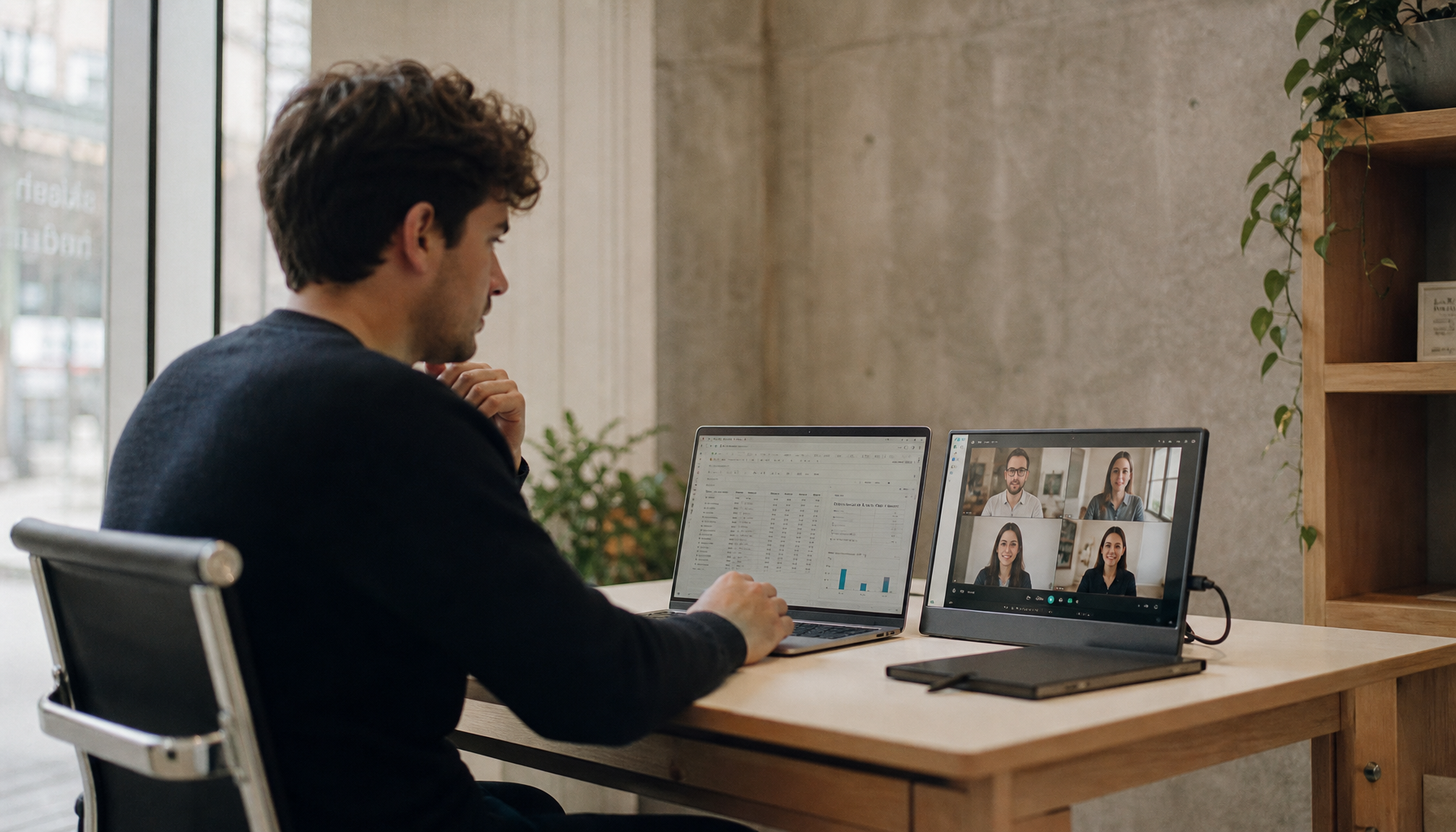
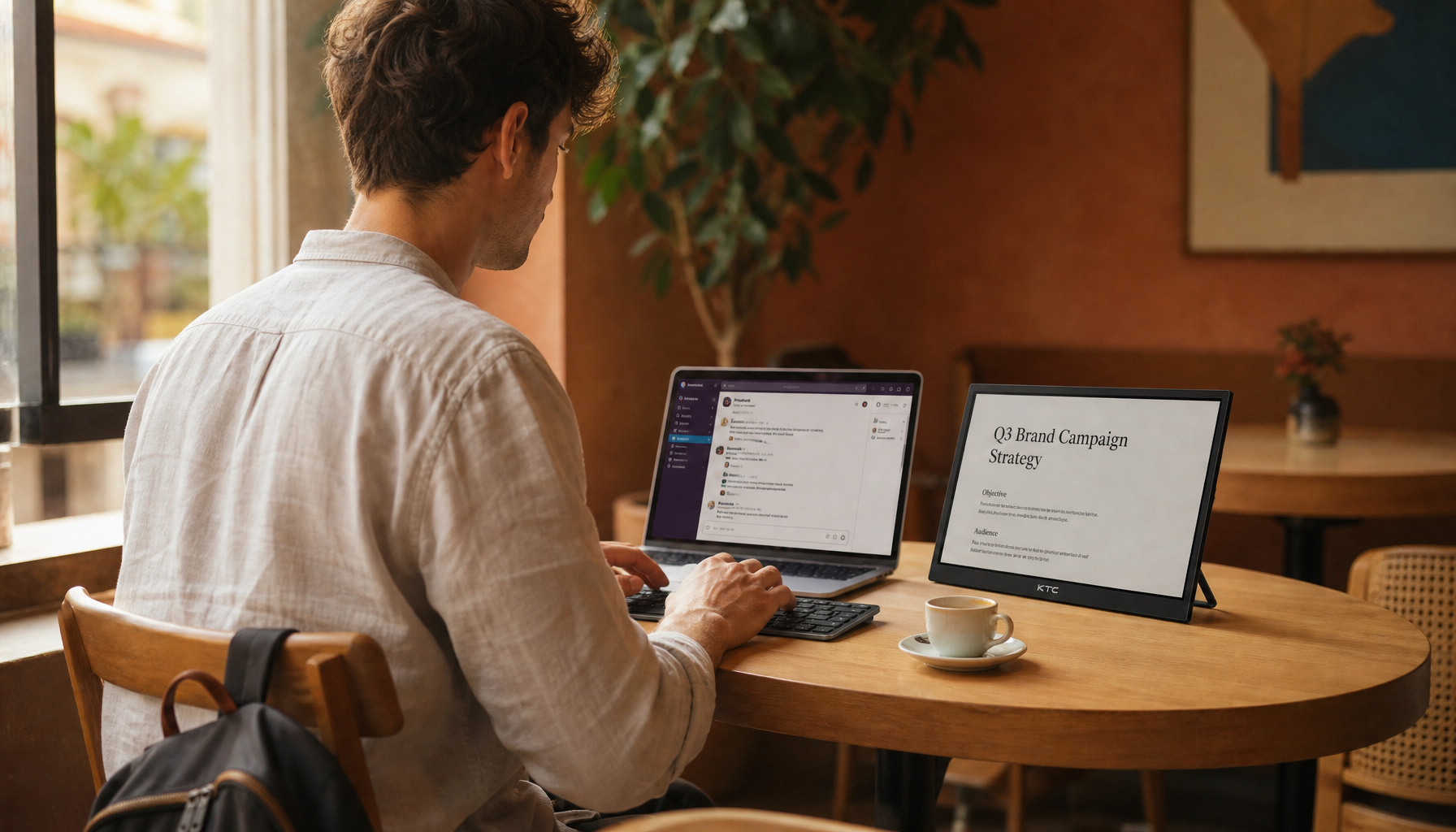
Fixed studio monitors often tie music producers to a single desk position, disrupting workflow during vocal tracking, drum monitoring, or collaborative sessions. A rolling 32-inch 4K touch display such as the MegPad changes this by letting you move a full DAW view exactly where it is needed—next to the microphone, beside the kit, or into the live room—while allowing you to roll it completely out of the critical listening path during final mixing.

The Acoustic Disaster of Fixed Studio Monitors
Large fixed screens placed between studio monitors create early reflections that arrive within roughly 15 ms of the direct sound. According to the EBU Tech 3276 listening conditions standard, these reflections can produce comb filtering and midrange coloration that smear the stereo image and degrade mix accuracy.
Industry guidelines also require a clear 60-degree equilateral triangle between speakers and the listening position. A permanent screen on the desk bridge often violates this acoustic axis rule, forcing producers to choose between visual convenience and neutral monitoring.
The practical solution is mobility. A rolling display lets you enjoy a massive secondary screen for arranging, tracking, and plugin management, then push it aside or behind the listening position when critical mixing begins. This acoustic decoupling is the primary reason many prosumer studios now treat a movable session monitor as essential rather than optional.
Rolling Workflows: Vocal Booths and Drum Rooms
Solo producers frequently lose momentum sprinting between the control-room desk and the vocal booth after hitting record. Positioning the MegPad on its rolling stand next to the microphone stand eliminates that run. Vocalists can see the full timeline, waveforms, lyrics, and take markers in 4K without squinting at a tablet.
In drum rooms the same mobility pays dividends. Drummers can roll the 32-inch screen beside the kit to manage click tracks, monitor mixes, and cue changes without relying on a second engineer or leaving the throne. The large format also makes it easier for the full band to glance at session status during rehearsal-room playback.
These room-to-room transitions require planning. Long HDMI or USB-C cables (or careful wireless casting for non-real-time tasks) must be routed to avoid tripping hazards, and clear floor space is necessary for the stand to move freely. When these conditions are met, the rolling monitor transforms desk-bound workflows into fluid, location-independent ones.

For producers who regularly move between positions, see our guide on how to prevent accidental touch inputs when using a portable monitor in transit and how to clean a portable touch screen without damaging the capacitive layer.
DAW Compatibility: The Windows vs. macOS Divide
Touch performance depends heavily on the host operating system and DAW. Windows users, especially those running FL Studio 2026, benefit from native multi-touch support that includes dedicated controller windows and optimized gesture recognition for large displays. This makes the MegPad feel like a natural extension of the mixing surface.
macOS users face a different reality. The operating system does not natively support full multi-touch gestures on external displays, so Logic Pro or Ableton Live users must rely on third-party drivers such as UPDD. These solutions can work well but add setup friction and may require reconfiguration after OS updates. Wireless casting also introduces latency that makes real-time MIDI editing or fader moves unreliable; wired connections are strongly recommended for zero-latency interaction.
Another practical limit is UI scaling. If your primary DAW lacks a dedicated touch-optimized mode, the 4K resolution on a 32-inch panel can render buttons and text too small for accurate finger control. Checking your DAW’s touch readiness before purchase prevents disappointment.
If your workflow is heavily visual and you want full DAW legibility, review our article on 5 essential specs to check before buying a portable touch screen monitor.
MegPad vs. Fixed Monitors vs. iPad Remotes
Choosing the right secondary display depends on whether your priority is acoustic neutrality, session visibility, or zero-friction mobility. Fixed monitors deliver the lowest latency and no cable management but create permanent speaker-boundary interference response (SBIR) and obstruct the acoustic axis. As explained in the boundary interference guide, large stationary obstacles between speakers produce unpredictable low-mid dips that are difficult to treat.
iPads excel at acoustic transparency and macro remote control (transport, basic level tweaks) but lack the screen real estate and resolution for comfortable full-session editing or detailed MIDI work. The MegPad sits in the middle: it can be rolled out of the reflection path during mixing, offers full 4K session visibility, and supports precise touch gestures on compatible DAWs.
The table below summarizes the typical trade-offs across common music-production scenarios.
| Setup | Acoustic Transparency | Producer-to-Talent Line-of-Sight | Full Session Legibility | Input Latency |
|---|---|---|---|---|
| Fixed Monitor | Low | Low | High | Very Low |
| iPad Remote | High | Medium | Low | Low |
| Rolling MegPad | High (when moved) | High | High | Very Low (wired) |
This comparison makes clear that the rolling approach is usually the strongest compromise for solo producers and small collaborative studios that need both visual feedback and acoustic integrity.
The KTC MEGAPAD 32" 4K Android 14 Google EDLA Smart Touch Monitor with 8550mAh Battery or its Android 13 sibling deliver exactly this mobility in a single rolling stand. For users who want a broader selection of smart touch options, the Mobile Touch Screen collection includes several sizes and battery capacities that can be evaluated against your room layout.
When a Rolling DAW Display Is Not the Right Choice
Despite its strengths, the MegPad is not ideal for every studio. If your space lacks floor clearance for the rolling stand, the unit becomes a large fixed acoustic reflector and defeats its own purpose. Mac-based studios that cannot tolerate driver management or occasional reconfiguration after updates may prefer a simpler tablet remote for macro tasks and keep the main monitor fixed.
Producers whose work is primarily tactile—relying on hardware controllers, outboard gear, or muscle-memory keyboard shortcuts—often find that a large touch screen adds little value over a traditional fixed display. Likewise, if your DAW has poor UI scaling or no touch-optimized layout, the 4K resolution can make precise finger editing frustrating rather than efficient.
In these cases, sticking with a well-treated fixed monitor plus a smaller tablet for remote control usually delivers better results and fewer regrets. The decision ultimately comes down to whether your workflow is dominated by visual session management or by low-latency tactile control and pristine acoustics that cannot tolerate any movable object in the room.
Choosing the Right Rolling Session Monitor for Your Studio in 2026
Start by mapping your most common transitions: vocal booth to desk, drum room to control room, or rehearsal space to mixing position. Measure the available floor path and confirm you can keep cables or wireless casting reliable. Verify that your DAW and operating system combination supports the level of touch interaction you need—Windows and FL Studio currently offer the smoothest experience.
Next, decide whether the display will spend most of its time as a full DAW mixer, a plugin host, a lyrics and waveform reference, or all three. This determines whether the 32-inch 4K model is worth the investment or whether a smaller smart touch panel from the Smart Monitor collection would suffice.
Finally, treat the MegPad as an acoustic and workflow tool rather than a color-critical mastering display. Its greatest value is the ability to appear when you need visual feedback and disappear when you need an uncompromised listening environment. When those conditions align with your studio layout and DAW habits, a rolling session monitor can eliminate the desk-to-booth friction that slows down many 2026 productions.
FAQs
Does the MegPad Work Natively With Logic Pro on macOS?
No. macOS does not provide native multi-touch support for external displays, so Logic Pro users must install and maintain third-party drivers. These can deliver usable gesture control but may break after major OS updates and require periodic recalibration. Windows users with FL Studio avoid this extra layer entirely.
How Do You Manage Cables When Rolling the Monitor Between Rooms?
Most users rely on long, high-quality HDMI and USB-C cables routed along baseboards or overhead tracks. For occasional wireless casting, keep expectations realistic—latency is acceptable for reference playback or lyrics display but too high for real-time fader rides or MIDI editing. Planning cable paths during studio layout is essential.
Is a 32-Inch 4K Rolling Monitor Too Large for Small Project Studios?
It depends on floor space. The stand requires roughly 80 cm of clear width to maneuver safely. In very compact rooms the monitor can become an acoustic liability if it cannot be rolled fully out of the speaker path. Measure your workflow routes before purchase; a 27-inch model may be more practical in tight spaces.
Can the MegPad Replace a Dedicated Studio Monitor for Mixing?
No. It is designed as a secondary session and plugin screen, not a primary listening monitor. Its value lies in being moved out of the acoustic field during critical mixing passes. Rely on properly positioned, calibrated studio monitors for final tonal decisions.
When Should a Producer Choose an iPad Over the MegPad?
Choose an iPad when your needs are limited to macro transport commands, basic level adjustments, or reference playback in acoustically sensitive spaces where even a movable large screen would create reflections. The MegPad is the better choice when you require full DAW visibility, detailed waveform editing, or multi-touch plugin control at the performance position.