If you wear progressive lenses, your monitor usually needs to sit lower and tilt back more than standard desk advice suggests. Start with the screen about an arm’s length away, then adjust the display to match your eyes rather than forcing your posture to compensate.
Does your neck tighten by noon because you keep lifting your chin just to bring the screen into focus? The biggest comfort improvement is often not a new chair or monitor, but lowering the screen until the clear part of your lenses matches the work you do most. Use height, distance, tilt, and multi-screen placement together so long work sessions feel steadier and less fatiguing.

Why Standard Monitor Advice Can Miss the Mark
Progressive lenses combine distance, intermediate, and near vision in one lens, which makes them convenient but can complicate desk setup. The screen usually sits in that middle-distance zone, so if the monitor is too high, you may hunt for clarity by tipping your head back instead of moving the display.
General workstation guidance often says the monitor should sit straight ahead, about an arm’s length away, with the top at or slightly below eye level. That works well for many single-vision users, but bifocal and progressive-lens wearers often need the screen lower and tilted backward so the neck stays neutral rather than extended.
In real desk tune-ups, the pattern shows up often: a person may have a supportive chair, good keyboard height, and a decent desk, yet still feel “wrong” because the screen is positioned for generic ergonomics instead of the lens zone that actually provides clear focus. The fix is simple and performance-driven: align the screen to your visual zone, not to a generic rule.
The Monitor Position That Usually Works Best
Set Height by Your Clearest Working Zone
Progressive-lens users should place the monitor lower and tilt it back slightly, because that reduces the chin-up posture that can trigger neck and shoulder strain. Sit fully back in the chair, relax your shoulders, look straight ahead, and notice where your eyes naturally drop when you try to read. Then lower the monitor until the part of the screen you use most, usually the center to upper-middle area for email, documents, or dashboards, becomes clear without lifting your chin.

A useful real-world example is spreadsheet work. If your formulas and active cells sit around the center of the display, that center area should be readable through your intermediate zone with your nose pointed straight ahead. If the only way to sharpen the text is to raise your chin or poke your head forward, the monitor is still too high.
Keep Distance Far Enough for Comfort and Close Enough for Clarity
An arm’s-length viewing distance of roughly 20 to 30 inches is still the right starting point for most desks, including progressive-lens setups. Sit back, extend your arm, and place the screen near that reach. If your natural reach from eye to knuckles is about 26 inches, start there rather than guessing.

If text is hard to read at the correct distance, enlarge text or interface scaling instead of dragging the monitor closer. That matters even more with progressives because pushing the screen too near increases focusing effort and often makes people lean forward, which swaps one problem for two more: eye fatigue and neck flexion.
Use Tilt and Lighting to Stop Compensation
Bifocal guidance often recommends a stronger backward tilt, about 30° to 45°, for wearers who need the screen lower than usual, while more general ergonomic sources suggest a milder backward tilt. That difference makes sense once you try it: after the screen drops, a stronger tilt can keep the panel facing your eyes rather than your chest. The right amount is the one that lets you read without glare, chin lift, or brow furrowing.
Glare control is part of monitor positioning, not a cosmetic tweak. If a window reflection hits the screen, most people unconsciously crane, lean, or twist to find a clearer angle. Setting the monitor at a right angle to windows, reducing ambient glare, and using anti-reflective coatings when needed can make the “right” height much easier to hold.
The Rest of the Workstation Still Matters
Whole-desk workstation guidance ties monitor comfort to the full setup: back supported, feet flat, elbows near 90 degrees, and posture changing through the day instead of freezing in one pose. That matters for progressive-lens wearers because once you lower the monitor, chair height and keyboard height may need small adjustments to keep everything else neutral.
When the screen cannot go low enough, the smartest temporary workaround is usually to raise the chair a little and add a footrest so your feet stay supported while your eyes and monitor line up better. The better long-term fix is an arm or stand that truly lowers the display close to desk level; many stock stands do not drop far enough for progressive-lens comfort.
Dual Monitors, Laptops, and Deep Desks
Two Monitors Need a Primary Visual Path
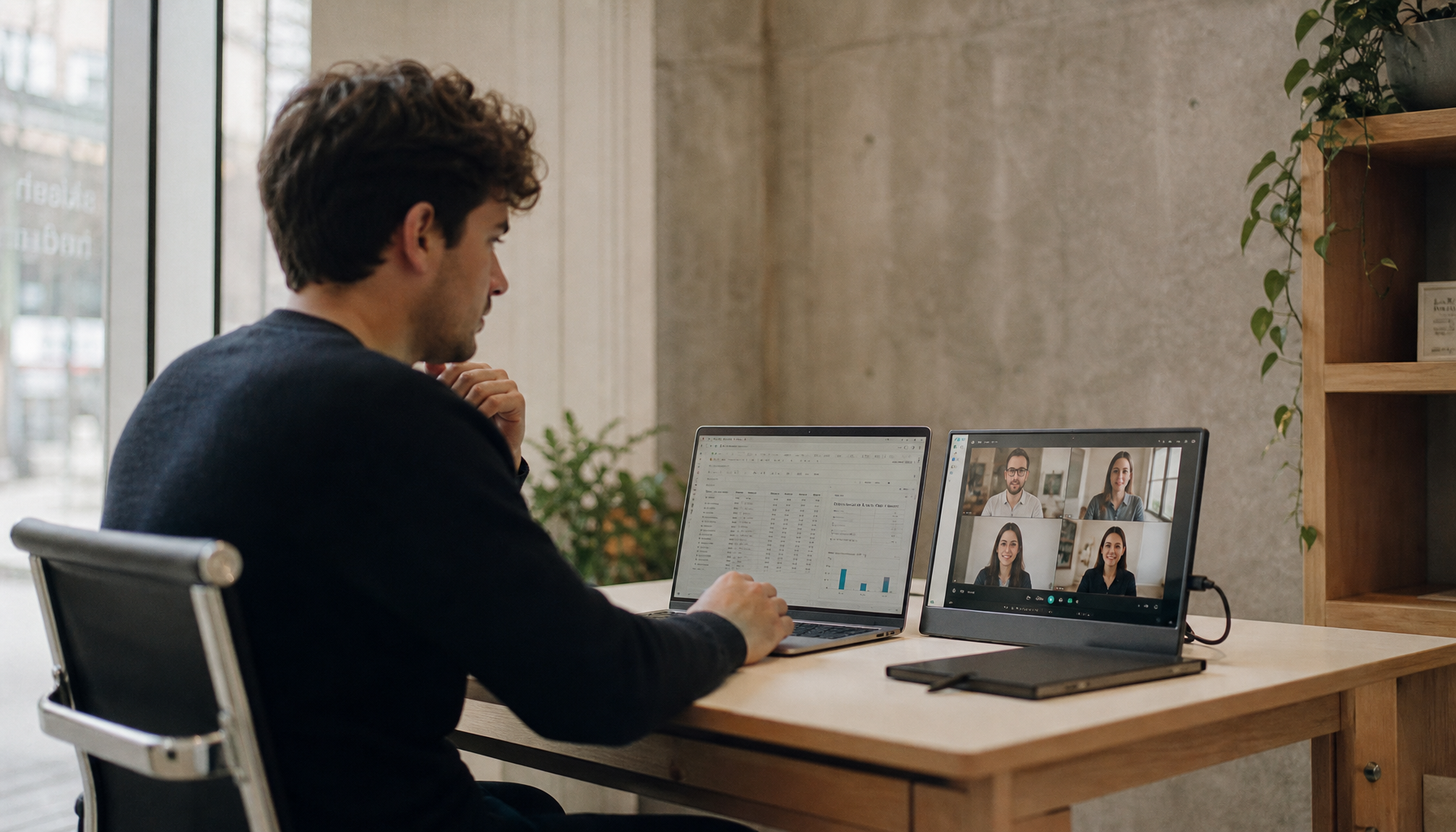
Dual-monitor guidance is straightforward once progressive lenses enter the picture. If one screen handles most of the work, keep that display directly in front of you and lower it to your comfortable viewing zone, while the second screen sits beside it at the same height and distance. If both screens matter equally, center yourself on the join so you are not constantly turning your neck more to one side than the other.

A practical gaming-and-work example is a 27-inch main monitor paired with a smaller side display for chat, email, or tools. The main screen should get the prime real estate straight ahead. The side screen can sit slightly off-axis, but if it is much higher, much closer, or much brighter, your eyes will keep refocusing and your neck will keep adjusting, which defeats the purpose of a tuned setup.
Laptops Should Not Drag Your Head Downward
A laptop is usually good for typing or viewing, but not both at once. For progressive-lens users, a flat laptop on the desk almost guarantees either a bent neck from looking down or a cramped arm position from lifting the whole machine too high. A stand plus external keyboard and mouse turns the laptop from a posture trap into a usable secondary display.

When Computer Progressives Are the Better Tool
Computer progressive lenses are designed to give you a wider intermediate zone for screen distance, which is why they can feel dramatically better at a desk than everyday progressives. The trade-off is that they are task-specific: they are excellent for office work, editing, trading screens, and long writing sessions, but they are not the pair you want for driving or across-the-room distance.
Here is the practical trade-off in one view.
Lens setup |
Best fit |
Main upside |
Main trade-off |
Standard progressive lenses |
Mixed daily life with walking, driving, and short desk sessions |
One pair handles distance, room, and near tasks |
Narrower screen-distance zone can trigger chin lift at the desk |
Computer progressive lenses |
Long computer days, multi-app work, desk-based reading |
Wider intermediate zone often improves screen comfort and posture |
Usually weaker for long-distance tasks away from the desk |
If your job keeps you on screens for most of the day and you have already lowered the monitor, improved lighting, and increased text size, this is often the point where an optometrist conversation pays off. Bring your working distances to the appointment, including how far your eyes are from the monitor and whether you also read paper documents on the desk. That makes the prescription more useful than a generic “computer strain” complaint.
Signs Your Setup Still Needs Adjustment
The most common eyestrain signs are headaches, dry or gritty eyes, blurred vision, eye fatigue, and neck or shoulder discomfort. For progressive-lens wearers, one extra clue stands out: if you keep lifting your chin to find a sharp spot on the screen, your monitor is probably still too high or too flat. If you keep leaning forward instead, the screen may be too far away, the text too small, or the prescription may not match your screen distance well.
The 20-20-20 rule remains a reliable reset even after the hardware is dialed in. Every 20 minutes, look about 20 feet away for 20 seconds, then blink fully before returning to the screen. Add a quick posture change every 30 minutes or so, because even a strong setup loses its advantage if you hold one position for hours.
FAQ
Should the Top of the Monitor Be at Eye Level if I Wear Progressive Lenses?
Not usually. Standard ergonomics often starts there, but progressive-lens wearers commonly do better with the monitor set lower so the screen lines up with the intermediate viewing area of the lens rather than forcing a chin-up posture. If dropping the screen makes your neck relax immediately, that is the stronger rule for your body.
Are Monitor Arms Worth It for Progressive Lenses?
Usually yes, because precise vertical adjustment matters more here than it does for many single-vision users. A good arm lets you lower the screen, pull it forward or back, and change tilt without stacking books or compromising keyboard height.
How Long Should I Keep Trying Before I Blame the Glasses?
A short adaptation period can be normal, and many wearers settle in over a period of days to a couple of weeks. But if your chin is still lifting, your neck is still aching, or you only see clearly by contorting around the screen, that is a setup problem, a lens-design issue, or both, not something you should simply push through.
A progressive-friendly monitor setup should feel empowering, not like a daily workaround. Lower the screen, give it the tilt your lenses demand, keep it at a readable arm’s length, and let the display adapt to you; that is how comfort turns into endurance, and endurance turns into better work and better play.