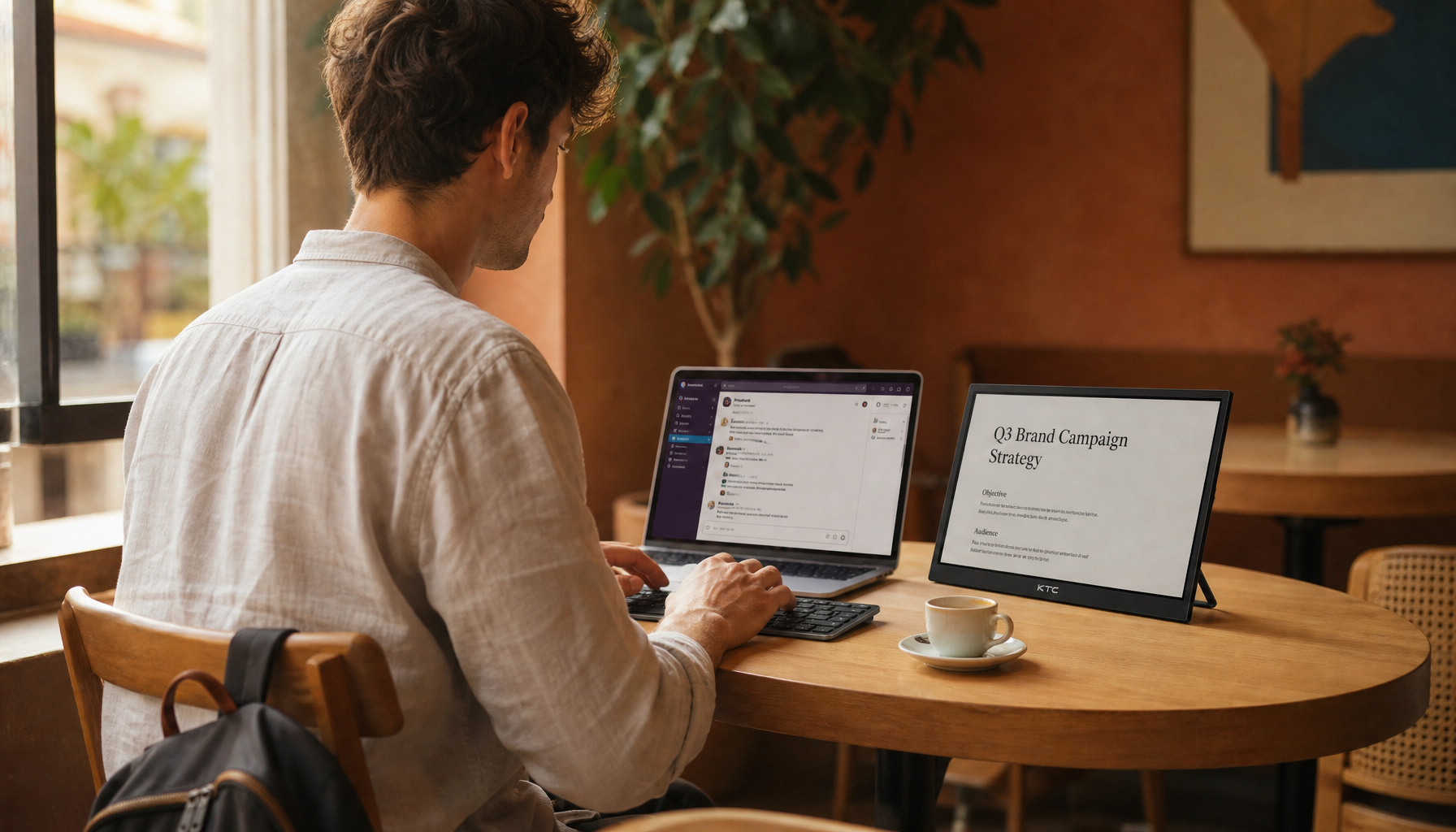
Monitor height controls whether your neck stays neutral or spends the day chasing the screen. For sit-stand work, the best setup keeps the top of the display at or slightly below eye level in both positions, with quick adjustment between sitting and standing.
Does your neck feel fine at 10:00 AM but tight after a few desk-height changes? A setup that keeps the screen near eye level, about an arm’s length away, and matched to your keyboard height can reduce the most common posture drift: raised shoulders, forward head tilt, and leaning into the display. Here is how to place your monitor so sitting and standing feel like one smooth workflow, not two separate workstations.
Why Monitor Height Matters More on a Sit-Stand Desk
A fixed desk asks your monitor to serve one posture. A sit-stand desk asks it to serve two, which is where many otherwise capable displays start working against the body.
When the monitor is too low, your head drops forward and your upper back rounds. When it is too high, your chin lifts and the neck extensors stay active longer than they should. The top of the screen should sit at or slightly below eye level, with the monitor directly in front of you and roughly an arm’s length away. That rule is simple, but the execution changes when your eyes move several inches between seated and standing positions.
In display testing and workstation tuning, the problem usually appears after transitions. A user raises the desk, but the monitor stays visually “almost right.” After 45 minutes, the body has compensated with a small chin lift, shoulder shrug, or forward lean. Those micro-adjustments are easy to miss, yet they compound during long gaming sessions, spreadsheet work, editing timelines, or trading dashboards.
The Posture Chain: Screen Height, Neck Angle, Shoulders, and Spine
Monitor placement does not only affect the eyes. It sets the posture of the head, which sets the tone for the shoulders, upper spine, and arms.

A screen that sits too high encourages a slight backward head tilt. That can increase tension through the neck and upper back, especially when you are standing and already stabilizing through the feet, hips, and core. A screen that sits too low pulls the head down and forward, which often makes the user abandon chair support while seated or lean toward the desk while standing.
Office ergonomics guidance also emphasizes monitor placement at about eye level and arm’s length away, paired with movement and visual breaks. For a performance display setup, that means monitor height is not an isolated spec. It must work with chair height, desk height, keyboard position, lighting, and how often you change posture.
The Neutral Viewing Target
The practical target is a relaxed head position with the eyes looking slightly downward toward the center of the screen. The top bezel should usually land at eye level or a touch below it. For large monitors, ultrawides, or stacked screens, avoid treating the physical center of the entire display array as the target. Your most-used content should sit in the easiest viewing zone.
For example, a 32-inch productivity monitor may feel impressive when mounted high, but if the menu bar or top rows of a spreadsheet make you lift your chin repeatedly, the screen is too high for sustained work. A better setup places the top edge near eye level and uses window positioning so active content lives in the upper-middle to center region.
Sitting vs. Standing: What Actually Changes?
When you sit, your chair sets the foundation. Your feet should be supported, knees near a right angle, back supported, and elbows close to the body. When you stand, your feet, footwear, floor mat, and desk height become the foundation. The monitor must follow the eyes, not the desk surface.
Standing all day is not an ergonomic win by itself; posture variation matters more than locking into one “perfect” pose. That is why monitor height should be adjustable enough to support sitting, standing, and small changes inside each mode.
A common mistake is saving sit and stand desk presets based only on elbow height. Elbow height matters for the keyboard and mouse, but your display may still be too low or too high after the desk moves. If your monitor is sitting on its factory stand, the desk rise changes keyboard height and screen height together. That sounds convenient, but it rarely matches the exact difference between seated eye level and standing eye level.
A Simple Sit-Stand Check
Sit normally, with your back supported and shoulders relaxed. Look straight ahead, then let your eyes drop slightly without bending your neck. The top of the screen should be near that line. Now stand, reset your feet, relax your shoulders, and repeat the same check.

If the standing view makes you lift your chin, lower the screen or adjust tilt. If the standing view makes you lean forward, bring the screen closer or raise it slightly. If the seated view is perfect but standing is wrong, the desk preset alone is not enough; you need a monitor arm, riser change, or a display with greater height adjustment.
Desk Height and Monitor Height Are Related, But Not the Same
Desk height should support the hands. Monitor height should support the head. Blending those two jobs is the source of many expensive but uncomfortable setups.
A standing desk is usually set so your elbows bend around 90 degrees, shoulders stay relaxed, and wrists remain neutral. An ergonomic office setup connects desk height, monitor placement, seating, lighting, movement, and input devices instead of treating each item as a separate upgrade. That is especially important with sit-stand desks, because changing one height changes the whole workstation geometry.
For a 5’9” user, a standing keyboard surface often lands in the low 40-inch range, while a seated keyboard surface may be in the mid-20-inch range depending on chair and body proportions. The monitor cannot simply “ride along” without review. Your eye height changes differently than your elbow height, and shoes or an anti-fatigue mat can add about an inch to the standing setup.
Monitor Arm, Riser, or Built-In Stand?
A fixed riser is stable, affordable, and clean for a single seated setup. It is less effective when you alternate between sitting and standing because it cannot change height quickly. A built-in adjustable stand can work if it has enough vertical range and tilt. A monitor arm is usually the strongest choice for dynamic workstations because it lets you tune height, depth, tilt, and angle without rebuilding the desk.

Monitor placement that is too high or too low can trigger repeated posture adjustments through the neck, shoulders, and spine. For a sit-stand desk, those repeated adjustments happen more often because your body position changes during the day. That is where a gas-spring arm earns its space: it lets the display meet your posture instead of making your posture meet the display.
For portable smart screens and laptop-plus-monitor setups, the same principle applies. Raising a laptop screen without an external keyboard only moves the problem from the neck to the wrists. Laptop use at a desk is more ergonomic when paired with an external keyboard, mouse, and stand, because the screen and input devices need different heights.
Dual Monitors and Ultrawides: Height Placement Gets Less Forgiving
With one monitor, the body can usually adapt to small errors for a while. With two monitors, errors multiply through rotation, refocusing, and uneven viewing height.
If both displays are used equally, place them side by side with the inner edges close and the screens angled slightly inward. If one display is primary, put it directly in front of your keyboard and body, then place the secondary display to the side at a similar height and distance. The monitor should be at eye level and about 20 to 40 inches away, with the eyes aligned near the top third of the screen.

For gaming monitors, ultrawides, and high-refresh creative displays, the temptation is to push the screen back, raise it, and create a cockpit feel. Immersion is valuable, but not if it forces chin lift or shoulder tension. A 34-inch ultrawide should usually be centered, with the top edge slightly below eye level, and far enough back that you can scan the edges without turning your head aggressively.
For vertical monitors, align the active reading zone rather than obsessing over matching top bezels. A vertical coding or chat display can sit slightly lower if its primary content is near the upper-middle portion of the screen. The posture target is the eyes and neck, not a perfectly symmetrical photo of the desk.
Distance, Tilt, and Glare Change the Height Decision
Height is only one axis. A monitor that is technically at the right height can still cause posture problems if it is too close, too far, too flat, or fighting glare.
General workstation guidance places monitor distance at about 20 to 40 inches from the face. In practice, smaller office monitors often feel right near arm’s length, while larger productivity and gaming screens may need more depth. If text becomes too small at the correct distance, increase scaling before pulling the screen closer and collapsing your posture.
Tilt also matters. A slight backward tilt can help maintain a natural viewing angle and reduce glare, especially when standing. For progressive lenses or bifocals, the monitor may need to sit lower than the usual rule so you are not craning your neck to look through the correct lens zone. Progressive lenses often call for a lower monitor position with a slight backward tilt.
Pros and Cons of Higher vs. Lower Placement
Placement Choice |
Potential Benefit |
Main Risk |
Best Use Case |
Slightly below eye level |
Supports a relaxed downward gaze |
Can become too low if you slump |
Most sit-stand workstations |
Exactly at top-edge eye level |
Easy reference point during setup |
May feel high on large displays |
Standard 24-inch to 27-inch monitors |
Higher than eye level |
Can clear desk clutter or support presentations |
Encourages chin lift and neck tension |
Short viewing, not all-day work |
Lower than eye level |
Helps some progressive lens users |
Encourages forward head posture if overdone |
Bifocal/progressive lens setups with careful tilt |
The highest-performance choice is usually not the highest screen. It is the position that lets you keep your head balanced, shoulders quiet, and eyes moving more than your neck.
How to Tune Your Setup in Under Ten Minutes
Start seated. Set your chair first, then your keyboard and mouse, then your monitor. Your shoulders should feel dropped, not braced. Your elbows should stay close to your body, and your wrists should not bend upward to reach the keys.
Next, place the monitor directly behind the keyboard and roughly arm’s length away. Adjust the height until the top edge is at or slightly below eye level. Look at the center of the display. If your chin moves up or down before your eyes settle, adjust again.
Then stand and repeat the same visual test. Do not judge the setup in the first five seconds after raising the desk. Type, scroll, and read for several minutes. Watch for the first compensation: chin lift, forward lean, shoulder shrug, or shifting weight to get closer to the screen. That compensation tells you the next adjustment.
Finally, save separate sitting and standing desk presets after the monitor position is proven in both modes. For arm-mounted displays, make a small reference mark or note the arm position if multiple people use the same station.
FAQ
Should the monitor move every time the desk moves?
Ideally, yes, but not always by the same amount as the desk. If your desk preset keeps the keyboard perfect but your eyes no longer meet the screen correctly, adjust the monitor separately with an arm or a taller stand range.
Is a monitor arm necessary for a standing desk?
It is not mandatory, but it is the most reliable solution for users who switch positions often, use large monitors, or run dual displays. A riser can work for a mostly seated setup, while an arm is better for frequent height, depth, and tilt changes.
Should gaming monitors be higher for immersion?
Not for long sessions. Immersion should come from screen size, distance, refresh rate, contrast, and field of view, not from placing the display so high that your neck has to hold the experience together.
Final Word
Monitor height is the posture anchor of a sit-stand desk. Keep the top edge at or slightly below eye level, tune distance and tilt, and make the display adjustable enough to follow your real working positions. A powerful screen should pull you into the task, not pull your head, shoulders, and spine out of alignment.