









Mismatched monitor resolutions do not automatically reduce productivity, but they can create friction through uneven text size, cursor jumps, soft scaling, and inconsistent window behavior. The best setups keep each display at native resolution, use sensible scaling, and assign each monitor a clear job.
Ever drag a browser from your sharp main display to a side monitor and watch it suddenly become too large, too small, or blurry? In practical desk setups, a 27-inch 1440p monitor at about 109 PPI often feels more balanced than a larger low-density display, while a 27-inch 4K monitor can look extremely sharp if scaling is configured well. This guide explains when mixed resolutions help, when they slow you down, and how to configure a multi-display setup that feels consistent.
What “Mismatched Resolution” Really Means
A mixed-resolution setup usually means two or more displays have different pixel counts, such as a 4K main monitor paired with a 1080p side monitor. Resolution alone does not describe the full experience: a 1080p display has 2,073,600 pixels, 1440p has 3,686,400 pixels, and 4K has 8,294,400 pixels, so a 4K screen gives the operating system a much larger digital canvas even if the physical monitor is the same size as the other display.
That difference matters because operating systems arrange displays by pixel dimensions, not by the physical size of the panels. A 27-inch 4K monitor can appear much “taller” than a 27-inch 1440p monitor in display settings, which can create cursor walls, uneven edge transitions, and windows that change apparent size when moved between displays.
Resolution, Size, and Pixel Density Are Separate Decisions
Pixel density, measured in PPI, is often a better predictor of text comfort than resolution by itself. A 27-inch 1080p monitor is roughly 82 PPI, a 27-inch 1440p monitor is about 109 PPI, and a 27-inch 4K monitor is around 163 PPI, so the same “27-inch monitor” can feel coarse, balanced, or very sharp depending on resolution.

This is why a buyer can be disappointed by a 32-inch 1440p monitor for text-heavy work even though 1440p sounds like an upgrade. At roughly 92 PPI, it is closer in sharpness to a 24-inch 1080p monitor than many shoppers expect, which can make spreadsheets, code editors, and dense browser pages look softer than a smaller 1440p screen.
How Mixed Resolutions Affect Productivity
The biggest productivity cost is not that one monitor has fewer pixels. It is that your eyes, mouse, and apps have to adjust every time you cross from one display to another. Mixed resolutions can create pointer misalignment and window size changes, especially when one screen uses 100% scaling and the other uses 125% or 150%.
For example, a 27-inch 4K main monitor at 150% scaling beside a 24-inch 1080p monitor at 100% scaling can be excellent for focused writing, coding, editing, or design review. The same setup can feel awkward if you constantly move one app window back and forth, because buttons, line breaks, panels, and browser zoom levels may not feel stable across screens.
The Common Friction Points
The most common issue is inconsistent text size. If your email window looks comfortable on the 4K display but oversized on the 1080p display, you may start resizing windows instead of working. That small interruption becomes noticeable when repeated dozens of times during a workday.
Cursor movement is another frequent problem. If the displays are not aligned in system settings to match their real positions on the desk, the pointer may only cross at part of the monitor edge. That makes the side display feel less like extra workspace and more like a separate zone you have to deliberately aim for.

Eye comfort also changes with density and viewing distance. A 24-inch 1080p monitor may look acceptable at a normal desk distance, while a 27-inch 1080p monitor often needs more distance to hide visible pixel structure; viewing distance affects perceived sharpness because larger pixels become easier to notice up close.
What Matters Most: Resolution, PPI, Scaling, or Refresh Rate?
For productivity, pixel density and scaling consistency usually matter more than matching resolution exactly. A 27-inch 1440p monitor and a 24-inch 1080p monitor can be comfortable together because both can often run near 100% scaling, while a 27-inch 4K monitor beside a 1080p screen may require more careful tuning.
Refresh rate is still important, especially for gaming monitors and high-refresh-rate displays used for work. A 144 Hz or 165 Hz monitor can make mouse movement and scrolling feel smoother, which helps in long work sessions, but refresh rate does not fix text softness or uneven scaling. If you split your time between competitive gaming and office work, the best main monitor may be a high-refresh 1440p display rather than a 4K panel that forces heavier GPU load.
Setup Option |
Typical Strength |
Productivity Risk |
Best Use Case |
Recommended Starting Point |
24-inch 1080p |
Affordable, simple scaling |
Limited workspace and softer fine text |
Secondary email, chat, notes, portable setups |
Native 1080p, 100% scaling |
27-inch 1440p |
Balanced sharpness and workspace |
May feel small to some users at 100% |
Main productivity and gaming monitor |
Native 1440p, 100% or 125% scaling |
27-inch 4K |
Very sharp text and detail |
Scaling mismatch with lower-res screens |
Creative work, writing, coding, media review |
Native 4K, 125% or 150% scaling |
32-inch 1440p |
Large physical canvas |
Lower PPI than expected for close desk work |
Mixed productivity and relaxed gaming |
Native 1440p, check text comfort before buying |
4K main + 1080p side |
Strong focus screen plus low-cost utility display |
Window and cursor inconsistency |
Main work plus communication/reference |
Keep fixed app roles per display |
Ultrawide + portable monitor |
Wide timeline or workspace plus mobile utility |
Aspect ratio and height mismatch |
Editing, dashboards, travel workstations |
Align tops or centers in display settings |
When Refresh Rate Complicates the Choice
Some modern gaming monitors add another wrinkle: dual-mode operation. Dual-mode monitors can switch between a high-resolution mode such as 4K and a lower-resolution high-refresh mode such as 1080p at 300 Hz or higher, with mode switching handled through a button or on-screen display setting.
This can be useful when one display needs to serve both productivity and competitive gaming. However, running a 4K panel at 1080p means the output resolution no longer maps 1:1 to the physical pixels, so text and desktop UI can look less sharp even if games look acceptable. A review of dual-mode models notes that lowering true output resolution enables much higher refresh rates, but running a 4K panel at 1080p can reduce sharpness in principle.
How to Configure a Mixed-Resolution Setup
The first rule is to keep each monitor at native resolution whenever possible. Lowering a 4K display to 1440p or 1080p may make text larger, but it usually sacrifices sharpness because the monitor must scale the image. It is better to leave the panel at native resolution and adjust operating system scaling.
A practical starting point is 125% or 150% scaling for a 27-inch 4K monitor, 100% or 125% for a 27-inch 1440p monitor, and 100% for a 24-inch 1080p monitor. These values are not universal, but they give you a good baseline before tuning based on your eyesight, desk distance, and primary apps.
Align the Digital Layout to the Physical Desk
Display settings should mirror how the monitors actually sit on your desk. If your 1080p side monitor is physically centered next to a 4K display, center it vertically in the operating system’s arrangement view. If the tops of the monitors line up physically, align their top edges digitally.

This small adjustment can remove a lot of perceived awkwardness. When the pointer crosses exactly where your hand expects, the secondary screen starts to feel like part of one workspace rather than a separate device. For portrait side monitors, align the edge you use most often, usually the vertical center or top third.
Give Each Monitor a Job
Mixed-resolution setups work best when the monitors are not treated as interchangeable. Use the sharpest and most comfortable display directly in front of you for focus work: writing, spreadsheets, coding, CAD review, video timelines, photo editing, or long browser sessions. Use the lower-resolution display for email, chat, music controls, documentation, reference pages, or task lists.
This role-based approach reduces resizing and scaling friction. A 4K main monitor with a 1080p side display can be highly productive if the 1080p screen holds stable utility windows instead of becoming a constant destination for your main work window.
Buying Guidance for Mixed Monitor Setups
Matching every monitor is the cleanest solution, but it is not always the best use of money. If you spend most of the day on one central display, a higher-quality main monitor plus a modest secondary display often delivers more value than two identical midrange monitors. For many users, a 27-inch 1440p high-refresh-rate display is the practical middle ground because it balances workspace, gaming performance, cost, and scaling simplicity.
For example, a 27-inch QHD 100Hz/120Hz home-office monitor from a brand is a 27-inch QHD reference point when comparing displays for a desk built around 1440p screens; keeping the main monitors in the same resolution class can reduce scaling friction.

If text clarity is the priority, consider PPI before size. Around 100 PPI is often where desktop images stop looking coarse at normal desk distance, while 140+ PPI makes individual pixels hard to notice up close. That is why 27-inch 1440p and 27- to 32-inch 4K monitors are common productivity sweet spots.
When Matching Resolutions Is Worth It
Matching resolutions is worth the cost when you constantly move windows between monitors, use multi-monitor spreadsheets, edit across several panels, or need consistent UI size for design and development review. It is also useful for streamers, video editors, and simulation gamers who rely on predictable window positioning.
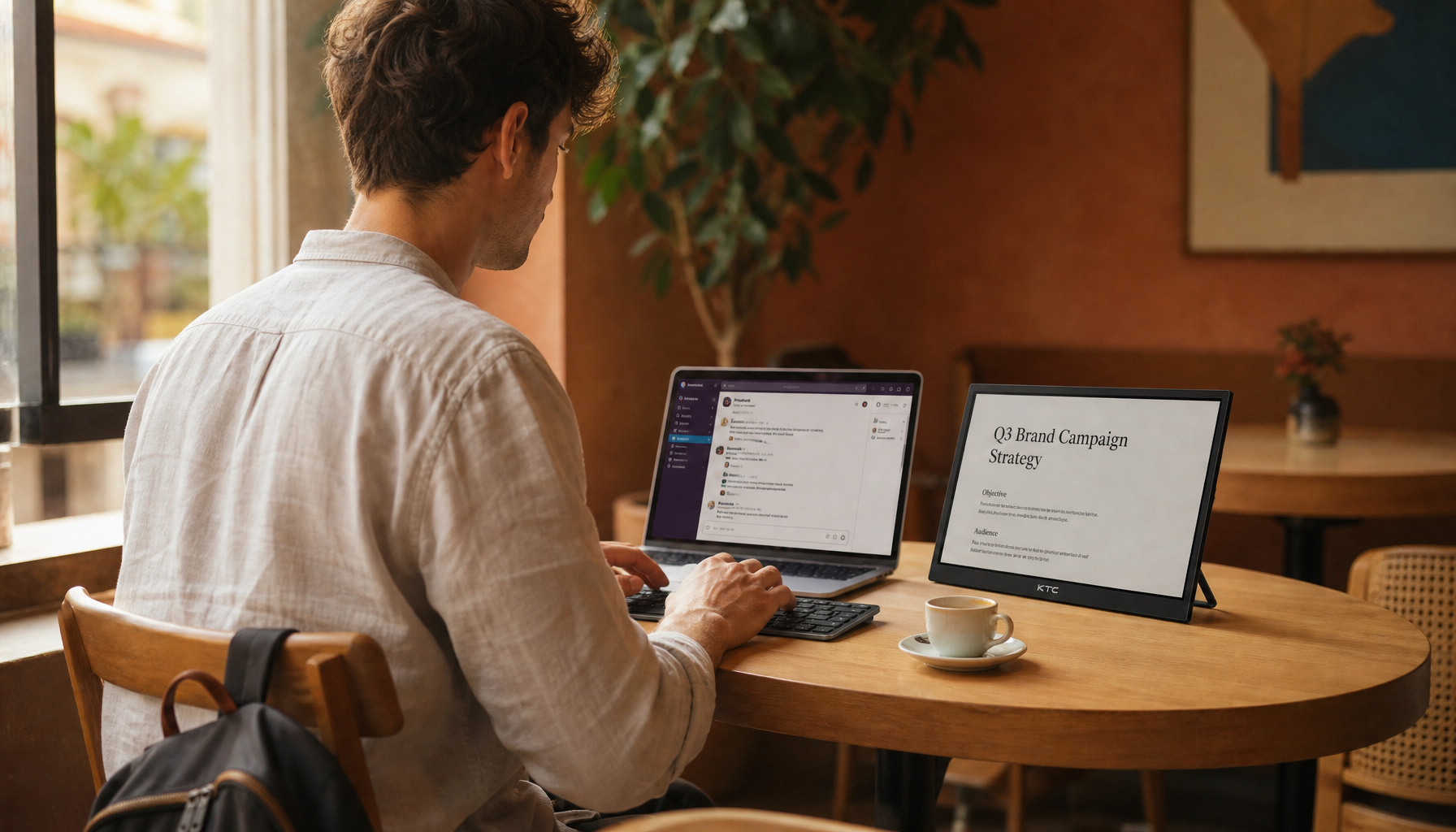
Matching resolution is less important when the second screen has a fixed support role. A 1080p portable monitor can be excellent for travel, video calls, chat, or notes, even next to a sharper laptop or 4K desktop display. In that case, matching height, brightness, stand adjustability, and scaling comfort may matter more than matching pixel count.
Ultrawide and Portable Monitor Pairings
An ultrawide monitor changes the decision because it can replace two side-by-side displays for many workflows. A 34-inch ultrawide at 1440p-class resolution gives you a broad workspace without a center bezel, which is useful for timelines, large spreadsheets, and multi-pane productivity apps. The tradeoff is that a side monitor may feel more mismatched if its height, density, or aspect ratio is very different.
Portable monitors are more forgiving because they usually hold secondary tasks. A 15- to 16-inch 1080p portable display can work well next to a laptop or main monitor if you keep it at native resolution and avoid using it for dense, all-day text work. For travel, a stable stand and sensible brightness control can matter more than chasing 4K in a small screen.
FAQ
Q: Does using monitors with different resolutions always hurt productivity?
A: No. Mixed resolutions hurt productivity mainly when they cause frequent resizing, blurry scaling, cursor misalignment, or inconsistent text size. A clear monitor role system can make a 4K-plus-1080p setup productive: use the 4K screen for focused work and keep the 1080p screen for reference, communication, or controls.
Q: Is it better to match screen size or resolution?
A: For comfort, matching pixel density and scaling behavior is often more useful than matching size alone. Two 27-inch monitors can feel very different if one is 1080p and the other is 4K. A 27-inch 1440p display paired with a 24-inch 1080p side monitor may feel more consistent than two same-size monitors with very different PPI.
Q: Should I lower the resolution on a 4K monitor to make text bigger?
A: Usually no. Keep the monitor at native 4K and increase operating system scaling first. Lowering the output resolution can reduce sharpness because the image no longer maps cleanly to the panel’s physical pixels.
Practical Next Steps
Start by deciding whether your second monitor is a peer display or a support display. If both screens will handle the same type of work all day, buy closer in size, PPI, and scaling behavior. If the second screen is mainly for chat, email, notes, or reference, a lower-resolution display can be perfectly practical.
- Set every display to its native resolution.
- Put the primary monitor directly in front of you, with the top third at or slightly below eye level.
- Arrange the monitors in your operating system so the digital layout matches the physical desk.
- Start with 150% scaling for 27-inch 4K, 100% or 125% for 27-inch 1440p, and 100% for 24-inch 1080p.
- Test your real workflow for 15 minutes: move your main apps, cross monitor edges, read small text, and check browser zoom.
- Assign stable roles to each display so your main work window does not constantly bounce between different scaling environments.
- If the setup still feels awkward, prioritize matching PPI and scaling behavior before buying a higher-resolution secondary monitor.
Key Takeaways
Mismatched monitor resolutions affect productivity through the details: text clarity, scaling, cursor movement, window size, and physical alignment. They are not automatically bad, and many mixed setups work well when the sharpest display handles focus work and the lower-resolution display handles support tasks.
For most monitor buyers, the safest productivity choices are a 27-inch 1440p display for balanced work and gaming, a 27- to 32-inch 4K display for sharp text and creative review, or a modest 1080p display for secondary utility use. The setup succeeds when the monitors are configured around how you actually work, not just how many pixels are listed on the spec sheet.



,%20and%20alignment%20for%20a%20seamless%20workflow.
)