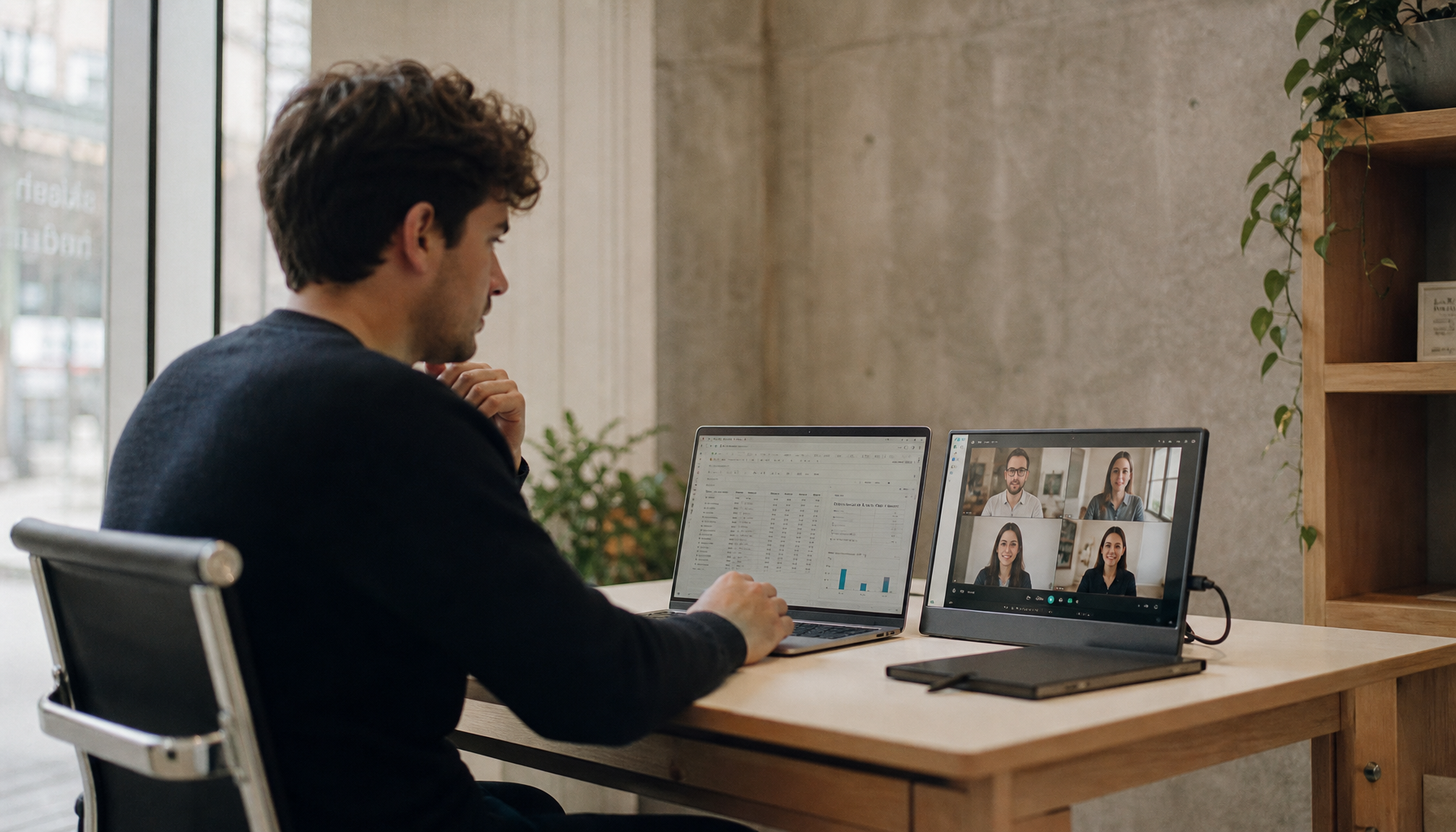
The 2026 'Invisible Desk' solves a common problem for design-conscious remote workers: how to maintain a productive home office that completely disappears into your living space when the workday ends. By combining a battery-powered smart display like the MegPad with wireless peripherals and rolling mobility, you can create a setup that supports video calls, multitasking, and focused work during the day yet leaves the room looking like a pure living area in the evening. The key is accepting that this is an aesthetic and functional compromise rather than a cable-free utopia—battery life depends heavily on screen brightness, and some charging or tethering is inevitable.

The 2026 Workspace Problem: Why 'Invisible' is the New Minimalist
Modern homes increasingly function as multi-purpose 'second living spaces' where a dedicated office corner would disrupt the overall decor. Traditional monitors, stands, and cable runs create permanent visual clutter that clashes with clean, minimalist aesthetics many homeowners now prioritize. The 'Invisible Desk' concept addresses this by using functional reduction—fewer permanent fixtures, hidden storage for peripherals, and mobile displays that can be repositioned or stored out of sight.
As trends toward blended living and working environments grow, the goal shifts from hiding a desk to making the entire workstation modular and transient. This approach works particularly well in open-plan apartments, shared multipurpose rooms, or living room corners that double as workspaces. The result is a space that supports productivity without permanently claiming real estate in your home's aesthetic.
Building the Wireless Ecosystem: Peripherals and Connectivity
A functional invisible setup requires eliminating visible tethers to both power outlets and your main computer during work hours. This means relying on modern wireless standards: Wi-Fi 6 for stable high-resolution streaming and Bluetooth 5.2 for low-latency connections to keyboards, mice, and headsets. These technologies keep data flowing smoothly without the physical cable clutter that breaks the minimalist illusion.
For most users, the ideal is a 'one-cable or zero-cable' experience while working. A laptop or mini-PC can connect wirelessly or via a single USB-C link for power and data, while the smart display handles its own Android-based apps for video calls or background tasks. Wireless peripherals from reputable brands complete the picture, though you should test range and latency in your specific environment—interference from thick walls or many connected devices can still introduce minor hiccups.
For deeper advice on decluttering with single-cable solutions, see our guide on How a USB-C Monitor Can Streamline Your Workspace.
The Power Paradox: Managing a Battery-Powered Smart Display
Battery-powered smart displays promise freedom from outlets, but real-world runtime forces careful management. The MegPad series, for example, can deliver up to 11 hours under light use at moderate brightness and volume, yet this drops to around 4 hours when running 4K content at full brightness. This creates a 'power paradox': the brighter the screen needs to be to overcome ambient light or deliver vivid streaming, the shorter your cable-free window becomes.
To preserve the invisible aesthetic, plan around brightness tiers. Use 'Ambient Dimming'—keeping the display at 30-40% for background dashboards, email, or music—and reserve higher intensity for focused sprints. A planned 45-minute charging session during lunch can often restore enough capacity for the afternoon. High-glare rooms make the fully wireless dream harder, as combating sunlight typically demands 80%+ brightness and accelerates drain.
This behavior turns the display from an 'always-ready portable TV' into a cycle-based workstation component. Understanding your typical brightness needs and room lighting is the first filter before buying. The KTC MEGAPAD 32" 4K Android 13 Google EDLA Smart Touch Monitor with 9500mAh Battery is a strong example of this category, with its built-in battery and Android ecosystem supporting both work and entertainment modes.
Ergonomics in Motion: Staying Healthy on a Mobile Desk
Rolling displays bring genuine flexibility—you can wheel the screen from a dining table to a couch or recliner as your tasks change. However, they are not a direct 1:1 replacement for a premium adjustable standing desk. The typical height range on models like the A32Q7 Pro (roughly 1131–1331 mm) aligns well with seated eye level or low-perch postures on standard chairs and stools, making them excellent for most home-office or hybrid living-room use.
Taller users (over about 5'8") may find the maximum height still requires a slight downward gaze during prolonged standing, which can contribute to neck strain. The 90-degree pivot feature is particularly useful for the invisible goal: rotating to portrait mode shrinks the horizontal footprint dramatically, letting the unit tuck neatly between furniture or into a closet when not in use. This mobility also enables 'postural rotation'—landscape orientation at a table for spreadsheets, then portrait by the sofa for reading or calls.
The chart below visualizes these trade-offs across common scenarios.
Height Fit vs Battery Runtime by Scenario
This chart shows the likely best-fit scenario, not an exact ergonomic or battery benchmark. Use it to compare when seated/perch use is safer than standing, and when brighter settings usually trade down runtime.
View chart data
| Scenario | Low brightness | Medium brightness | High brightness |
|---|---|---|---|
| Seated / perch | 3.0 | 2.0 | 1.0 |
| Standing | 1.0 | 2.0 | 3.0 |
For more on selecting monitors that support healthy posture, review our Home Office Setup Guide: How to Choose the Right Ergonomic Monitor.

Decor Integration: How to Make Your Desk Disappear
Once the display itself is mobile, the remaining challenge is concealing chargers, hubs, and your main computing device. Minimalist design principles emphasize keeping only essential tools visible while using hidden storage—under-desk trays, built-in cabinetry, or even attractive baskets—to manage the necessary 'ugly' components. When the workday ends, the rolling display can transition to an entertainment screen in the living area or be wheeled into a closet, restoring the room to its non-work identity.
Effective integration often involves choosing furniture with cable channels or planning a single charging station that doubles as decor. The goal is not literal invisibility but a setup whose presence feels intentional and harmonious with your interior style rather than an obvious workspace.
How to Choose the Right Setup for Your Space
Start by assessing your primary work posture and room lighting. If you spend most time seated or perched and your space has moderate ambient light, a battery-powered 32-inch 4K smart display on a rolling stand offers excellent flexibility and meets the invisible ideal for many users. Taller individuals who stand frequently or rooms with heavy glare may need to prioritize brighter models and accept more frequent charging, or consider supplementing with a fixed ergonomic monitor for demanding sessions.
Check your wireless environment next—strong Wi-Fi 6 coverage is essential for smooth performance. Test potential placements for rolling ease on your flooring, and ensure you have realistic storage options for the unit when not in use. Avoid expecting all-day unplugged operation at high brightness; instead, build a routine that includes strategic midday top-ups.
Common mistakes include underestimating battery sensitivity to brightness, choosing a stand height that forces poor posture for your body type, or failing to plan cable management for the non-display components. When these factors align with your habits, the invisible desk becomes a practical, stylish evolution of the home office rather than a daily frustration.
Can a Battery-Powered Smart Display Run All Day Without Charging?
No, not at high brightness or during intensive tasks. Most models deliver 7–11 hours under moderate conditions (around 50% brightness and volume), but 4K streaming or full brightness often reduces this to 4 hours or less. Plan for a midday charge or keep brightness low for background use to extend the wireless window. Actual runtime also varies with Wi-Fi strength and battery age over time.
Is a Rolling Smart Display a Good Replacement for a Standing Desk?
It depends on your height and primary posture. The typical height range works well for seated or low-perch setups and offers great mobility between rooms. Taller users may experience neck strain during extended standing, as the maximum height is often still below ideal eye level. Treat it as a flexible perch workstation rather than a full standing-desk equivalent.
How Do You Hide Cables and Chargers in an Invisible Desk Setup?
Use hidden storage solutions such as under-desk trays, furniture with built-in channels, or decorative boxes. Many users centralize charging in one attractive station and rely on the display's battery for daytime mobility. The key is reducing visible wires during active hours through wireless peripherals and strategic placement.
Does This Setup Work Well in Shared or Multi-Purpose Rooms?
Yes, especially when the display can roll away or pivot to portrait for compact storage. It excels in living rooms or open apartments where the workspace must vanish after hours. Success depends on smooth flooring for the wheels, adequate wireless coverage, and furniture gaps that allow the unit to tuck out of sight without dominating the decor.
What Brightness Level Preserves Battery Life Best for Work?
30–50% brightness is usually sufficient for productivity tasks like documents, video calls, or ambient dashboards in typical indoor lighting. Reserve higher settings for media consumption or bright rooms. Automating brightness changes or using the display's ambient modes helps maintain the cable-free aesthetic longer.