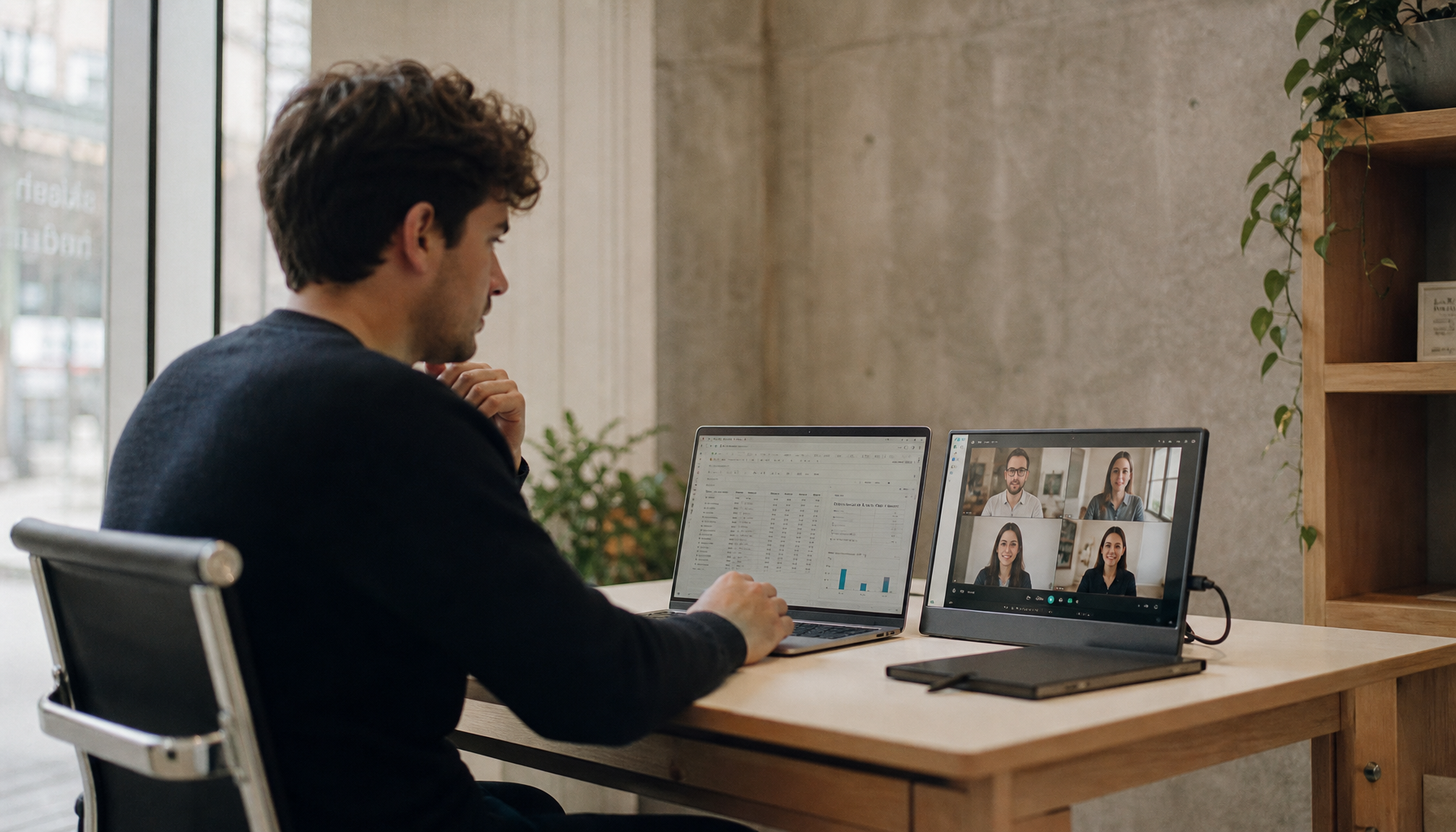
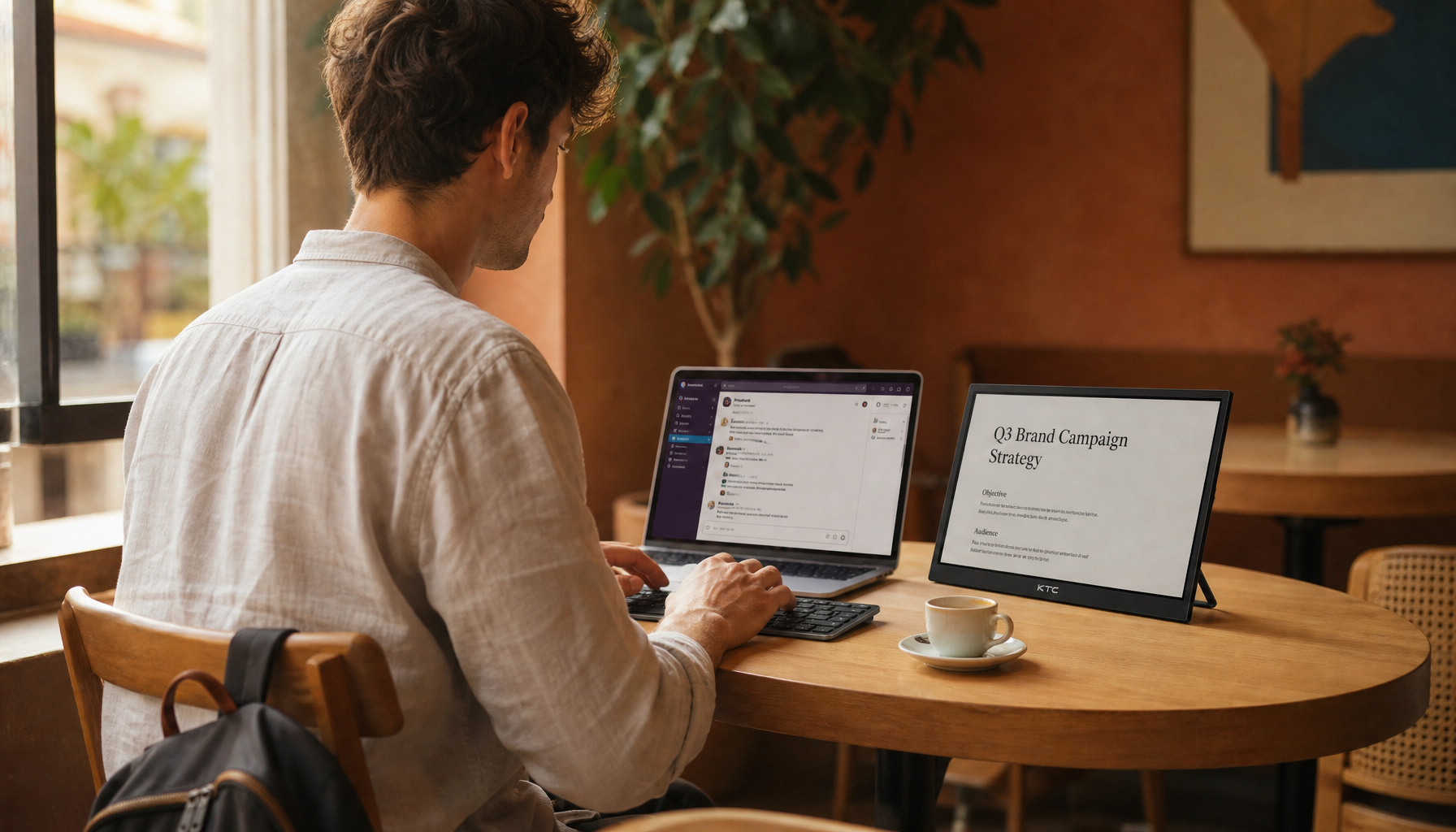
Prevent neck strain by placing a large monitor slightly lower and farther back than many people expect, then matching your chair, desk, and screen tilt to a neutral head position. Your eyes should fall naturally to the action instead of forcing your chin up or your head forward.
Does your neck feel tight after an hour on a big screen even though the game looks great? In most setups, the fastest improvement comes from changing monitor height and distance before buying anything new. A 32-inch or larger display should feel immersive without forcing your neck to do extra work.
Why big monitors create a different neck problem
A neutral head-and-neck posture matters more on a 32-inch or larger monitor because the screen is physically taller, so poor placement exaggerates every glance up, down, or sideways. On a smaller display, being a little too high or a little too close may be tolerable. On a 32-inch panel, a top edge that sits too high can make you lift your chin for hours, while a screen that sits too close can make you push your head forward to take in the whole image.
That is why the usual rule of placing the top of the screen at eye level needs adjustment on large displays. Positioning advice for large screens and other ergonomic guidance point to the same practical result: your eyes should angle slightly downward toward the center of the screen, not straight ahead or upward. For gaming, that often means the top half or top quarter of the screen sits around eye level rather than having the entire top edge line up with your sightline.
Start with your chair, not the monitor
A stable seated position keeps monitor adjustments honest. If your feet are dangling, your knees are too high, or your lower back has no support, you will compensate with your neck even if the screen is perfectly placed. The most reliable sequence is to set your chair first, plant your feet flat, keep your knees near a right angle, and let the backrest support you instead of perching on the seat edge.

For gaming, a slight recline is usually better than a rigid upright posture. Ergonomic guidance consistently lands in the same range: about 100 to 110 degrees of backrest recline reduces upper-body strain while keeping you engaged. If you sit farther forward for competitive games, that is fine, but your default resting position should still keep your head over your shoulders instead of hanging in front of them.
The best monitor height for 32-inch and larger screens
The top third of the screen is the best aiming point for most large-monitor gaming setups. One source recommends that your gaze naturally land around the top third, while another places your eyes roughly 2 to 4 inches below the top edge and notes that the screen center should sit about 17 to 18 degrees below eye level. In practice, those recommendations fit together well: the bigger the screen, the less useful a rigid top-edge-at-eye-level rule becomes.
The key nuance is that large displays often need to sit slightly lower than people expect. That does not conflict with other ergonomic guidance; it mainly reflects screen size and task differences. A large gaming display fills more of your vertical field of view, so lowering it slightly often keeps the main action within a comfortable downward gaze.
A simple example makes this clearer. A 32-inch 16:9 monitor is tall enough that if the top bezel sits too high, your minimap, HUD, or other upper-screen elements can force repeated chin lift. Lowering the display by even 1 to 2 inches is often enough to stop that. If your neck feels pinched at the base after playing, the monitor is usually too high. If your upper back rounds and you lean in, it is usually too low or too far away.
Distance matters more than most gamers think
An arm’s-length viewing distance is the baseline, but 32-inch and larger screens usually work best near the far end of that range. Some ergonomic guidance suggests about 31 to 39 inches for 32-inch-and-up monitors, while other sources support the arm’s-length rule and warn that sitting too far away can also cause leaning.
That gives large-screen players a useful test. Sit back with your lower back supported and reach forward. If your fingertips just barely reach the screen, you are close to a workable distance. If the display is well inside easy reach, it is probably too close for a 32-inch panel. If it is so far away that text or HUD elements make you crane forward, do not drag your face toward the monitor; enlarge text or interface elements where possible, or bring the screen in slightly.

Angle, centering, and desk depth
A slight backward tilt of about 10 to 20 degrees can improve comfort, especially if it lets your eyes meet the panel more squarely without lifting your chin. It can also reduce glare, which matters because reflections often make people shift posture to find a clearer image. Another useful rule is to keep windows and strong light sources to the side rather than directly in front of or behind the screen.

Centering is nonnegotiable. An off-center screen creates repeated head rotation, and that problem gets worse on a large monitor because the visual sweep is already larger. If you use a second display for chat, maps, or streaming controls, keep the primary gaming screen directly in front of you, place the secondary close beside it, and angle it inward so glances come mostly from eye movement and small head turns rather than full neck rotation.
Desk depth also determines whether a big monitor can be comfortable to use. Desks that support larger displays suit 32-inch and 34-inch screens better because they allow enough viewing distance without pushing the keyboard into an awkward reach zone. If your desk is shallow, a monitor arm is often the cleanest fix because it frees space and lets you lower, raise, and pull back the screen precisely.
What to change if your neck still hurts
A slightly lower screen center is often the best next adjustment if your neck still feels loaded after the basic setup is fixed. This is especially true for gamers who spend most of their time tracking the center of the screen rather than reading menus at the top. Lowering the monitor a bit can also help if you wear bifocals or progressive lenses, since a high screen often makes those users tip the head backward.
Movement is the other missing piece. Changing posture through the session reduces strain that no monitor position can fully solve. A practical pattern is to avoid staying static for long stretches. Even without a standing desk, standing up between matches and resetting your shoulders can stop a small setup flaw from turning into real pain.
Best setup targets for a large gaming monitor
Setup factor |
Strong target for 32-inch+ gaming |
Height |
Eyes land around the top third or upper half, with the screen center slightly below eye level |
Distance |
Usually about 31 to 39 inches, or slightly beyond fingertip reach |
Tilt |
Slight backward tilt, often around 10 to 20 degrees |
Position |
Directly in front of your face, not centered to the desk only for appearance |
Chair |
Feet flat, back supported, knees near 90 degrees, backrest around 100 to 110 degrees |
Close beside the main display and angled inward |
A big monitor should feel expansive, not demanding. If your head stays stacked over your shoulders and your eyes drop naturally into the action, the screen is helping your performance instead of taxing your body.