Center the work you look at most, not necessarily every inch of the panel. Set the ultrawide slightly below eye level, keep it about 24 to 31 inches from your eyes for most large curved models, and reserve the far edges for low-use windows.
Ever finish a long work session or gaming night with one shoulder tighter than the other because your main window lived on the left side of a 34-inch or 49-inch display? The practical fix is often measurable in minutes: move the active window to the center third, adjust height to a slight downward gaze, and increase distance before pulling the screen closer. This guide shows how to position an ultrawide monitor so you keep the wide workspace without training your neck to twist all day.
Why Ultrawide Monitors Can Strain the Neck and Shoulders
Ultrawide monitors are useful because they expand horizontal workspace for spreadsheets, coding, timelines, dashboards, streaming tools, and immersive gaming. The same width can become the problem when the app you use most sits far left or far right. Poor ultrawide placement increases neck rotation, eye travel, and static posture load, especially when the screen is too close or when the main task is not centered in front of the keyboard and chair ultrawide placement.
The issue is not simply screen size. It is repeated viewing behavior. If your code editor, browser, game minimap, or spreadsheet columns require you to hold your head turned for minutes at a time, the upper trapezius and shoulder muscles work harder than they need to. Office ergonomics guidance warns that monitor placement can force chin-up, forward-bent, or sideways postures that contribute to neck and shoulder discomfort monitor placement.
The Readable Zone Matters More Than the Physical Width
A useful way to think about an ultrawide is to separate the readable zone from the storage zone. Human vision can recognize symbols across roughly 60 degrees total, about 30 degrees to either side of center, without turning the head. Peripheral vision can detect movement farther out, but it is not ideal for reading text or identifying small interface details human vision.
That matters on a 49-inch 32:9 display. At about 35 inches away, a 49-inch panel can span roughly 78 degrees; at 28 inches, it can span about 100 degrees. In practice, that means the edges are excellent for passive information, such as chat, music, a hardware monitor, or a map, but not for the document, game HUD, timeline, or browser tab you stare at continuously.
Center the Primary Viewing Area, Not Just the Panel

For a single ultrawide, the best starting position is simple: sit normally, place the keyboard and mouse where your shoulders feel relaxed, then put your primary task directly in front of your nose and sternum. The center third of the ultrawide should hold the windows you read, type into, aim through, or edit most often; the outer thirds should hold lower-frequency reference content center third.
This is especially important when the physical center of the panel is not the same as your workflow center. For example, a developer using a 34-inch ultrawide might keep the code editor in the middle, documentation on the right, and terminal logs on the left. A video editor might keep the timeline centered, bins on one side, and scopes on the other. A gamer might center the game viewport and move a chat platform, a streaming tool, or performance overlays to the edges.
When the Whole Monitor Should Be Centered
If you use one main app full screen, center the whole monitor on your body. This works well for full-screen gaming, CAD, single-app writing, photo editing, and any task where the visual focus naturally sits in the middle of the panel.
If you split the screen into two equal windows, do not accept a permanent half-left or half-right neck turn. Either make one window primary and larger in the center, or shift the monitor slightly so the window you use most is in front of you. The goal is not visual symmetry on the desk; it is reducing repeated neck rotation during the actual task.
When Only the Main Work Zone Should Be Centered
On very wide monitors, especially 40-inch and 49-inch models, centering the entire panel may still leave important content too far from the body. In that case, center the active work zone and treat the edges as utility space. A 2024 lab study summarized in ultrawide ergonomics guidance found that wider displays increased head-rotation demands, and some users found 40-inch displays overwhelming; reduced twisting helped explain why 34-inch options were often preferred head-rotation demands.
A practical rule: if you catch yourself turning your nose toward a window more than a few times per minute, that window belongs closer to the center. Move passive items outward before moving the chair, keyboard, or monitor.
Set Height, Distance, and Tilt Before Fine-Tuning Apps

Monitor height should support a slight downward gaze. A reliable target is to place the top of the usable screen at or slightly below eye level, with the central viewing area lower than a straight-ahead horizontal line. Ergonomics guidance places comfortable viewing around 15 degrees below eye level, with a broader acceptable downward visual zone depending on the task comfortable viewing.
For ultrawides, height mistakes often feel like shoulder tension because users compensate with the whole upper body. A screen that is too high encourages chin lift and neck extension. A screen that is too low can pull the head forward. If you wear bifocals or progressive lenses, the monitor often needs to sit lower so you do not lift your chin to find the right lens zone progressive lens users.
Viewing Distance: Start Far Enough Back
For many large curved ultrawide displays, a practical viewing-distance range is about 24 to 31 inches from the eyes. Larger or flatter screens may need more distance, especially if the far edges make you rotate your head. If text feels too small at a comfortable distance, increase operating system scaling, browser zoom, app font size, or in-game UI scale before moving the monitor closer viewing-distance range.
Desk depth is the constraint many buyers underestimate. A 24-inch-deep desk can feel tight once a deep factory stand pushes a 34-inch or 40-inch monitor toward the user. In that setup, a monitor arm or a shallower mounting stand may matter more than another display spec because it gives you the extra few inches needed to reduce edge angle and shoulder tension.
Tilt and Vertical Alignment
Tilt the monitor so the screen faces your eyes rather than your chest or forehead. On a curved ultrawide, the goal is to keep the centerline natural and avoid reflections that make you lean forward. Small tilt changes are enough; if you need an extreme tilt to read the top or bottom, the height is probably wrong.
For sit-stand desks, set two known positions instead of adjusting by feel every time. Measure your seated eye height and standing eye height, then configure the arm or riser around those two points. Many setups need about 10 to 14 inches of height change between seated and standing positions, so a fixed stand that works while sitting may be too low when standing.
Match the Setup to Your Monitor Size and Desk

A 34-inch 21:9 ultrawide is often the easiest size to position for all-day productivity because it adds meaningful width without forcing constant head turns on a typical desk. A 40-inch or 49-inch display can still be comfortable, but it needs more distance, better window discipline, and enough desk depth to keep the full span within a usable viewing angle 34-inch ultra-wide. For example, a 49-inch DQHD 1000R curved display such as a curved ultrawide monitor is a case where the center-third rule matters more than trying to center every open window.
Curvature helps, but it is not a cure. A curved panel can reduce the distance difference between the center and edges, which makes scanning feel more natural than on a very wide flat panel. It does not remove the need to center the primary work zone. If the main content is parked at the far edge, a curved monitor still asks your neck to rotate.
Setup Choice |
Best Use |
Positioning Target |
Main Risk |
Practical Adjustment |
All-day office work, coding, mixed productivity, gaming |
Center the panel and keep primary windows in the center third |
Crowded desk if the stand is deep |
Use 24 to 31 inches of viewing distance and raise text scaling if needed |
|
40-inch ultrawide |
Large timelines, wide spreadsheets, heavy multitasking |
Center the main work zone, not just the physical panel |
More head rotation and visual travel |
Push the screen farther back and keep frequent tasks near the middle |
49-inch super ultrawide |
Simulation games, trading dashboards, multi-app command centers |
Treat edges as secondary zones |
Constant far-edge reading |
Put active work in the middle 60 degrees of view and reserve edges for passive panels |
Flat ultrawide |
Design work, lower-cost wide displays, mixed use |
Increase distance to reduce edge angle |
Edges feel farther and may invite leaning |
Sit farther back than with a comparable curved model |
Curved ultrawide |
Immersive gaming, productivity, wide dashboards |
Align curve center with your body |
False confidence that width solves posture |
Still center the app you look at most |
Monitor Arm Considerations
A monitor arm can improve an ultrawide setup when it gives better control over height, depth, tilt, and alignment. It can also make things worse if the arm sags, wobbles, pulls on cables, or cannot support the monitor well. Use only about 60% to 70% of the arm’s rated capacity as a practical stability margin, and leave 4 to 6 inches of cable slack at each joint so cable tension does not drag the display out of position monitor arm.
Before buying an arm for a gaming monitor or high-refresh-rate ultrawide, check mounting-standard compatibility, monitor weight without the stand, desk clamp clearance, and whether the arm can hold the display at your preferred depth. A heavy 49-inch monitor on a marginal arm can create tiny vibrations during typing or mouse movement, which encourages leaning and shoulder bracing.
Positioning for Work, Gaming, and Multi-Screen Layouts
For productivity, the center third is your working lane. Put the document, spreadsheet cells, code editor, design canvas, or browser tab you interact with most in that lane. Put reference material, chat, email, calendars, dashboards, or music controls on the sides. This keeps the ultrawide useful without turning the far edges into mandatory reading zones.
For gaming, center the game viewport and align the middle of the screen with your body, chair, keyboard, and mouse pad. Competitive players using high-refresh-rate ultrawide monitors should be especially careful with posture because small aiming corrections add up over long sessions. If the in-game HUD stretches too far outward, use the game’s HUD safe-zone, UI scale, or field-of-view settings when available.
Dual Monitors and Stacked Displays
If you pair an ultrawide with a second monitor, decide which screen is primary. The primary display should sit directly in front of you; the secondary display should be angled inward and used for lower-frequency content. Office guidance for multiple and wide-screen setups recommends keeping frequently used content directly in front, angling side screens in a semi-circle, and keeping screens around arm’s length away multiple and wide-screen setups.
Stacked displays need extra caution. A top monitor is useful for passive dashboards, video previews, stream chat, or system monitoring, but it should not hold your main reading or editing task. If you repeatedly lift your chin to use the upper screen, bring that content down or swap roles between the displays.
Portable Monitors Beside an Ultrawide
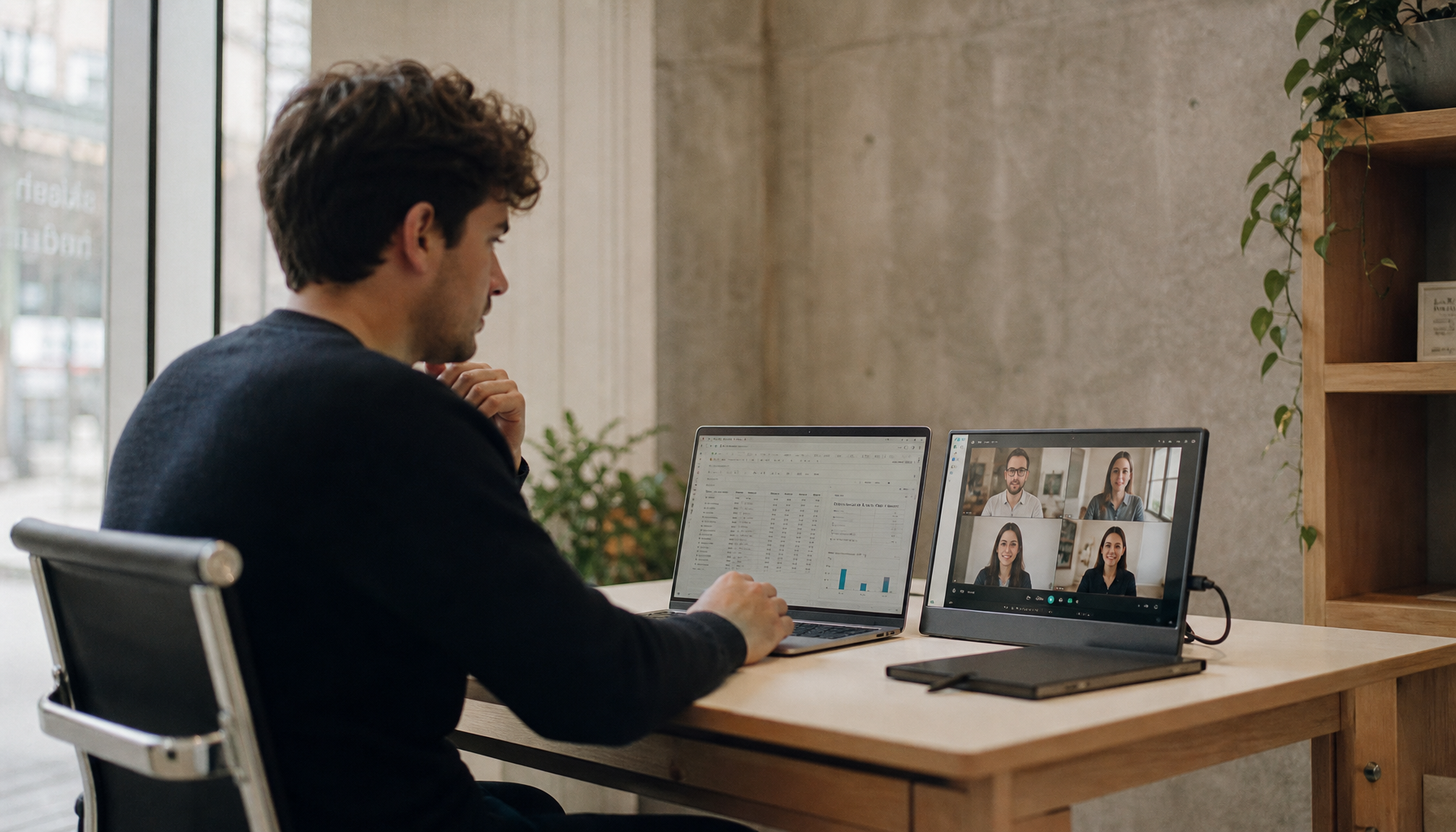
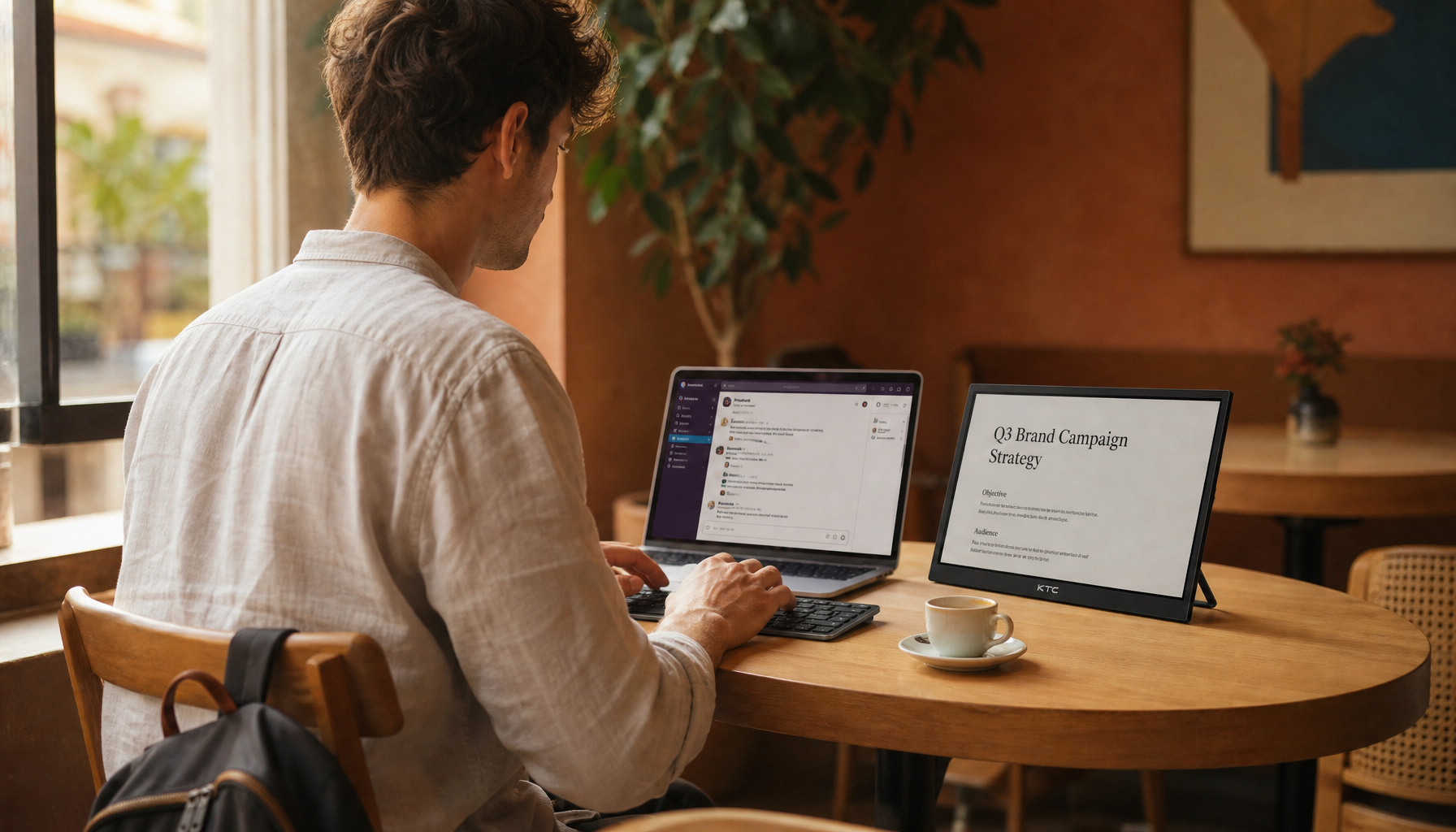
A portable monitor can work well as a side display for notes, messaging, preview windows, or a laptop screen, but it should not become the main focus unless it is centered. Keep it close to the ultrawide edge and angle it inward. Large gaps between screens make the neck rotate farther, especially when you jump between windows every few seconds.
For laptop-plus-ultrawide setups, avoid using the laptop keyboard while looking at the ultrawide off to the side. Use an external keyboard and mouse aligned with the ultrawide’s primary work zone. This one change often removes the shoulder twist that comes from typing straight ahead while reading diagonally.
Quick Ergonomic Check You Can Do in Five Minutes

Start with your normal chair height, keyboard position, and mouse position. Sit back with your feet supported and shoulders relaxed. Without reaching for the monitor, look straight ahead. The center of your main task should be in that line, and the top of the usable screen should be at or slightly below eye level.
Then test your real workflow, not a blank desktop. Open the apps you use for 80% of the day or your usual game layout. If your nose, chin, or chest keeps turning toward the same side, move that content inward. If your head moves forward, increase text size or bring the monitor slightly closer only after checking whether it is already within a reasonable distance.
Action Checklist
- Sit in your normal working or gaming posture before moving the display.
- Place the primary task in the center third of the ultrawide.
- Set the top of the usable screen at or slightly below eye level.
- Start around 24 to 31 inches from your eyes for most large curved ultrawides.
- Move passive windows, such as chat, music, email, and dashboards, to the far left and right.
- Increase scaling or font size before moving the monitor closer.
- Check cable slack and arm stability if the monitor sags, wobbles, or drifts.
FAQ
Q: Should my ultrawide monitor be centered on my body?
A: Center the area you look at most. On a 34-inch ultrawide used mostly as one large screen, that often means centering the whole monitor. On a 40-inch or 49-inch model with many windows, it usually means centering the active work zone and using the edges for secondary content.
Q: Is a curved ultrawide better for neck comfort than a flat ultrawide?
A: A curved ultrawide can reduce how far the edges feel from your eyes, which may make scanning more comfortable. It does not eliminate neck rotation if your main content sits at the far left or right. Curvature works best when combined with proper distance, height, and centered primary tasks.
Q: What should I do if my shoulders still feel tight after adjusting the monitor?
A: Check the whole workstation. Make sure the keyboard and mouse are centered with the main viewing area, the armrests are not pushing your shoulders upward, and the monitor is not too high or too close. If discomfort persists, consider a professional ergonomics assessment or medical advice, especially if pain, numbness, or tingling continues.
Practical Next Steps
The best ultrawide position is the one that matches your actual viewing pattern. For most users, that means the primary task sits straight ahead, the screen supports a slight downward gaze, and the far edges hold information that is useful but not constantly read. A 34-inch ultrawide is usually easier to tune on a typical desk, while 40-inch and 49-inch displays need more viewing distance and stricter window placement.
Before replacing a monitor, try a positioning reset: move the active window to the center, push the display back if the edges feel too wide, raise or lower the screen to eye level, and increase text scaling. Those changes preserve the wide-screen benefit while reducing the posture habits that create neck twist and shoulder tension.