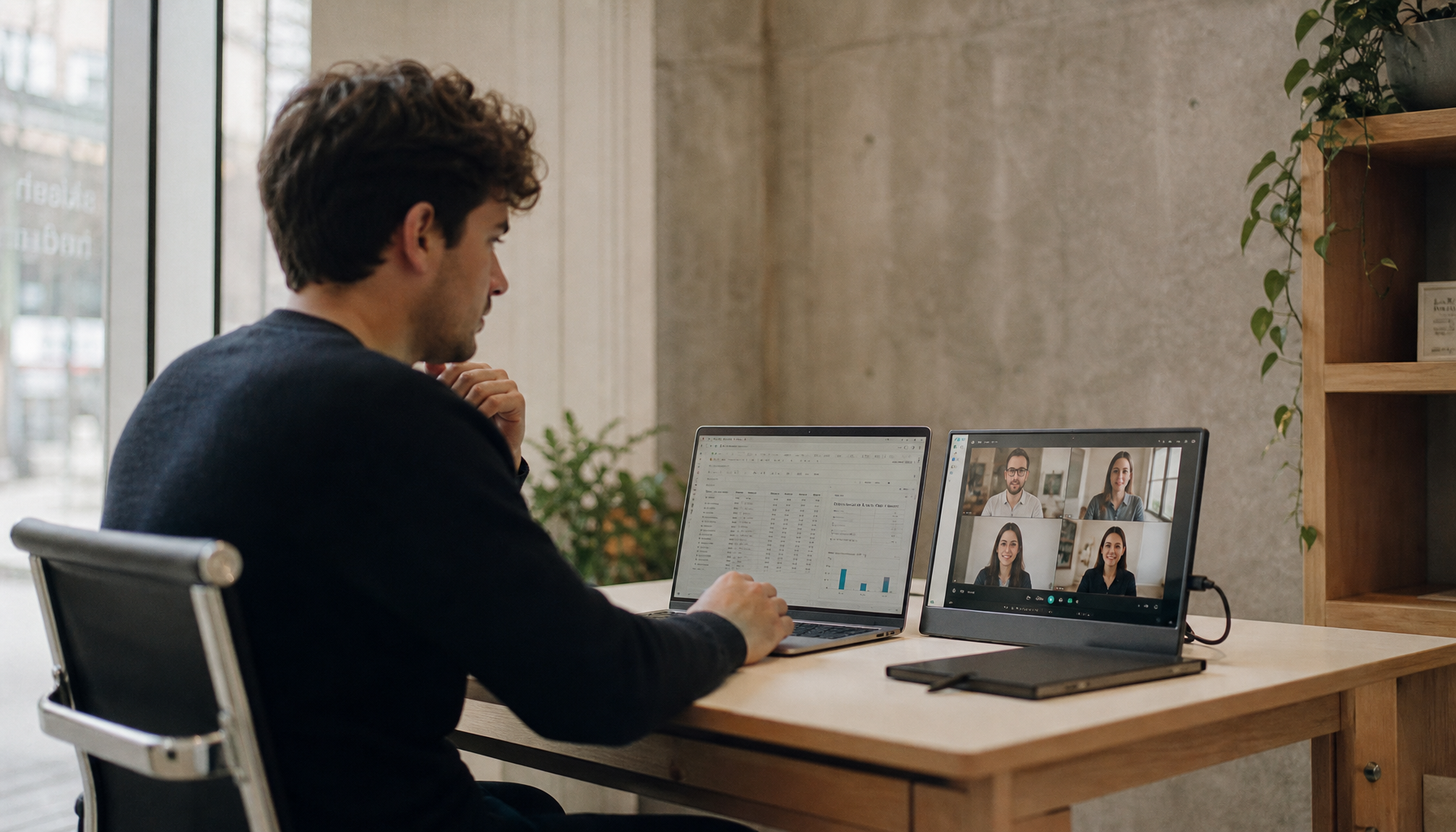
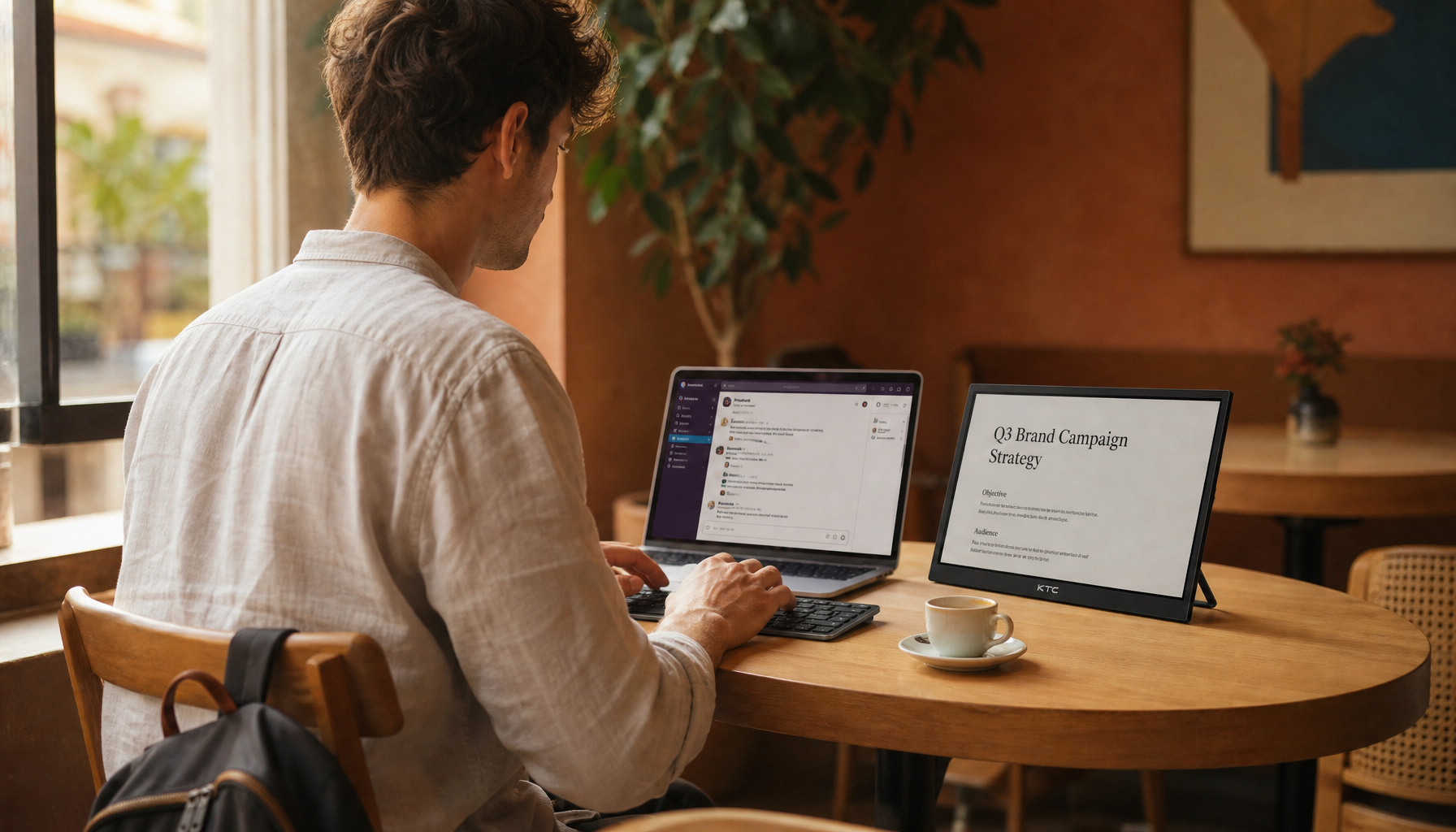
Set the monitor around your seated position, not your body around the monitor. Center your main task, move the screen far enough back, and use small angle, height, and tilt adjustments to keep your neck, shoulders, and torso neutral.
Do the far-left tabs on your ultrawide make you turn your chest just to read them? A practical setup change you can test today is moving your main window into the center 40% to 50% of the screen and pushing a 34-inch-plus curved display back to about arm’s length or farther. That reduces edge chasing without sacrificing the wide canvas. You’ll get a clear way to set distance, angle, height, and window zones so the curve feels immersive instead of physically demanding.
Why Curved Monitor Edges Cause Torso Twisting
A curved monitor is built to wrap part of the display around your field of view. That is why curved screens work well for racing sims, open-world games, timelines, dashboards, and multitasking. The same advantage becomes a problem when the screen is too close, too wide, or centered around the panel instead of centered around your actual task.
The ergonomic principle is simple: your head and torso should stay mostly forward while your eyes handle small scanning movements. Posture guidance recommends placing the monitor about an arm’s length away, with the top of the screen around eye level, because poor placement encourages neck and shoulder strain. For curved ultrawides, that arm’s-length rule is only the starting point. A 49-inch display often needs more distance than a 24-inch office monitor because the edges sit much farther into your peripheral field.
In hands-on desk tuning, the symptom is easy to spot. If you keep your hips square to the keyboard but your sternum rotates toward the left edge to read chat, layers, code, or a minimap, the monitor is acting too wide for your current distance and content layout. The fix is usually to widen your viewing distance, rotate the display so the active zone faces you, and stop parking high-frequency work at the far edges.

Start With the Primary Task, Not the Monitor Center
The most common mistake is treating the physical center of a curved monitor as sacred. For gaming, your crosshair or driving line should sit straight ahead. For office work, your document, spreadsheet cells, code editor, or video timeline should sit straight ahead. The monitor’s geometric center matters less than where your eyes spend the most time.
Ergonomic guidance emphasizes that the monitor should be directly in front to avoid head and neck twisting. On an ultrawide, translate that into a workflow rule: the main task belongs in the center, while secondary tools belong beside it. For example, on a 34-inch curved monitor, keep your main browser, editor, game, or document in the middle half of the display. Put music, chat, system stats, file trees, or reference windows closer to the sides because they are checked occasionally, not read continuously.
This is also where curved monitors differ from dual flat displays. A dual-monitor setup often tempts you to face the bezel or split your body between screens. A single curved ultrawide can reduce that friction, but only when the center zone is treated as the cockpit. If your most-used app lives at the far left because your operating system remembered yesterday’s window position, the curve cannot save your posture.
Set the Distance So the Edges Stay in Your Viewing Arc
Distance is the biggest lever. If the edges make you twist, move the screen back before you adjust height or chair position. A wider screen at the same distance creates a larger viewing angle, which means more head and torso rotation.
Ergonomics research notes that for a 34-inch curved monitor to remain within an acceptable viewing angle, it should sit at least about 28 inches from the viewer’s eyes, with enough desk depth for the stand or arm. That lines up with broader ergonomic advice that larger displays need more distance. If your desk is only 24 inches deep and the monitor stand uses 8 inches, your eyes may be far closer than you think.

A practical test works better than guessing. Sit in your normal chair position with your keyboard and mouse where you actually use them. Face the center of your primary task window. Without turning your shoulders, glance to each edge. If you can read edge content only by rotating your torso, push the monitor back 2 to 4 inches. If text becomes too small, increase scaling or app font size instead of sliding your chair forward again.

Screen Type |
Starting Distance |
What To Watch For |
24- to 27-inch standard monitor |
About 20 to 30 inches |
Full screen visible with little head movement |
34-inch curved ultrawide |
About 28 to 35 inches |
Edges readable without shoulder rotation |
49-inch super ultrawide |
Often 35 inches or more |
Main content must stay centered; edges should hold low-frequency tools |
Angle the Curve Around Your Seat
Once distance is close, angle matters. A curved monitor should face your seated centerline, not the wall, the desk edge, or an imaginary perfect grid. The midpoint of your primary task should be perpendicular to your nose when you are sitting naturally.
For a single curved monitor, start with the screen centered and square to you. Then make small yaw adjustments, rotating the whole display left or right by a few degrees if your main task is not physically centered. This is useful for mixed workstations where the keyboard, chair, or monitor arm cannot sit perfectly centered because of speakers, a tower, or a laptop dock.
If you use a curved monitor with a secondary display, angle the curved monitor toward your main seated position and keep the secondary screen slightly inward, close to the same height and distance. KTC’s collaborative-space advice notes that wider and curved monitors may need to sit farther back to reduce neck rotation, which becomes even more important when another screen pulls your gaze sideways. The secondary display should support the main screen, not lure your body into a permanent half-turn.
Match Curvature to Viewing Distance
Curvature ratings are easy to overlook, but they explain why two curved monitors can feel completely different. A lower R number means a stronger curve. A 1000R display is more aggressive than a 1800R display, so it generally expects you to sit closer to the center of the curve. A gentler 1800R or 3800R curve can feel more natural for mixed productivity, especially if you sit farther back.

The goal is not to chase the strongest curve. It is to make the edges feel equally reachable by your eyes. Ergonomic research explains that curvature is expressed as a radius and that lower numbers represent a tighter curve, while some curved displays improved legibility and visual fatigue compared with flat displays in computer work. That does not mean every tight curve is better for every desk. If a 1000R monitor is jammed close on a shallow desk, its edges may feel visually intense and physically demanding. If a gentle curve is placed too close, it can behave like a very wide flat panel and still force rotation.
A quick real-world example: a 34-inch 1800R monitor on a 30-inch-deep desk can usually sit far enough back for balanced productivity. A 49-inch 1000R monitor on the same desk may need a monitor arm that moves the panel behind the desk edge; otherwise, the screen width dominates your posture.
Dial In Height and Tilt After Distance
Height and tilt should support a relaxed downward gaze. They should not compensate for a monitor that is too close. Most ergonomic sources converge on the same baseline: the top of the screen should be at or slightly below eye level, and the center of the screen should sit below your horizontal line of sight.
Comfortable computing depends on neutral posture, motion, and rest, with the monitor top at or slightly below eye level and the display at least 20 inches away, with more distance for larger screens. For a curved ultrawide, set the top third near eye level rather than raising the whole panel high. That keeps the upper corners from pulling your chin up and the lower content from requiring a slouch.
Tilt the display back slightly, usually around 10 to 20 degrees, if it helps the full panel look evenly visible. Monitor-height guidance recommends a backward tilt in that range to reduce glare and support a relaxed viewing posture. If you wear progressive lenses, the screen may need to sit lower with more backward tilt so you are not craning your neck to find the right lens zone.
Control Glare Before You Blame the Curve
Curved panels can catch reflections from more angles, especially glossy models and bright rooms with side windows. When glare hits the left or right edge, your body may twist unconsciously just to find a readable angle.
The fix starts with light placement. Ergonomic guidance recommends positioning monitors to eliminate glare and placing screens at a right angle to windows or away from bright task lights. On a curved gaming monitor, this often means rotating the desk slightly, lowering an overhead light, closing blinds during peak sun, or using a matte panel mode if your monitor has one.
A monitor arm is valuable here because it lets you make small, repeatable changes. If you switch from daytime office work to nighttime gaming, the best angle may change with room lighting. A rigid stand can force you to solve glare with your posture; an adjustable arm lets the display move instead.

Pros and Cons of Angling a Curved Monitor Aggressively
A deeper inward angle can make a curved monitor feel more immersive and can bring the edges into easier view. For games, timelines, trading dashboards, and wide spreadsheets, that can feel fast and controlled. It also helps the display act like a single continuous workspace instead of two awkward side screens.
The tradeoff is precision and sharing. Curved monitors are optimized for one centered user, so side viewing can look less accurate. Curved displays are strongest for immersive single-user use, while flat displays remain better for shared viewing, multi-monitor alignment, and precision-heavy workflows like CAD or layout work. If you frequently invite someone to review the screen from beside you, do not angle the curve so tightly that only your seat has a clean view.
For competitive esports, a smaller flat or less aggressive curved monitor may still be the better tool. For immersive single-player, simulation, editing, and productivity, a correctly distanced curved ultrawide can be excellent value because it replaces bezel-heavy multi-monitor layouts while keeping the main action in front of you.
A Fast Setup Check You Can Do Today
Sit down as you normally work, with your feet planted, lower back supported, and keyboard centered to your body. Put your most important app in the middle of the screen. Move the monitor back until both edges are visible without rotating your torso. Raise or lower the panel until the top is near eye level, then tilt it back slightly until the center and lower areas are easy to read. Finally, move low-priority windows to the edges and keep demanding tasks out of the far corners.
After 20 minutes, pay attention to your body rather than the spec sheet. If your shoulders remain square and your eyes can scan naturally, the angle is working. If your chair slowly drifts sideways or your chest keeps turning toward one edge, the monitor is still too close, your main task is misplaced, or the curve is too aggressive for the desk depth.
FAQ
Should a curved monitor be perfectly centered?
The primary task should be centered on your body. That may or may not be the physical center of the monitor, especially if you use window zones or a side-by-side layout.
Is a curved monitor bad for office work?
Not inherently. A curved ultrawide can work well for timelines, spreadsheets, coding, and multitasking when it is far enough back and zoned correctly. Flat monitors remain better for shared viewing, tight desks, and precision work where straight-line geometry matters.
How far should I sit from a 34-inch curved monitor?
Start around 28 to 35 inches from your eyes, then adjust based on edge visibility and text comfort. If you need to twist to read the edges, move it farther back and increase scaling before moving closer.
A curved monitor should feel like a controlled cockpit, not a workout for your spine. Center the work that matters, give the panel enough distance, tune the tilt, and let the edges serve as peripheral workspace instead of pulling your torso out of alignment.