For most people, the sweet spot for a 27-inch monitor is about 24 to 32 inches from your eyes, with the screen centered and the top edge at or slightly below eye level.
Neck tightness after a long ranked session or a spreadsheet-heavy afternoon usually means your screen is making your body chase the image. A simple arm’s-length setup can give you readable detail without forcing your chin forward, your shoulders up, or your head turned. Here’s how to set a 27-inch display for comfort, focus, and lasting performance.
The Best Viewing Distance for a 27-Inch Monitor

A 27-inch monitor should usually sit about 24 to 32 inches from your eyes. That range lines up with practical ergonomic guidance that a screen should be around arm’s length away, while larger displays need slightly more distance than compact 24-inch screens. A 27-inch monitor is commonly recommended around 24 to 32 inches because it gives your eyes enough room to scan the panel without making your neck travel across the screen.
For a quick desk check, sit back with your lower back supported, extend your arm forward, and place the screen so your fingertips land near the panel. If you have to lean in to read email text or game HUD elements, increase scaling or font size before moving your head toward the monitor. If you feel like you are watching a tennis match across the panel, move the display slightly farther back or reduce oversized UI elements.
A broader useful range places 27-inch monitors around 24 to 36 inches depending on use, eyesight, resolution, and preference. That extra flexibility matters. A 27-inch 4K office display can sit closer because text remains sharp, while a 27-inch 1080p panel may feel better a little farther away because pixels and jagged edges are less noticeable.
27-Inch Use Case |
Practical Distance |
Why It Works |
Competitive gaming |
24 to 28 inches |
Keeps HUD and targets readable without excessive head movement |
Office productivity |
26 to 32 inches |
Supports scanning documents, spreadsheets, and browser windows |
4K creative work |
24 to 30 inches |
Lets you benefit from sharper detail while staying comfortable |
1080p casual use |
28 to 36 inches |
Helps soften visible pixel structure and reduce visual fatigue |
Why Distance Affects Neck Strain

Neck strain rarely comes from distance alone. It usually comes from a chain reaction: the monitor is too far away, text feels small, you lean forward, your head drifts ahead of your shoulders, and your upper traps stay loaded for hours. OSHA’s workstation guidance warns that a monitor positioned too high can force the head backward and strain the back and neck muscles, but the same principle applies when distance makes you crane forward.
A good ergonomic monitor setup keeps your head stacked over your shoulders. Your eyes do the fine aiming, not your neck. When the screen is too close, you may feel eye fatigue, dry eyes, or a sense that the panel overwhelms your field of view. When it is too far, you may squint, slide forward in the chair, or round your upper back.
For example, if your 27-inch monitor is 18 inches away on a shallow desk, you may need to move your eyes and head more to cover the corners. If it is 40 inches away with small default text, you may lean forward every time you read a file name or spreadsheet cell. A better solution is usually 26 to 30 inches away, followed by display scaling adjustments until you can read small text while your shoulders stay relaxed.
Set Height Before You Fine-Tune Distance

Distance is only half the setup. Monitor height decides whether your neck stays neutral or spends the day tilted. A strong baseline is to place the top of the visible screen at or slightly below eye level, with your eyes naturally landing in the upper third of the display. The top line of the screen should generally sit at or slightly below eye level, with a comfortable downward viewing angle rather than an upward gaze.
For a 27-inch monitor, this usually means your eyes should not be aimed at the exact center when you sit upright. The center of the screen should feel slightly below your horizontal line of sight. That lets your eyelids rest more naturally and keeps your chin from lifting.
If you use progressive lenses or bifocals, lower the monitor slightly. A screen that is too high can make you tip your head back to find the right lens zone, which is especially uncomfortable during long work sessions. For bifocal users, the top of the screen should often sit below eye level so the neck does not extend backward.
Center the Monitor, Then Control the Angle
A 27-inch screen is wide enough that off-center placement can create real neck rotation. Keep the primary monitor directly in front of your nose, torso, keyboard, and chair. If your keyboard is centered but the monitor is shifted to one side, your neck pays for that mismatch.
The monitor should also have a slight backward tilt, often around 10 to 20 degrees, especially if overhead lighting or window glare makes you change posture. Reducing glare matters because reflections can make you tilt, twist, or lean just to read the screen. The best performance setup is not just sharp; it is readable without compensation.
For dual displays, put the 27-inch monitor you use most directly in front of you. The secondary screen should sit close beside it and angle inward. If you use both equally, align them like a shallow arc so the inner edges meet near your centerline. Dual-screen ergonomics favors keeping screens about arm’s length away and angled to reduce repeated neck turning.
Resolution Changes the Feel, Not the Ergonomic Goal
A 27-inch monitor can be 1080p, 1440p, or 4K, and each one feels different at the same distance. Higher pixel density lets you sit closer without seeing rough edges, while lower resolution often feels cleaner from farther back. That does not mean 4K lets you ignore posture. It means you can choose a closer point inside the healthy range if your neck and eyes stay relaxed.
For most users, 1440p is the balanced 27-inch format because it gives strong detail without forcing extreme scaling. A 4K 27-inch display can be excellent for text clarity, design work, and dense dashboards, but you may need operating system scaling so text stays readable at 24 to 30 inches. A 1080p 27-inch display is still usable, especially for casual gaming and budget setups, but it often feels more comfortable closer to the far side of the range.
The performance rule is simple: move the monitor for posture, then adjust software for readability. Do not solve tiny text by leaning forward.
Desk Depth and Monitor Arms Matter

A 27-inch monitor needs enough desk depth to hit the 24-to-32-inch target while leaving room for your keyboard and mouse. If the factory stand eats several inches of desk space, the panel may end up too close even on a normal desk. A monitor arm can reclaim depth and give finer control over height, tilt, and distance.
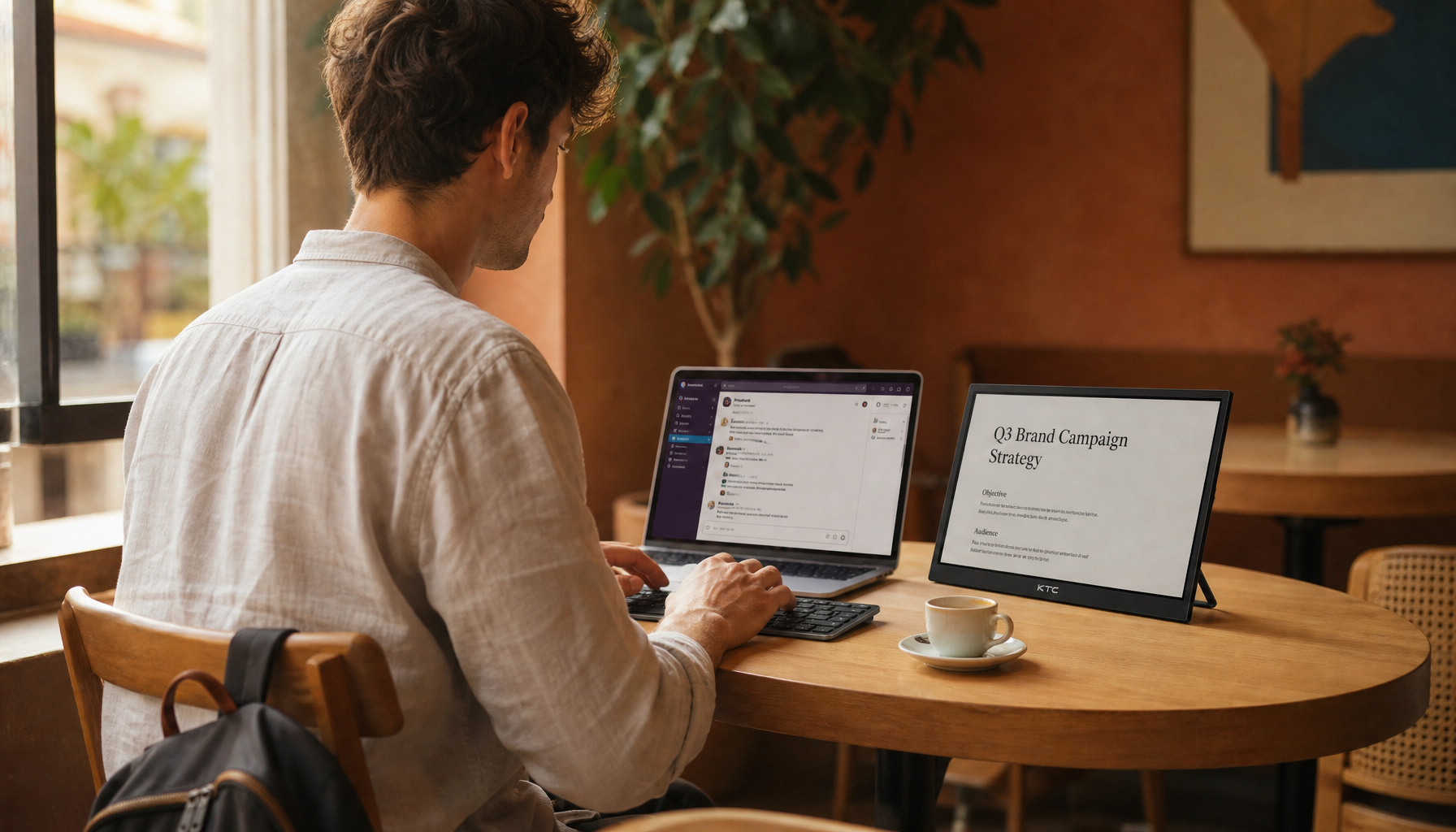
This is especially useful for hybrid setups that switch between gaming, office work, and a portable smart screen on the side. Put the main 27-inch display in the ergonomic priority position, then place the portable screen lower or to the side for reference tasks. If the side screen becomes your active work zone for long stretches, bring it closer to center instead of twisting toward it for hours.
Quick Comfort Test for a 27-Inch Monitor
Sit in your normal chair position with feet flat, back supported, and shoulders relaxed. Look straight ahead, then let your gaze drop slightly. Your eyes should land near the upper third of the screen, not above it and not near the bottom. Extend your arm; the display should be around fingertip reach or a little beyond.
Now read a dense paragraph, scan the far corners, and use your most common app for five minutes. If you lean forward, increase text size or bring the monitor slightly closer. If your neck rotates or your eyes feel overloaded by the panel width, move it farther away by an inch or two. If the base of your neck feels pinched, lower the screen. If your upper back rounds, raise the screen or bring the content closer through scaling.
Pros and Cons of Sitting Closer or Farther Back
Sitting closer can make a 27-inch monitor feel more immersive and reveal the value of 1440p or 4K sharpness. It can also improve precision in creative work or competitive gaming because small details are easier to see. The downside is that too-close placement can increase eye fatigue and make the screen edges feel busy.
Sitting farther back can reduce visual intensity and make a lower-resolution panel look smoother. It also helps some users keep a calmer posture during long office sessions. The tradeoff is readability: if the distance makes you squint or drift forward, it is no longer ergonomic.
The right answer is not the farthest distance you can tolerate. It is the distance where you can read, react, and work without changing your posture to compensate.
Final Setup Recommendation
Start with your 27-inch monitor 26 to 30 inches from your eyes, centered directly in front of you, with the top edge at or slightly below eye level. Adjust within 24 to 32 inches based on resolution, eyesight, desk depth, and task. The winning setup is the one where your head stays stacked, your shoulders stay down, and the screen feels powerful without pulling your body out of position.