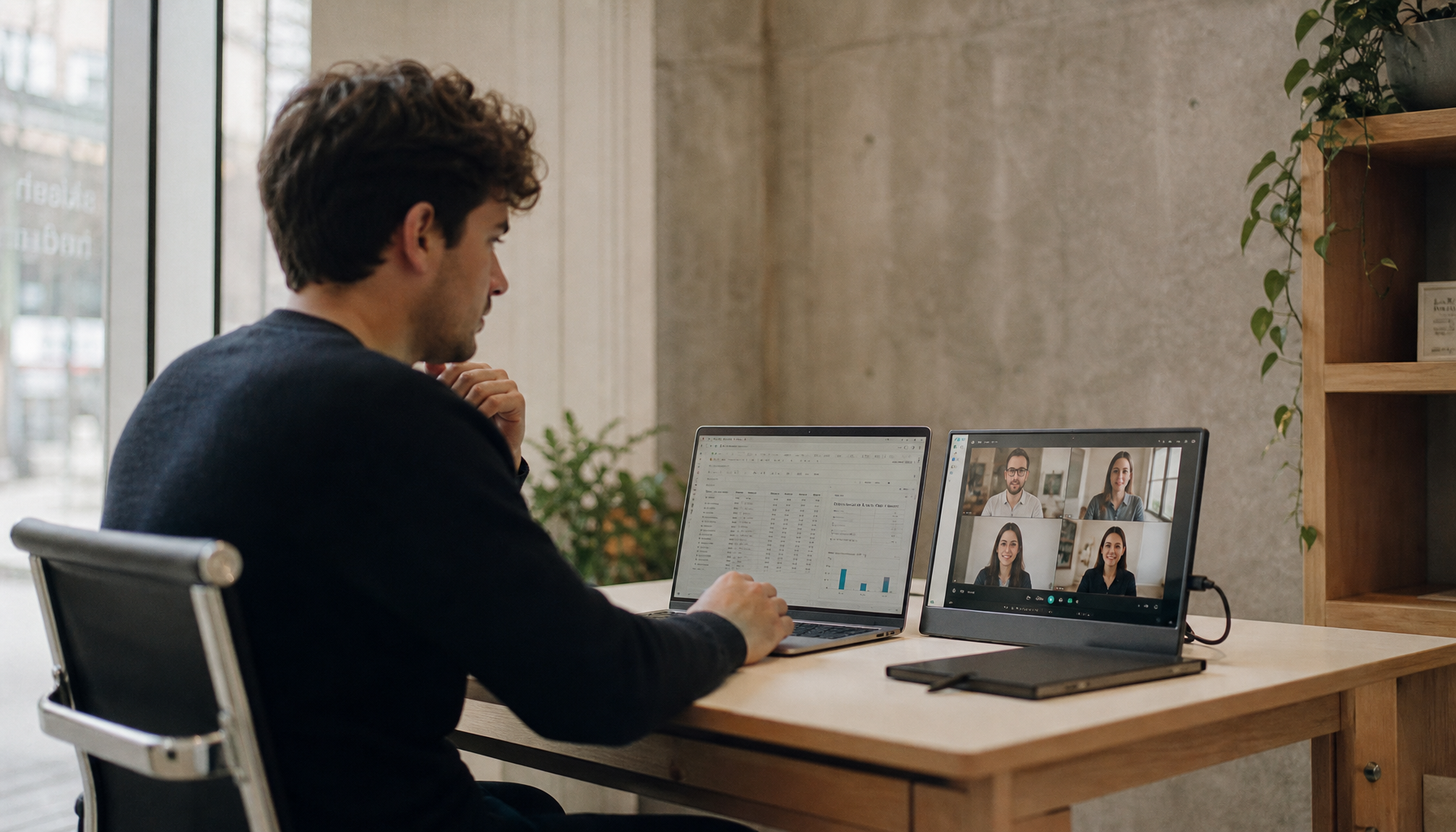
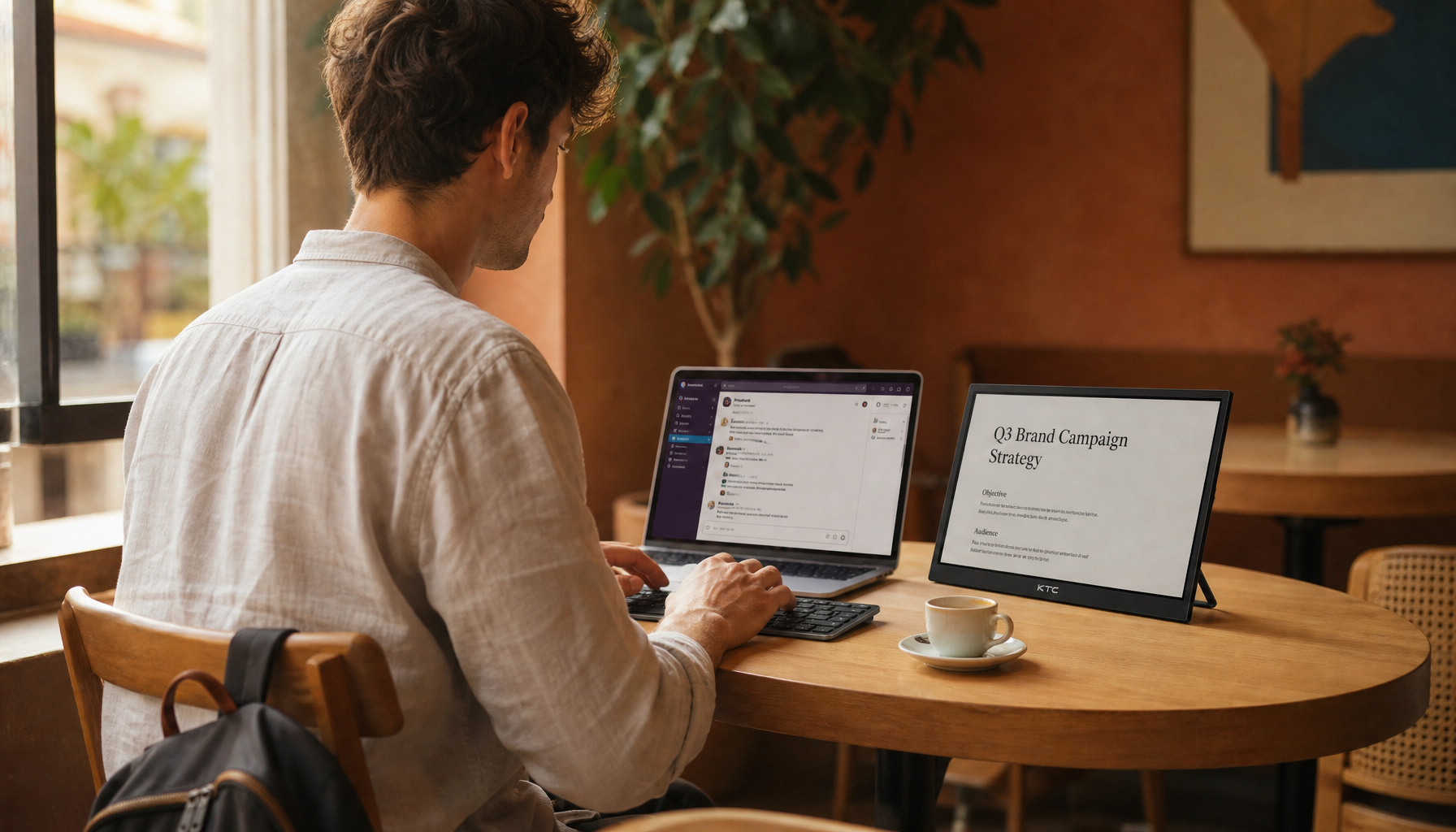
Eye strain usually comes from repeated adaptation between two screens that differ in brightness, contrast, glare, text rendering, and position, not from brightness alone.
Ever dock a laptop into a bright external monitor and feel your eyes start burning, drying out, or blurring within the first half hour? That pattern shows up often when people move from older 60 Hz office displays to newer gaming monitors or larger ultrawides, especially when the work involves reading instead of video. The good news is that the trigger is usually identifiable, and the fix is more precise than simply turning brightness down.

Why Switching Between Screens Feels Worse Than Using One Alone
Your eyes keep re-adapting
Eye strain from several hours without breaks gets worse when your eyes must constantly refocus on two different-looking images, because screen text is built from pixels and lower contrast makes that work harder. In a dual-screen desk setup, the problem is not just the laptop on the left and the monitor on the right. It is the repeated jump between a dimmer, smaller panel and a larger display that may be much brighter, cooler in color, and more reflective.

Balanced display brightness matters because a screen that is too bright behaves like a light source, while one that is too dim encourages squinting. That is why a laptop that feels fine by itself can become uncomfortable once it sits next to a 27-inch gaming monitor at a much higher apparent brightness. Your eyes are being asked to adapt every few seconds.
Dryness turns a small mismatch into a big symptom
Screen use can cut blinking to about 3 to 7 times per minute, which dries the eye surface and makes brightness changes feel sharper than they otherwise would. Once dryness is in the mix, the same brightness mismatch that looked mildly annoying at 9:00 AM can turn into burning, hazy vision, or a headache by early afternoon.
Why Reading Text Usually Exposes the Problem First
Text punishes poor contrast and scaling
Comfortable contrast around 60% to 70% and larger text often reduce strain faster than refresh-rate changes do. Reading forces your eyes to stay locked on fine detail, so a mismatch between a crisp laptop screen and a brighter external monitor with smaller-looking text becomes obvious on email, spreadsheets, and web pages long before it shows up in a game or movie.
Good lighting and text settings matter because dark rooms, harsh reflections, and tiny fonts all raise effort. A practical example is a high-refresh-rate 1440p monitor running default scaling next to a laptop that already uses larger text. The external screen may technically look sharper, but it can still feel harsher because your eyes are working harder to parse the text.
Position changes the way your eyes and neck work
A more comfortable monitor setup usually means about an arm’s length of distance, with the top of the screen at or just below eye level. If the laptop sits flat on the desk while the external monitor is higher and farther back, your focus, blink pattern, and neck posture all change as you move between them. That can make the strain feel like a “brightness problem” even when geometry is contributing just as much.

Which Monitor Traits Can Make the Jump Harder
Bigger panels and wider layouts can amplify discomfort
Preferred viewing distance of about 2 ft to 3 ft 4 in becomes more important as screens get larger, and some users report that larger displays feel less comfortable because they keep the eyes open wider and reduce tears on the surface. That helps explain why a 34-inch ultrawide or even a bright portable monitor used too close can feel worse than a smaller laptop, even when the content is identical.
High refresh rate is not a guaranteed fix
Real-world reports from new gaming monitors show that irritation can start within 15 to 30 minutes and may continue even after lowering refresh rate to 60 Hz, changing brightness, adjusting blue-light settings, and switching cables. That does not mean 144 Hz or 240 Hz monitors are bad for everyone. It means refresh rate alone is not the main variable in many eye-strain cases.
Hidden display behavior can matter for sensitive users
Repeated user reports on newer displays suggest that panel behavior, contrast characteristics, or backlight control can still bother some people after obvious settings are corrected. Those reports are not clinical proof, but they are useful buying guidance: if one monitor consistently causes symptoms while an older display feels normal, do not assume your eyes will “just adjust” if the return window is still open.
Dual-Monitor Settings That Usually Help First
Match apparent brightness, not menu percentages
Screen brightness should match ambient room light, and two displays set to the same percentage rarely produce the same amount of light. The fastest test is to open the same white document on both screens and lower the brighter one until the whites look similar from your seated position. In bright daytime rooms, both screens can come up. At night, both should come down.
Use a comfort baseline before chasing exotic causes
A more ergonomic screen position and setup reduces the load on your eyes before you start worrying about panel chemistry or backlight quirks. Start with the basics below, then use the monitor for normal reading work for a few days before deciding whether the display itself is the problem.
Parameter |
Better starting point for dual-screen comfort |
Why it helps |
Brightness |
Match both screens by eye on a white page |
Reduces constant light adaptation |
Contrast |
60% to 70% |
Keeps text readable without harsh whites |
Text size |
Reduces squinting and refocusing |
|
Distance |
About an arm’s length, roughly 20 to 24 in |
Lowers focus demand |
Height |
Top at or just below eye level |
Reduces exposed eye surface and neck strain |
Screen center |
About 10 to 15 degrees below straight ahead |
Keeps gaze more relaxed |
Color temperature |
Warmer in dim rooms, cooler in bright rooms |
Makes the image feel less harsh |
Room light |
Even front or side light, minimal glare |
Prevents reflections and light imbalance |
Breaks and blinking still matter even with a perfect monitor
Regular breaks away from the screen help because no monitor setting fully solves dryness and focusing fatigue. The classic 20-20-20 rule is still useful: every 20 minutes, look at something 20 ft away for 20 seconds. If your eyes feel especially tight, the 30-minute version is also practical: look into the distance for 20 seconds, then close your eyes for 10 seconds.
When Buying a Different Monitor Actually Makes Sense
Features worth prioritizing
Lower glare and reflections should be near the top of the shopping list, which is why matte finishes, flexible stands, and easy brightness control often matter more than headline refresh rate. For gaming monitors, look for a model that can get comfortably dim at night, not just impressively bright in a showroom. For ultrawides, make sure you can sit far enough back. For portable monitors, pay extra attention to stand position because they often end up too low and too close.
Clear product-fit failures are real
One useful forum pattern is when symptoms appear quickly on one or several new monitors but ease when the user returns to an older display. If your eyes feel normal on your laptop alone, then strained within 15 to 30 minutes on a specific external monitor despite reasonable settings, that is a product-fit signal. Panel type by itself is not enough to predict comfort, so return policy matters.
Persistent symptoms deserve an eye exam
Some cases of eyestrain need more than setup changes, especially if you are also getting headaches, light sensitivity, or blurry vision that lingers after work. Task-specific glasses, artificial tears, or treatment for an underlying vision issue may help more than another round of monitor tweaking.
Practical Next Steps
If you want the fastest path to relief, treat this like a controlled monitor test rather than a guessing game. Change one variable at a time and judge the result during normal reading, not just a quick glance at the desktop.
- Open the same white page on both screens and lower the brighter display until the two whites look close in intensity.
- Set contrast around 60% to 70% and raise text size to about 125% to 150% if you are leaning in to read.
- Move both screens to roughly 20 to 24 in away, with the top edge at or slightly below eye level.
- Remove glare from overhead lights, bright windows behind the screen, or glossy reflections on the panel.
- Use the 20-20-20 rule during work and blink deliberately when your eyes start to feel dry.
- If one monitor still causes symptoms within 15 to 30 minutes while other screens do not, stop forcing adaptation and test a different model.
FAQ
Q: Should my laptop and external monitor use the same brightness percentage?
A: No. Different panels produce very different light output at the same menu number. Match their apparent brightness by looking at the same white page on both screens, then fine-tune for the room.
Q: Do high-refresh-rate gaming monitors cause eye strain by themselves?
A: Not necessarily. Some user reports with 144 Hz to 240 Hz monitors show that dropping to 60 Hz did not fully solve the issue, which suggests brightness, glare, text rendering, panel behavior, and setup geometry can matter more.
Q: Is a larger ultrawide always worse for your eyes than a smaller monitor?
A: No, but it is less forgiving. If the screen is too close, too high, or much brighter than your laptop, the wider field of view can make dryness and refocusing more noticeable.
References
- Digital Eye Strain: Tips for a Healthier Screen Time
- 10 steps for digital eye strain relief
- Computer Vision Syndrome (Digital Eye Strain): What It Is
- Eyestrain - Diagnosis and treatment
- Dealing with Digital Eye Strain
- The best monitor settings for your eyes
- Severe Eye Strain on Modern Displays
- Eye strain with all new gaming monitors - what could it be?
- Eye-strain with new monitor - how did you deal with it?
- Gaming Monitors That Doesnot Cause Eye Strain??