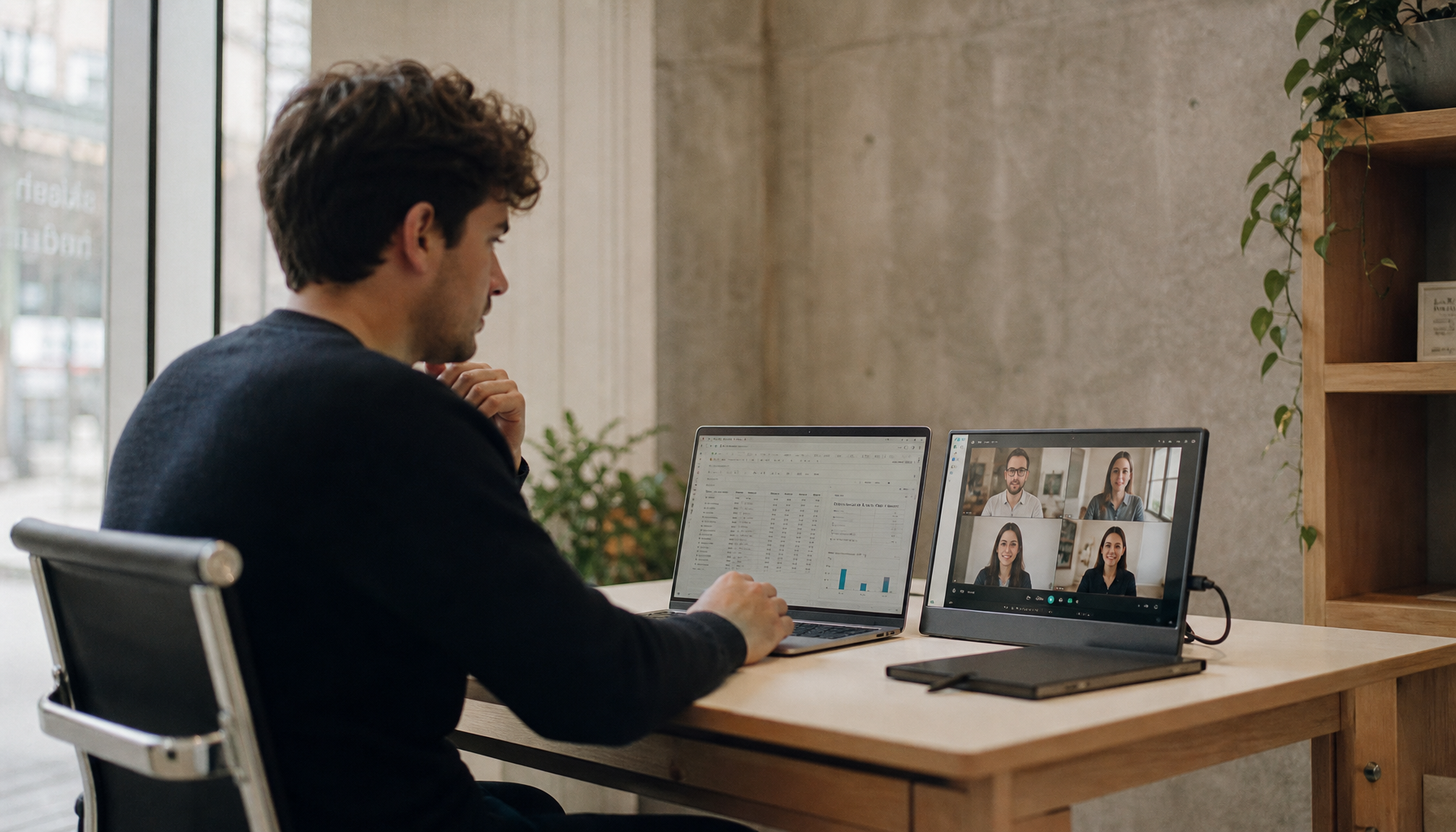
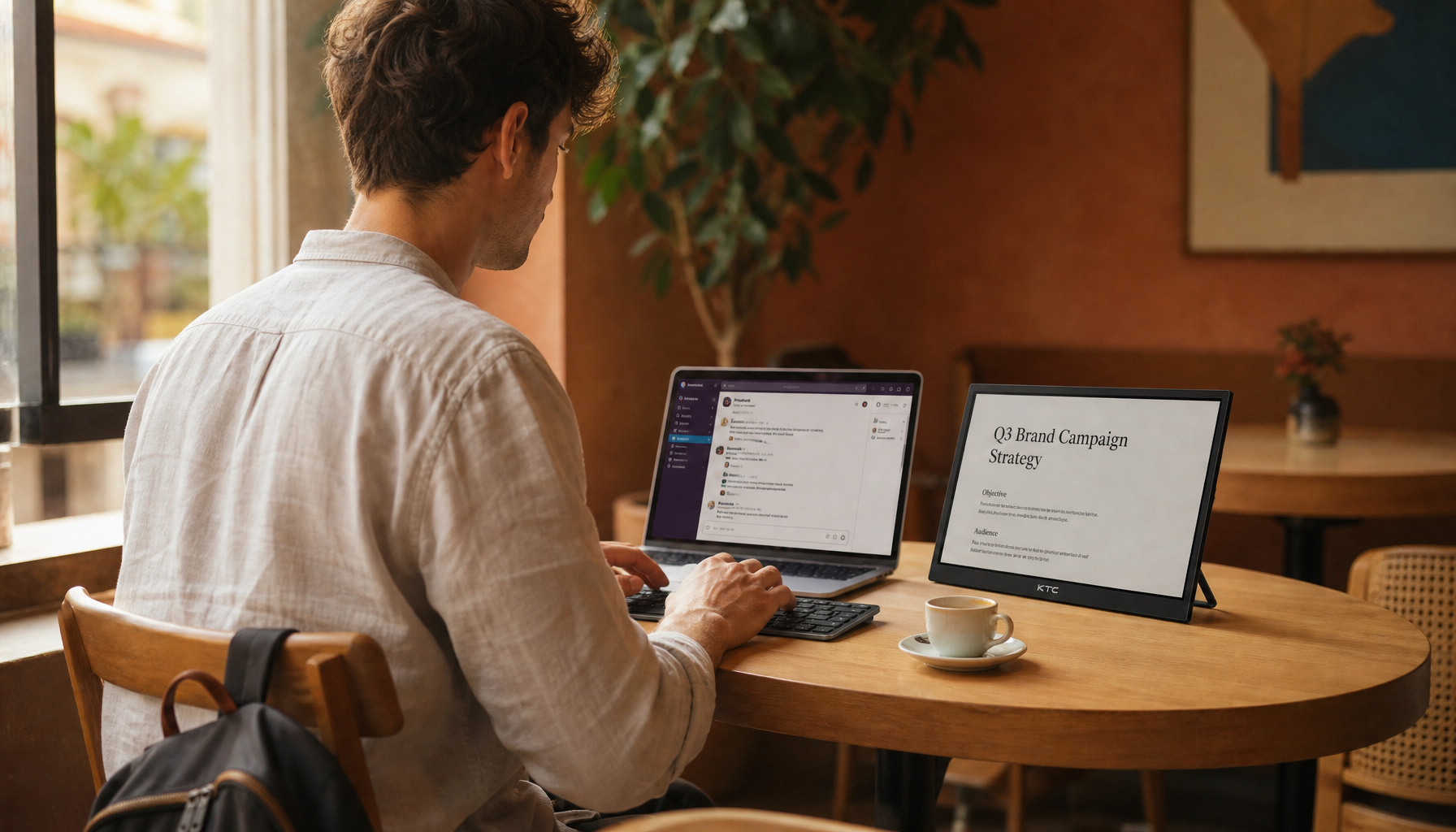
The most courteous dual-screen coffee shop setup is a compact V-shape or stacked layout built around two lightweight portable monitors with integrated or low-depth stands, short cables, and a laptop centered close to you.
Ever opened a dual-monitor setup in a coffee shop and immediately felt like you were annexing the next table? A compact portable-monitor layout can keep your screens usable without spreading past your own place setting, especially when you choose lighter 15.6-inch-class displays, low-footprint stands, and a single-cable connection path where possible. This will show you how to place the screens, pick the right monitor features, and adjust for tight public tables without turning your workspace into an obstacle course.
Start With the Most Space-Efficient Layout
Use a V-shape before you try full side-by-side
A V-shaped dual-monitor layout is usually the safest choice in a coffee shop because it reduces left-to-right spread while keeping both displays visible. Instead of pushing two screens flat across the table edge, angle them inward so the inner edges sit close together and your keyboard stays centered in the middle.

That matches ergonomic guidance for dual displays. A setup with inside edges touching and screens tilted slightly inward cuts down on repeated neck rotation, and it also keeps your gear from drifting into the neighboring seat’s visual space. For coffee shop use, that matters as much as comfort.
When one screen matters more, treat it like a primary monitor
If you mostly write on one display and park research, chat, or analytics on the other, place the primary monitor directly in front of you and set the secondary about 30 degrees to the side. That arrangement is more compact than trying to give both screens equal status on a narrow tabletop.

In practice, this works well with a laptop-plus-two-monitor triangle: laptop in the middle but slightly lower, primary portable monitor just behind or beside it, and the secondary angled inward. You stay mostly within your own shoulder width, which is a better public-space rule than chasing a perfectly symmetrical desk setup.
Use stacked only when the table is narrow but has vertical clearance
A vertical layout can save more horizontal space than side-by-side placement, but only if the stand is stable and the upper screen does not force you to crane your neck. For coffee shops, stacked works best when one display is reference-only, such as email, notes, or a dashboard.
The tradeoff is comfort. Ergonomic sources place the screen center from eye level to about 30 degrees below your line of sight, with the monitor tilted back roughly 10 to 20 degrees for a natural gaze path. If the top screen rises too high, the space savings stop being worth it.
Choose Portable Monitor Features That Keep the Footprint Small
Stand design affects how much table depth you lose
Portable monitors with built-in kickstands or magnet-mounted backs usually claim less table space than separate desktop stands. A magnetic portable monitor kickstand with a 10-inch depth already tells you how quickly rear support can consume a small café table, even before you add cables and a drink.
That is why integrated kickstands are often easier to manage in public. They reduce extra parts, lower setup time, and keep the support footprint closer to the screen body. If you do use a separate stand, keep it for a monitor that clearly benefits from extra height, not both screens.
Weight matters more with dual monitors than with one
For travel-friendly setups, many 15.6-inch portable monitors weigh about 1.5 to 2.2 lb. Once you carry two of them, plus cables and a charger, the difference between a lighter and heavier pair becomes noticeable both in your bag and on a small table.
Stability also changes with weight. A height-adjustable portable stand described by one manufacturer supports monitors up to about 2 lb and can raise a screen by roughly 15 inches. That sounds useful, but in a coffee shop it only makes sense if the monitor stays within the stand’s weight limit and the table does not wobble. Dual setups are less forgiving than single screens.
Pick specs that suit public work, not just spec-sheet bragging rights
For productivity, 1080p on a 15.6-inch portable monitor is still the practical sweet spot for cost, battery draw, and readability. If your work depends on fine detail, higher resolution can help, but it usually costs more and may increase power demands.
Brightness matters even more in a coffee shop. Around 300 nits is generally suitable indoors, while 400+ nits is the safer target near bright windows. A portable monitor with weak brightness or a glossy panel can force awkward posture changes as you chase a readable angle, which defeats the whole point of a clean dual-screen setup.
Arrange the Laptop, Cables, and Power So Nothing Spills Outward
Keep the laptop close and the screens just beyond it
A monitor distance of about an arm’s length is the core rule, but in a coffee shop you also need to protect table depth. The cleanest arrangement is laptop nearest to you, monitors just beyond it, and the keyboard centered with whichever screen gets most of your attention.
If the table is shallow, move yourself back rather than pushing the screens farther away. Ergonomic guidance for dual monitors notes that if the desk is not deep enough, a keyboard tray would normally solve that issue; in a café, the equivalent is using a compact external keyboard so the screens can sit farther back while your hands stay comfortable.
Cable length and port placement decide whether the setup feels tidy or chaotic
Portable monitors increasingly support single-cable video and power, but only if your laptop supports a standard display-output mode and has enough power available. That matters because every extra cable tends to spill sideways or forward into shared space.
Short, direct cable runs are better than looping cords across the front edge of the table. If one monitor needs a video connector and the other needs power, place the screen with the bulkier connector on the side closer to your laptop ports. That small choice can keep a cable from crossing your drink, your mouse area, or the aisle.
Avoid outlet sprawl
Coffee shop etiquette is simple: use one outlet if you can, and do not block the one next to it with a power brick. Portable monitors are attractive partly because they are low-power and designed for travel work, but dual displays still add load and charger clutter.
If your laptop can power one or both monitors over a single-cable connection, that is usually the cleanest public setup. If it cannot, sit where your own charger cable stays tight to the wall side of the table instead of running across chair legs or foot traffic.
Adjust the Setup for Different Coffee Shop Tables
Small round table: prioritize depth and symmetry
On a tiny round table, two monitors spread wide look rude fast. Use the laptop centered closest to you, then set the portable monitors in a narrow V behind it. Keep both displays the same height where possible, since matching height and similar screen size reduce eye strain and unnecessary posture changes.
This is where small-bezel portable displays help. Dual-monitor ergonomics advice notes that thinner bezels let screens sit closer together, which matters more on a compact café table than on a home desk.
Narrow two-top table: favor one primary screen
If the table is rectangular but narrow, treat one monitor as primary and the second as support. Put the main screen straight ahead, angle the second inward, and keep the laptop slightly offset only if it improves cable routing. This keeps your work area compact without giving up the benefit of dual portable monitors.
A fully equal side-by-side layout is better reserved for larger tables. Even users debating much bigger dual displays on a 48-inch-by-26-inch desk run into stand-clearance issues, so a small public table gives you even less margin for error.
Window seat: prioritize brightness and glare control
Glare is one of the fastest ways to wreck a coffee shop monitor setup. Angling the screen away from windows and bright task lights reduces reflections and keeps you from hunching or twisting to read.

This is also the situation where display buying guidance matters. If you often work near natural light, a brighter portable monitor is usually more valuable than paying extra for features you will not use in public, such as touch input or a high-refresh panel intended more for gaming than spreadsheet work.
Compare the Best Layout Options for Coffee Shop Use
Layout |
Best Use Case |
Table Footprint |
Comfort |
Main Risk |
Two monitors used regularly |
Small to medium |
High |
Can still feel wide if screens are too large |
|
Primary + angled secondary |
Writing, coding, research |
Small |
High |
Secondary screen may get less viewing time |
Stacked |
Very narrow tables |
Small side-to-side, taller overall |
Medium |
Upper screen can sit too high |
Flat side-by-side |
Large table only |
Largest |
Medium to high |
Most likely to invade neighbor space |
The practical winner for most coffee shop sessions is the narrow V-shape with lightweight 15.6-inch-class screens, especially if both monitors have integrated stands or very shallow support bases. Side-by-side only starts to make sense when the table is clearly larger than what you would normally claim in a shared café.
Action Checklist
- Choose two portable monitors that stay under about 2 lb each and support single-cable video if possible.
- Use integrated kickstands or shallow stands before packing bulky desktop-style supports.
- Center the main screen in front of you and angle the second screen inward rather than spreading both flat.
- Keep the screens at the same height when possible and tilt them back about 10 to 20 degrees.
- Route cables toward the laptop side, not across the front edge of the table.
- Sit away from direct glare and use one outlet without blocking access to the next one.
FAQ
Q: Is a stacked dual portable monitor setup better than side-by-side in a coffee shop?
A: Usually yes for table width, but only if the upper screen stays within a comfortable viewing angle. If you have to lift your chin to use it, a narrow V-shape is the better compromise.
Q: What portable monitor size is easiest to manage on a café table?
A: For most people, 15.6 inches is the sweet spot because it balances usable screen space with travel weight, setup speed, and a smaller physical footprint than 17-inch-plus models.
Q: Do I need high refresh rate portable monitors for coffee shop productivity?
A: Not usually. For writing, browser work, spreadsheets, and general multitasking, brightness, stand stability, cable simplicity, and readable 1080p or 1600p resolution matter more than refresh rate. A higher-refresh portable panel is more relevant if you also want a travel gaming monitor.
Final Takeaway
A good dual portable monitor coffee shop setup is less about squeezing in the biggest screens and more about controlling footprint. Keep the layout narrow, choose lighter monitors with low-depth stands, prioritize single-cable connectivity, and position the primary display directly in front of you.
If you can open both screens, keep your drink on the table, and leave the next chair and outlet unbothered, you arranged the setup correctly.