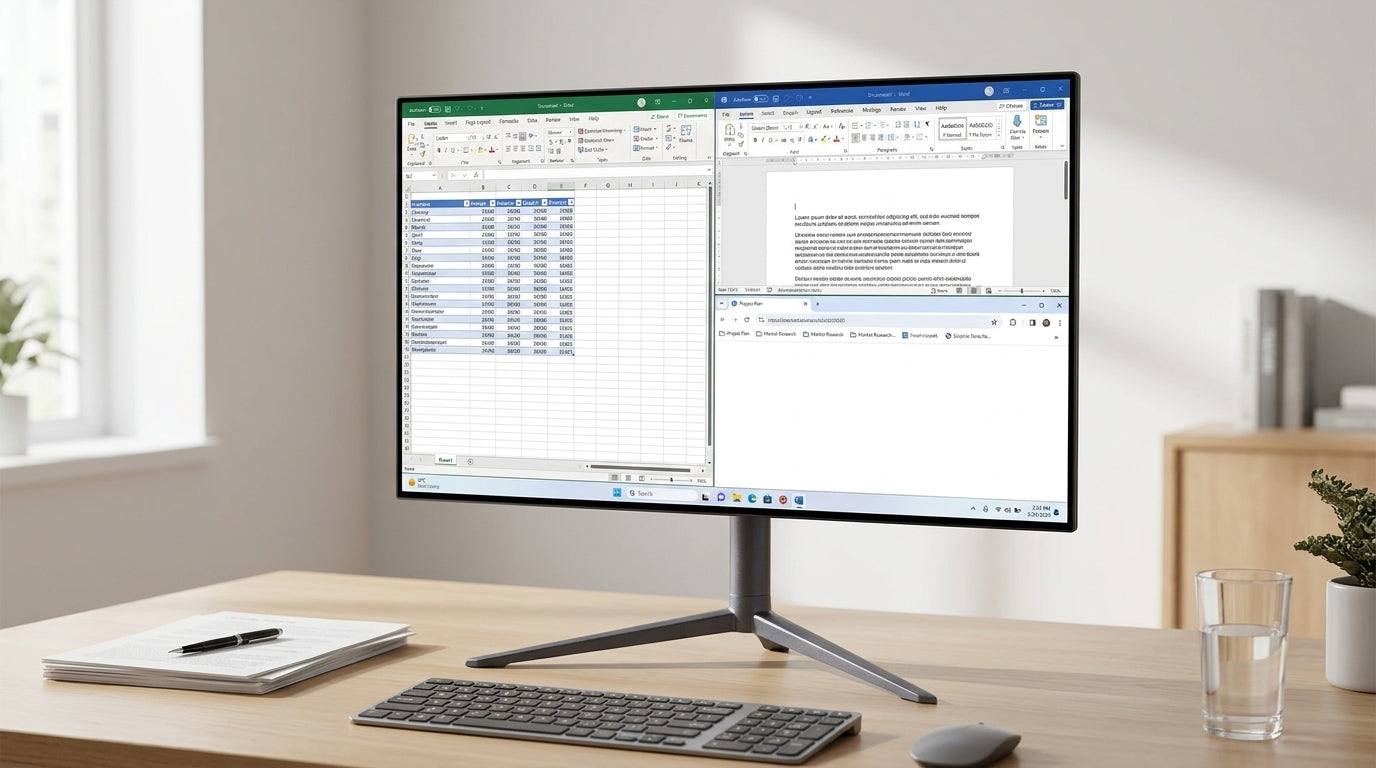
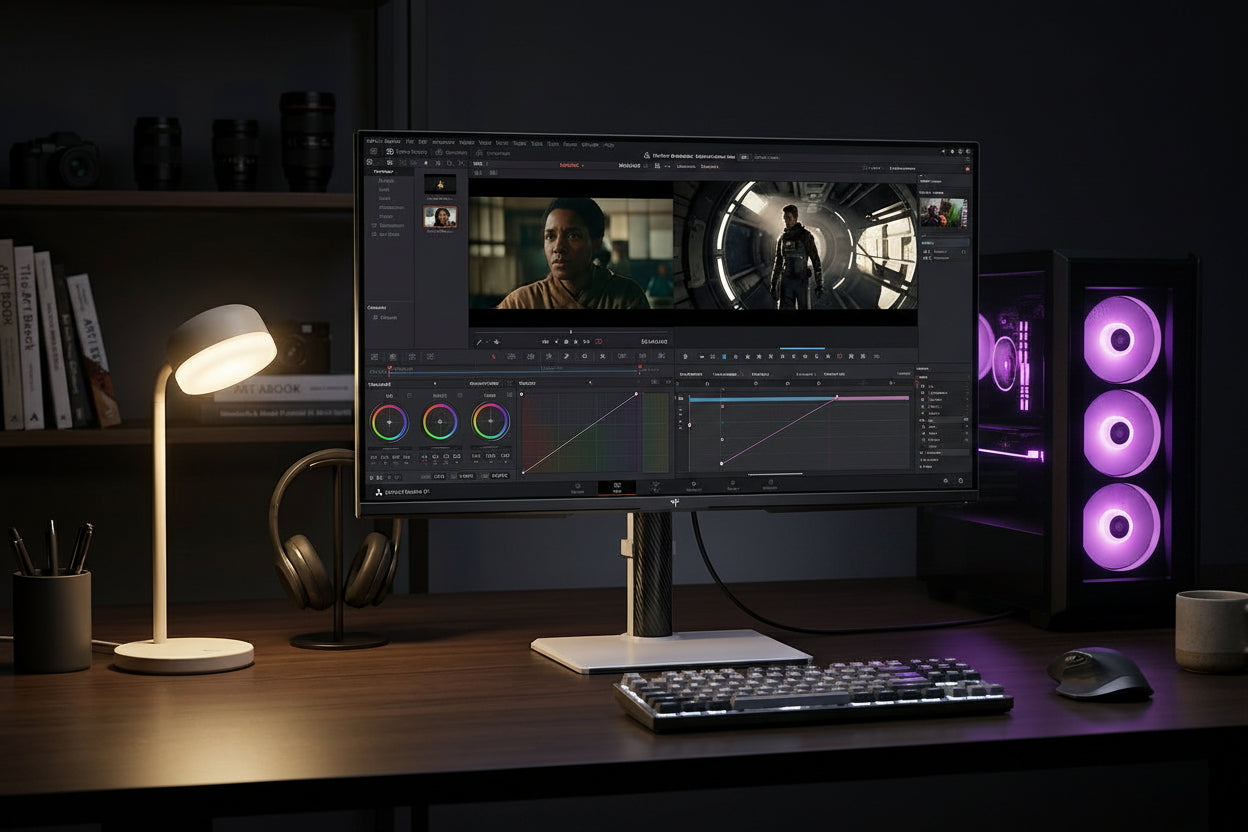
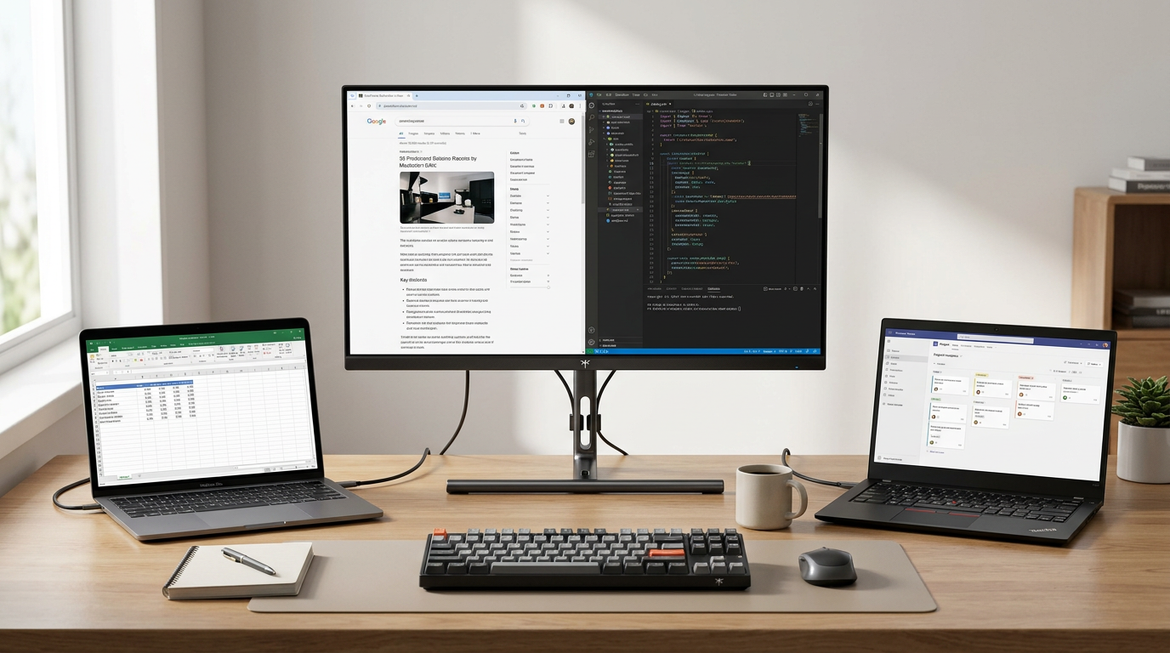
Prompt engineers constantly switch between crafting detailed instructions, reviewing dense model outputs, scrolling through lengthy logs, and cross-referencing documentation. The right monitor can meaningfully reduce cognitive load by improving text density for side-by-side reading or motion clarity for rapid skimming. For most users the decision comes down to operating system and primary workflow: Mac users usually gain more from 5K resolution that aligns with integer scaling, while Windows users and those doing heavy scrolling often benefit more from a high-refresh 4K panel that reduces eye fatigue during motion.

The AI Workflow: Balancing Prompt Density and Visual Clarity
Prompt engineering is a hybrid activity. You spend time writing and refining prompts in an IDE or web interface, then rapidly scan long context windows, chat histories, or generated logs to spot patterns or errors. Effective reading speed depends heavily on having enough characters visible per line without forcing tiny text or constant horizontal scrolling. High-resolution displays help here by allowing wider, side-by-side window arrangements while keeping text legible.
Research on reading efficiency shows that a minimum character count per line is needed for maximum reading speed, and larger high-resolution canvases make it easier to tile documentation, code, and model output without shrinking fonts to uncomfortable sizes (https://pmc.ncbi.nlm.nih.gov/articles/PMC7720185/). For prompt engineers this means fewer interruptions and lower mental effort when comparing outputs or iterating on prompts.
That said, resolution alone is not the full picture. Many workflows also involve fast vertical scrolling through thousands of lines. Here the monitor's refresh rate and how the panel handles motion become relevant factors in daily comfort.
5K vs. 4K for AI Development: The Scaling Factor
The practical difference between 5K and 4K for text-heavy AI work is strongly tied to your operating system. macOS is optimized around a 218 PPI “Retina” standard, which a 27-inch 5K panel delivers exactly. This allows clean integer scaling that keeps text and UI elements sharp without interpolation artifacts.
A 27-inch 4K panel, by contrast, sits at roughly 163 PPI. On macOS this often forces non-integer scaling choices that can produce slightly soft text or shimmer during scrolling. Many Mac users notice increased fatigue during long sessions of prompt writing and review, though individual sensitivity varies and some do not perceive the difference without a direct side-by-side comparison.
Windows 11 handles fractional scaling on 4K displays more gracefully for most users, delivering sharp text and code at 150% or similar settings. This makes a good 4K monitor a cost-effective choice for Windows-based prompt engineers who want high pixel density without paying the 5K premium.
In hybrid Mac/Windows or KVM setups the clarity gap can become noticeable: the Mac side may feel more tiring on a 4K screen while the Windows side looks excellent. For Mac-focused prompt engineers a 5K panel such as the KTC H27P3 therefore often justifies the higher cost. Windows users can usually achieve comparable productivity with a high-quality 4K model at roughly half the price.
If you run a mixed environment, test scaling behavior in your specific applications before committing. The vertical versus horizontal dual-monitor productivity setup guide offers practical advice on arranging multiple displays for prompt engineering workflows.
The Skimming Tax: Why 120Hz Matters for Prompt Engineers
Prompt engineering rarely involves only static reading. Much of the day is spent rapidly scrolling through model responses, debug logs, documentation, or long-context chats. At a standard 60 Hz refresh rate, fast-moving text can blur, forcing your eyes to pause and re-focus each time you stop scrolling. This repeated tracking effort adds up over hours and contributes to end-of-day fatigue.
Studies on visual tasks demonstrate that increasing refresh rate to 120 Hz or higher significantly improves motion perception and reduces the effort required for the eyes to track moving elements (https://pmc.ncbi.nlm.nih.gov/articles/PMC8777290/). For prompt engineers this translates into smoother “active skimming” — the ability to keep reading and spotting keywords even while the content is moving.
The benefit is most pronounced in workflows dominated by rapid navigation rather than meticulous static reading. A 4K 120 Hz or higher monitor can therefore deliver lower overall cognitive load than a 5K 60 Hz panel when your day consists of heavy log review or iterating through streaming outputs. The advantage remains somewhat subjective; users with lower sensitivity to motion blur may notice less difference.
High refresh also pairs well with the pixel-density comfort findings that higher-PPI displays (above roughly 132 PPI) are associated with fewer reports of headaches and physical fatigue during extended sessions (https://www.sciencedirect.com/science/article/abs/pii/S0141938216301494). A 27-inch 4K panel at typical viewing distance already sits comfortably above that threshold for most users.
Many who experience digital eye strain during long coding or prompt sessions find relief by combining higher refresh rates with proper ergonomics and lighting. The guide to remedying digital eye strain explores additional practical steps that complement monitor choice.
OS-Specific Scaling and Text Clarity Risks
Beyond raw resolution and refresh rate, several panel-level factors affect real-world comfort for prompt engineering. Mini-LED backlights deliver excellent contrast and brightness, but local dimming zones can create haloing or blooming around bright text or cursors on dark backgrounds common in IDEs. This often leads to a “toggle tax” — repeatedly entering the on-screen display menu to disable local dimming for work and re-enable it for media or gaming.
Standard IPS panels with conventional RGB subpixel layouts generally provide the cleanest character edges for code and documentation. Non-standard subpixel arrangements or OLED can sometimes introduce slight color fringing on fine text elements such as punctuation or syntax highlighting.
USB-C connectivity is convenient for single-cable Mac setups, yet some monitors exhibit wake-from-sleep inconsistencies that require unplugging and replugging. These practical frictions matter more in daily workstation use than marketing specifications suggest.
Choosing the Best Monitor for Your Setup
Start by identifying your dominant OS and workflow. Mac users doing dense, static prompt and documentation work will usually be happiest with a 5K panel that matches the Retina scaling sweet spot. The KTC H27P3 delivers native 5K sharpness, wide color coverage, and solid ergonomics for creator-style desks, making it a strong fit despite the premium price.
Windows users or those whose days involve substantial rapid skimming of logs and outputs should lean toward a high-refresh 4K monitor. The KTC H27P6 (or the similar H27P22S) provides 160 Hz capability in 4K, full ergonomic adjustment, and strong color performance that supports both productivity and occasional media consumption. These models let you maintain sharp text density while gaining the motion clarity that reduces scrolling fatigue.
Hybrid users should weigh the convenience of a single high-refresh 4K monitor against the clarity advantage a dedicated 5K Mac display can offer. If your setup includes Mini-LED, plan for occasional local-dimming adjustments when switching between dark-mode coding and brighter content.
For even more horizontal workspace, a super-ultrawide such as the KTC H49S66 can replace multiple windows with a single expansive canvas, though the curved form factor and 32:9 aspect ratio require desk space and adjustment time. Budget-conscious buyers may start with the KTC H27P27 4K 60 Hz office monitor and upgrade later once workflow patterns become clear.
Additional practical advice on subpixel layout effects and syntax highlighting visibility can be found in why some monitors make syntax highlighting look washed out and the explanation of RGB versus other subpixel layouts. The how a USB-C monitor can streamline your workspace article also covers connectivity considerations for prompt engineering stations.
The chart below visualizes typical fit levels across operating systems and workflow types.

Decision Framework for Prompt Engineering Monitors
Use this structured check to match a monitor to your needs rather than chasing the highest specification on paper.
Step 1: Identify your primary OS. If you work mainly on macOS, strongly consider a 5K model to avoid scaling-related softness. Windows users can safely choose 4K and allocate budget toward higher refresh instead.
Step 2: Map your dominant daily task. Dense static reading and meticulous prompt crafting favor maximum pixel density and stable sharpness. Rapid skimming of logs, streaming outputs, or long chats benefits more from 120 Hz or higher refresh that keeps text trackable in motion.
Step 3: Assess your tolerance for practical trade-offs. Are you willing to manage occasional local-dimming toggles on a Mini-LED panel? Do you need full ergonomic adjustment or is basic tilt sufficient? Will a single-cable USB-C setup be disrupted by wake-from-sleep quirks?
Step 4: Match to available options. For Mac clarity the H27P3 stands out. For balanced Windows or mixed high-velocity work the H27P6 or H27P22S deliver strong motion performance at attractive prices. Ultrawide models like the H49S66 suit users who prefer one expansive canvas over multiple tiled windows.
When to choose differently. If your workflow is almost entirely static documentation with minimal scrolling, a lower-cost 4K 60 Hz office monitor such as the H27P27 may be perfectly adequate. Conversely, competitive coders or those running GPU-intensive local models may prefer a dual-mode high-refresh panel even if it sacrifices some static pixel count.
Revisit this framework every six to twelve months as your prompting tools and habits evolve. The monitor that felt ideal during initial experimentation may no longer match a workflow that has shifted toward heavier log analysis or larger context windows.
Do 5K Monitors Improve Prompt Engineering Productivity?
They can for Mac users who spend most of their time on dense static reading, because native integer scaling removes blur and reduces fatigue. The productivity gain is smaller on Windows, where good 4K panels already deliver excellent clarity at lower cost. The improvement is most noticeable when comparing side-by-side rather than in isolation.
Does Higher Refresh Rate Help When Reading Code and Text?
It reduces the visual effort required to track fast-scrolling content, which lowers cumulative eye strain during long sessions of skimming logs or model outputs. The benefit is greater for rapid-navigation workflows than for slow, deliberate reading. Not every user perceives the difference equally.
How Important Is macOS Scaling for AI Developers?
It is one of the largest practical factors. macOS performs best at its 218 PPI Retina target; deviating from that on a 27-inch 4K screen often forces compromises that affect text sharpness and long-term comfort. Windows users face fewer scaling-related issues with the same hardware.
Should Prompt Engineers Buy Mini-LED Monitors?
Only if the contrast and brightness advantages outweigh the potential haloing around text in dark IDE themes. Many find the need to toggle local dimming between work and entertainment modes annoying enough to prefer standard IPS panels for pure productivity use.
What Monitor Size Works Best for Side-by-Side Prompt Work?
A 27-inch 4K or 5K panel usually provides the right balance of real estate and pixel density for tiling an IDE, documentation, and chat window. Larger 32-inch or ultrawide options add workspace but can require more desk depth and may push text farther from optimal viewing distance.
How Does Pixel Density Affect Eye Strain in Long AI Sessions?
Higher pixel density above roughly 132 PPI is linked to fewer reports of headaches and physical discomfort during extended reading. Combined with proper lighting, posture, and higher refresh rates, it forms one part of a broader strategy for sustaining comfort across multi-hour prompt engineering days.