UE5 VR developers need a desktop monitor with at least 4K resolution, HDR1000+ peak brightness, and hardware sRGB clamping to accurately preview Lumen global illumination, Nanite geometry, and headset-matched colors without introducing errors that extend build-and-deploy cycles. General-purpose gaming or office displays often fall short on sustained brightness or color modes, leading to lighting misjudgments or texture surprises in the headset.

Why Your UE5 VR Workflow Demands a Specialized Desktop Monitor
VR development in Unreal Engine 5 is a high-duty-cycle task. Developers routinely spend eight or more hours with static editor panels such as Details, Blueprints, and Content Browser visible alongside intense lighting previews. Standard office displays cannot reproduce the high-dynamic-range output or dense geometry that current VR headsets deliver, which forces more frequent headset testing and increases iteration time.
The practical goal of a dedicated workstation monitor is to shrink those "build and deploy" loops by giving you a trustworthy desktop representation of the final VR experience. Without accurate preview capability, small lighting or material errors compound across a scene and only surface during headset validation. This section establishes the baseline decision layer: if your workflow involves daily Lumen adjustments, Nanite asset auditing, or cross-headset color matching, a specialized monitor becomes a productivity tool rather than a luxury. Developers who only prototype occasionally or work primarily in lighter scenes may still manage with a high-quality 4K IPS panel, but those pushing visual fidelity should prioritize HDR capability and precise gamut control first.
Resolution and Nanite: Why 4K is the Baseline for VR Asset Auditing
Nanite virtualized geometry in UE5 lets artists import film-quality assets with enormous polygon counts. On a desktop monitor, 4K resolution (3840×2160) is the minimum that lets technical artists see sub-pixel texture detail and geometry density before those assets reach the headset. At 1440p, subtle aliasing or level-of-detail (LOD) transitions can remain hidden until the VR preview, leading to late-stage rework.
Pixel density (PPI) matters more than raw screen size for micro-texture and shader work. A 27-inch 4K panel delivers roughly 163 PPI, which is sufficient to inspect fine details without zooming excessively. This requirement is non-negotiable for high-fidelity VR projects; lower-resolution monitors should be treated as budget alternatives only when the target headset itself runs at 1440p-class rendering. Epic's official Nanite documentation confirms that the system's virtualized mesh streaming benefits significantly from high pixel counts during authoring.
For most UE5 VR developers, start your search by confirming the monitor is native 4K. If your GPU already struggles to drive the editor at 4K, consider a dual-mode 4K/1080p panel that can drop resolution for real-time editor performance while retaining pixel density for asset inspection.
Mastering Lumen: Balancing Peak Brightness with the 'Halo Struggle'
Lumen global illumination in UE5 relies on HDR metadata to produce realistic specular highlights and indirect lighting. A monitor certified to VESA DisplayHDR 1000 or higher provides the 1,000+ nits of peak brightness needed to preview these effects without clipping. Lower-tier HDR400 panels wash out bright areas, causing developers to over-brighten scenes that then appear harsh in the headset.
The "Toggle Tax" is a real workflow friction: UE5 requires Windows HDR to be enabled before launching the editor for full support. Switching mid-session often forces a restart, so many developers leave HDR on permanently. The Windows "SDR Content Brightness" slider then becomes the primary tool for balancing bright viewports against readable UI panels. Epic's HDR display output guide details these exact editor preferences.
Mini-LED panels introduce a secondary trade-off known as the "Halo Struggle." Local dimming zones can produce slight blooming around bright UI elements against dark backgrounds. In practice, this blooming can serve as a diagnostic cue for over-exposed Lumen lighting, but it can also distract during precise material tweaks. The VESA DisplayHDR performance criteria set the industry floor for these capabilities in professional content creation.
Color Accuracy and Gamut Clamping: Matching Your Target VR Headset
Different VR headsets target different color gamuts. Meta Quest 3 primarily uses sRGB, while Apple Vision Pro leans toward DCI-P3. Developing on a wide-gamut monitor without an sRGB clamping mode causes textures to appear undersaturated or oversaturated once they reach the target device. Hardware-level gamut clamping with Delta E < 2 is therefore a calibration standard for cross-platform VR work.
A monitor offering both 95%+ DCI-P3 coverage and a dedicated sRGB mode prevents the "Gamut Trap." You can author in the wider space for high-end spatial computing projects and then clamp for Quest-compatible builds. This check should be performed before purchase: verify the monitor lists explicit sRGB and DCI-P3 modes in its on-screen display rather than relying on software emulation. Our related guide on What Delta E Values Actually Mean for Your Creative Work explains how to interpret these color-accuracy metrics in practical terms.
For developers targeting multiple headsets, the self-check is simple: open your primary headset's developer documentation, note its reference gamut, and confirm the monitor can switch to a matching mode with measured accuracy. Without this, color-critical decisions made on the desktop will not translate reliably.
Mini-LED vs. OLED: Which Technology Survives the Unreal Engine Editor?
The choice between Mini-LED and OLED hinges on daily editor exposure rather than marketing claims. UE5's static panels (Details, Outliner, Blueprints) remain on screen for hours, creating burn-in risk for OLED panels. Longevity tests show that prolonged display of high-contrast UI elements can produce visible ghosting over time, making OLED a technical constraint for generalist developers.
Mini-LED panels act as the workhorse for most UE5 VR workflows. Their sustained high brightness excels at outdoor and daylight VR scenes where Lumen must fight against bright environments. Slight blooming is the trade-off, but it rarely compromises overall accuracy when the monitor is properly calibrated. OLED, by contrast, delivers infinite contrast and true blacks that align well with dark-scene VR projects such as horror or space simulations. Reserve OLED for lighting specialists who can implement screen-saver policies and pixel-shift routines to mitigate burn-in.
A practical scenario split emerges: solo or generalist developers working across varied lighting conditions should choose Mini-LED for longevity. Artists focused exclusively on atmospheric dark scenes may accept the burn-in management overhead for OLED's contrast advantage. Our deeper comparison MiniLED vs. OLED: Which Display Technology Wins for Gaming in 2025? explores these panel behaviors in extended sessions.
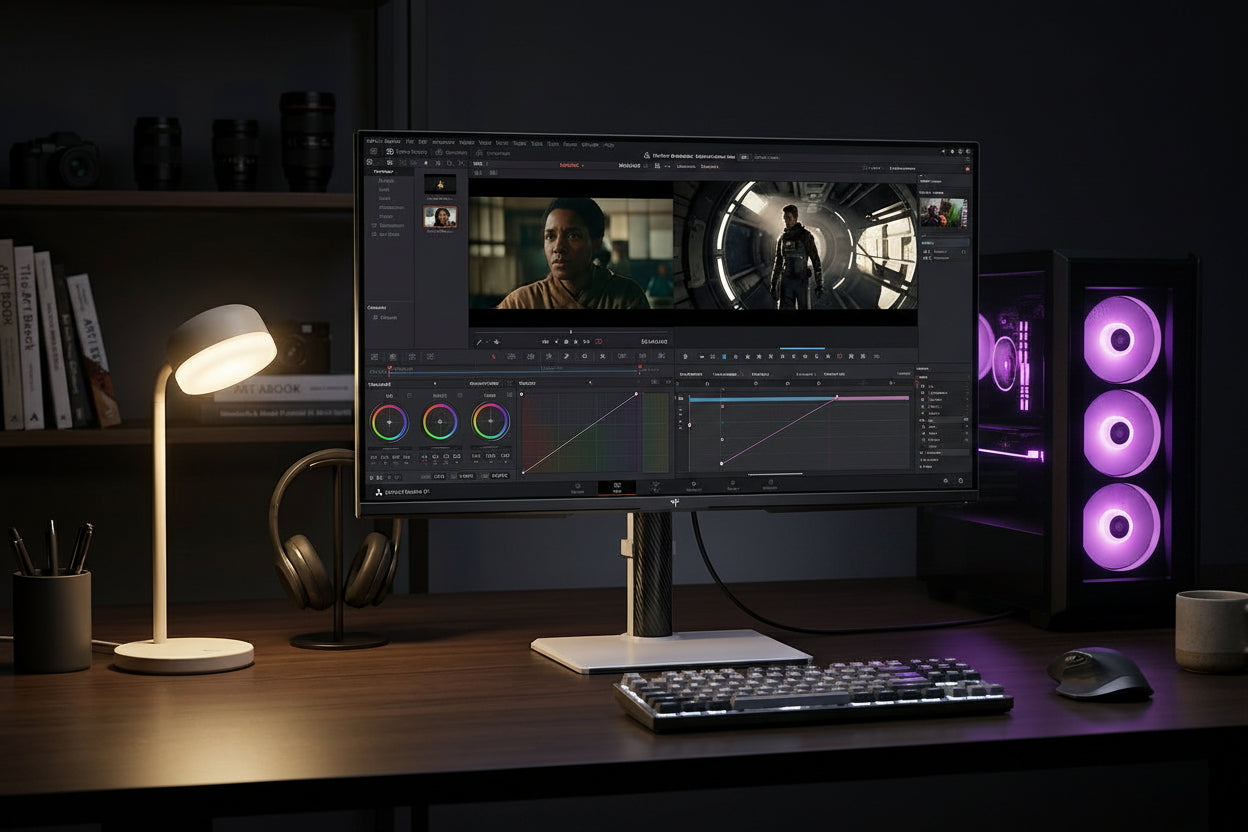
The image below illustrates the practical difference in a typical UE5 dark-scene preview.

Which Monitor Specs Matter Most for Your UE5 VR Workflow?
Use this checklist to filter options quickly:
- 4K native resolution for Nanite auditing
- HDR1000 or higher sustained brightness for Lumen preview
- Hardware sRGB clamping plus 95%+ DCI-P3 coverage
- Full ergonomic stand or VESA compatibility for long sessions
- At least a three-year warranty covering burn-in where applicable
For most generalist UE5 VR developers, a 27-inch 4K Mini-LED monitor such as the KTC M27P6 offers the strongest balance of brightness, resolution, and editor stability. The panel's 1152 local dimming zones and HDR1400 certification support accurate outdoor lighting previews while its Fast IPS base keeps text crisp.
Texture and UI-focused artists may prefer the KTC H27P6, a Fast IPS model with ΔE<2 factory calibration and no blooming. Its dual-mode 4K/1080p capability also helps maintain editor performance during complex scene work.
Developers specializing in dark-scene immersion can consider the KTC G27P6 OLED, but only if they implement strict pixel-management habits. Its infinite contrast matches headset "void" spaces exceptionally well, yet the static UE5 UI makes it less suitable for eight-hour generalist days.
Explore the broader 4K Monitor and All-Mini-LED Monitors collections to compare additional models against your specific GPU and room-lighting constraints. For deeper reading on related display technologies, see our articles on Why a Wide Color Gamut Matters for Gamers? and Mini-LED IPS vs. Standard IPS: Is the Advanced Backlight Worth the Upgrade?.
FAQs
Is 4K Resolution Required for Unreal Engine 5 VR Development?
For projects using Nanite virtualized geometry and high-density textures, 4K is the practical baseline on the desktop. It allows developers to spot aliasing and LOD transitions that 1440p can hide until headset testing. Lower resolutions remain viable for lighter prototyping or when GPU headroom is extremely limited, but they increase the risk of late-stage visual corrections. Always match your monitor resolution to the fidelity level of your target headset.
How Does HDR Brightness Affect Lumen Lighting Previews?
HDR1000 or higher certification provides the sustained brightness needed to evaluate Lumen's global illumination and specular highlights without clipping. Monitors limited to HDR400 typically force incorrect lighting decisions because bright areas appear washed out. Combine this with proper Windows HDR settings and the SDR Content Brightness slider to keep both viewport and editor UI usable during long sessions.
Should I Choose Mini-LED or OLED for UE5 VR Work?
Mini-LED is generally the safer choice for generalist developers because its lower burn-in risk accommodates the many hours of static UE5 UI panels. OLED excels in dark-scene projects where infinite contrast helps match headset void spaces, but it requires careful pixel-management habits. Evaluate your dominant lighting style and daily editor uptime before deciding; the trade-off is brightness and longevity versus perfect blacks.
Why Is Hardware sRGB Clamping Important for VR Developers?
Many VR headsets, including the Meta Quest 3, use an sRGB target gamut. A wide-gamut monitor without clamping produces oversaturated colors on the desktop that translate to undersaturated results in the headset. Hardware sRGB mode plus at least 95% DCI-P3 coverage lets you switch between authoring and validation gamuts without guesswork, reducing color-related iteration.
What Burn-In Risks Do OLED Monitors Carry in UE5?
The static nature of UE5 editor panels creates persistent high-contrast areas that can lead to image retention on OLED panels over extended use. While modern OLEDs include mitigation features, developers who keep the editor open for eight-plus hours daily face higher long-term risk compared with Mini-LED or IPS panels. Lighting specialists working primarily in dark scenes may accept this risk; generalists usually benefit from Mini-LED stability.
How Do I Calibrate a Monitor for Cross-Headset UE5 Development?
Begin by confirming the monitor offers both sRGB and DCI-P3 modes with factory Delta E < 2 accuracy. Use the on-screen display to select the matching gamut for your primary headset, then verify with UE5's color picker tools and a test build. For highest precision, a hardware colorimeter can fine-tune white point and gamma, but most developers achieve reliable results by sticking to the monitor's built-in calibrated presets and consistent room lighting.
Can a Single Monitor Serve Both UE5 Development and General Gaming?
Yes, provided it meets the stricter UE5 requirements of 4K, HDR1000+, and accurate color modes. Many current Mini-LED and Fast IPS panels include high refresh rates and low input lag that also suit gaming. The key is verifying that HDR and gamut settings remain easy to switch so you avoid the productivity cost of constant reconfiguration between creative and entertainment use.