Independent creators editing 4K video or designing graphics often need professional color accuracy and HDR performance, but flagship options from legacy brands frequently exceed $1,500–$2,000. Factory-direct Mini-LED monitors deliver the required Delta E accuracy, wide gamut coverage, and high peak brightness at roughly half the price by removing retail and brand markups. The key is understanding where this approach shines and where it introduces workflow friction that may not suit every creator.

The 'No-Brand-Tax' Advantage for Indie Creators
Many freelancers and small creative teams overpay for the badge on the bezel rather than the panel performance inside. Original Design Manufacturers (ODMs) build the core components for major brands and increasingly sell high-spec displays directly to consumers. This model removes traditional retail markups, allowing access to full-array local dimming (FALD) Mini-LED panels, high nits output, and factory calibration reports at prices that fit tighter indie budgets.
The advantage is real on paper: a monitor with 1152 dimming zones, HDR1400 certification, and Delta E under 2 can cost under $450 instead of $1,800. However, the trade-off appears in software integration, on-screen display (OSD) customization, and post-sale support. Factory-direct buyers often need to be more self-sufficient—checking calibration reports themselves, managing firmware updates, and handling returns without the concierge service some legacy brands provide. This setup works well for tinkerers comfortable with occasional manual tweaks but can frustrate those who want a completely set-and-forget experience.
For creators comparing options in 2026, the decision starts with whether your workflow justifies the hardware savings or whether the hidden management costs outweigh them. Many indie video editors find the savings transformative, while some graphic designers prefer the consistency of higher-priced ecosystems.
Spec Sheets Translated: What Creators Actually Need
Professional color work hinges on two measurable thresholds that marketing terms often obscure. A Delta E (dE) value below 2.0 is the accepted industry benchmark for color accuracy; at this level, color differences become imperceptible to the human eye in side-by-side viewing under controlled lighting. Most factory-calibrated creator monitors now ship with reports showing average dE < 2, but you should still verify the report covers your target color space—DCI-P3 for video or Adobe RGB for print and photography.
For HDR video mastering and color grading, VESA DisplayHDR 1400 sets a stricter floor. The certification requires at least 1400 nits peak luminance in small windows, combined with 95% DCI-P3 coverage and true 10-bit color processing. This combination ensures that bright highlights and deep shadows retain detail without crushing or clipping, which matters when delivering content for streaming platforms or high-end clients.
Gamut coverage tells only part of the story. Look at both coverage percentage (how much of the reference space the monitor can show) and gamut volume (how the colors are distributed in three-dimensional space). Values above 100% volume indicate the monitor can produce more saturated colors than the reference, which is useful for HDR but less critical for strict SDR print work. Treat these numbers as your non-negotiable baseline. If a monitor lacks a factory calibration report or falls short of Delta E < 2 and 95% DCI-P3, the risk of panel lottery variation increases significantly in the factory-direct segment.
See our guide to What Delta E Values Actually Mean for Your Creative Work for deeper calibration testing methods.
The Reality of Mini-LED: HDR Brilliance Meets SDR Friction
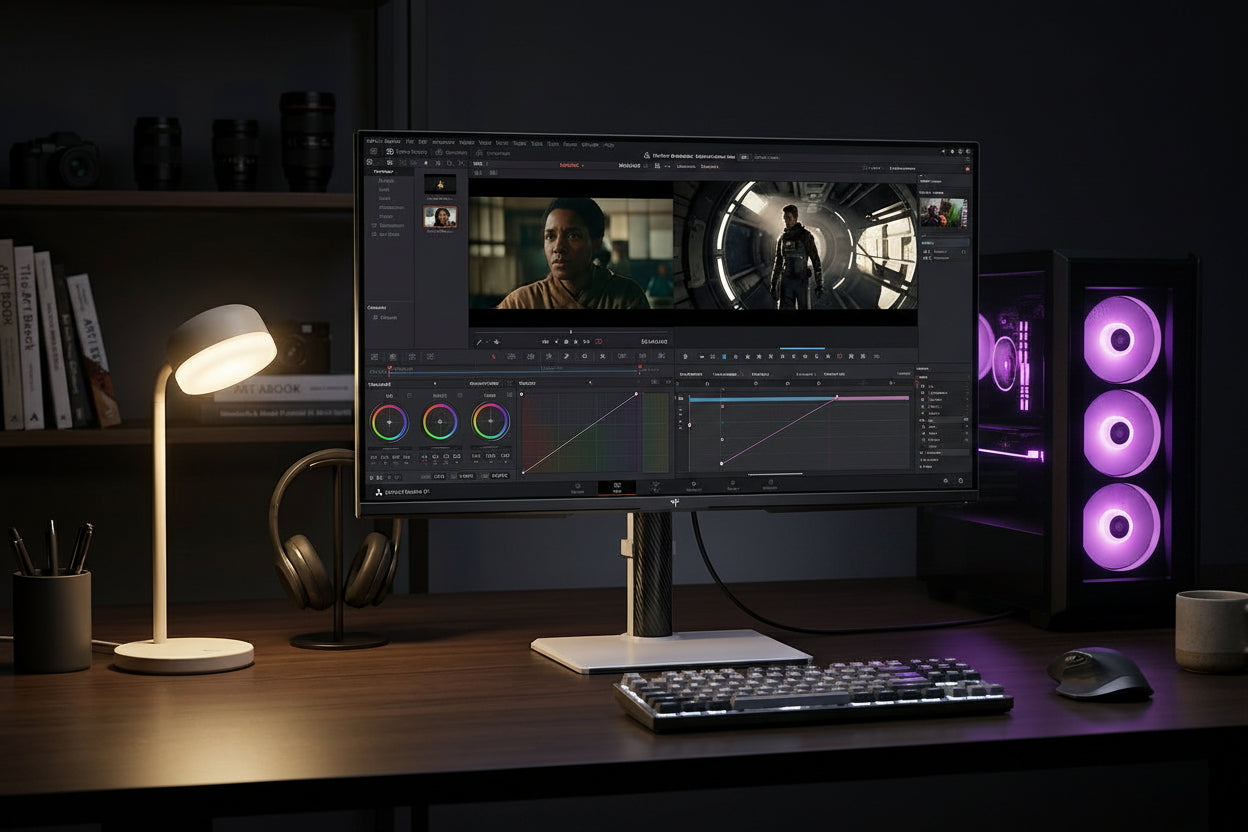
Mini-LED backlighting delivers the deep blacks and high peak brightness needed for accurate HDR mastering without the permanent burn-in risk associated with OLED panels during long timeline editing sessions. The local dimming zones—often 500 to over 1000 in current 27-inch models—create impressive contrast that makes specular highlights pop and shadow detail visible, which directly improves color grading decisions.
In standard desktop or SDR design work, however, the same local dimming creates a common frustration known as blooming. Bright UI elements or a white cursor against a dark background can produce visible halos around text and interface edges. This blooming is most noticeable in dark-mode applications and can distract during precise vector work or long coding sessions. The result is the “Toggle Tax”: many users end up opening the OSD menu multiple times per day to disable local dimming for design tasks and re-enable it for video review. Some models also show a modest increase in input lag when dimming is set to its highest aggressive level, which can subtly affect the feel of real-time timeline scrubbing.
This friction is subjective. Creators who spend 70% or more of their time in HDR timelines often tolerate the toggle because the contrast payoff is worth it. Those whose days mix design, web layout, and light video editing frequently prefer standard IPS panels that avoid blooming entirely. Weigh your actual daily split before assuming the hardware upgrade will feel seamless.
Learn more about the technology in Mini-LED IPS vs. Standard IPS: Is the Advanced Backlight Worth the Upgrade? and What “Local Dimming Zones” Mean in Monitor Backlight Technology.
Which Mini-LED Monitor Fits Your Workflow?
The right monitor depends on whether your primary output is HDR video, SDR design, or a balanced hybrid, and how much daily OSD management you will accept.
HDR-first video editors benefit most from high-zone Mini-LED models. The KTC M27P6, a 27-inch 4K panel with 1152 dimming zones and official HDR1400 certification, provides the peak luminance and black levels needed for professional mastering while staying under $450. Its factory Delta E < 2 calibration and 98% DCI-P3 coverage make it a strong match for indie color-critical timelines, provided you are comfortable toggling local dimming. Check the KTC Mini LED 27" 4K 160Hz HDR1400 Gaming Monitor | M27P6 for current pricing and calibration reports.
SDR-focused graphic designers and web creators who prioritize flawless text rendering and zero blooming usually see better results with high-resolution standard IPS options. The KTC H27P3, a 27-inch 5K panel with 99% DCI-P3 and measured Delta E < 2, delivers crisp pixel density for UI and print work without any local-dimming artifacts. Its 5120×2880 resolution at 60 Hz (or 2560×1440 at 120 Hz) suits Mac-based workflows particularly well. Explore the KTC 27" 5K@60Hz 2K@120Hz Home&Office Monitor | H27P3 if your projects stay mostly in SDR.
Value-conscious hybrids who split time between light video, design, and occasional gaming can start with 1440p Mini-LED models like the M27T6 or M27T6S series. These deliver strong HDR1000–1400 contrast and wide color volume at prices around $280 while maintaining full ergonomic stands. They represent a practical entry point when budget is tight but some HDR capability is still desired.
The chart above maps typical fit levels (3 = strong match, 1 = notable friction) across the two dominant creator workflows. It clarifies that no single technology wins universally—your tolerance for occasional OSD adjustments and your ratio of HDR versus SDR hours ultimately decide the better path. Factory-direct Mini-LED removes the brand tax on hardware but asks for a tinkerer mindset in return.
Before purchasing, confirm the monitor ships with a recent factory calibration report, verify your desk space can accommodate any blooming sensitivity, and decide whether you prefer the raw performance of Mini-LED or the seamless consistency of standard high-resolution IPS. This filtering step prevents the most common regret: buying impressive specs that do not match your actual daily workflow.
FAQs
What Does Delta E < 2 Actually Mean for Indie Video Editors?
A Delta E average below 2.0 means color errors are generally invisible to the human eye under standard viewing conditions. For indie editors, this level of factory calibration provides reliable out-of-the-box accuracy for client deliverables without immediate need for a separate hardware calibrator in most mid-tier projects. Still, color-critical mastering for broadcast or print may benefit from periodic verification with a colorimeter.
Is HDR1400 Certification Necessary for Most Independent Creators?
HDR1400 is not required for every creator, but it becomes valuable when delivering content for HDR streaming platforms or when clients review work on high-brightness reference displays. The certification guarantees both the 1400-nit peaks and the accompanying 95% DCI-P3 coverage, ensuring highlight detail survives compression. If your projects stay primarily SDR or web-based, HDR600 or HDR1000 models often suffice and cost less.
Do Factory-Direct Mini-LED Monitors Require Constant OSD Adjustments?
Many users do toggle local dimming between HDR video and SDR design modes, creating a modest daily inconvenience known as the Toggle Tax. Sensitivity varies; some creators barely notice blooming while others find it distracting in dark UI themes. Test your tolerance by using a return window, or choose a standard IPS model if text-heavy work dominates your day.
Are KTC Monitors a Good Value Compared to Apple Studio Display for Creators?
KTC factory-direct models frequently deliver superior HDR brightness, contrast, and refresh rate at one-quarter the price of the Apple Studio Display. The Studio Display wins on macOS integration, build finish, and zero blooming in SDR, but it lacks true HDR1400 capability. Indie creators whose income depends on HDR deliverables often find the KTC performance-per-dollar advantage outweighs the ecosystem polish.
Should I Buy a Mini-LED or Standard IPS Monitor for Graphic Design?
Choose standard IPS (such as 5K or high-PPI 4K models) if your work is primarily print, UI, or web design where perfect text clarity and zero blooming matter most. Opt for Mini-LED if you also handle video color grading or want future-proof HDR performance. The decision ultimately rests on your daily HDR-to-SDR ratio and willingness to manage occasional settings changes.
How Important Is Factory Calibration for Budget Creator Monitors?
Factory calibration with a provided Delta E report significantly reduces the risk of buying a panel that needs immediate adjustment. For most indie creators it removes the need for expensive external tools on day one. However, panels can drift over years of heavy use, so having access to a colorimeter remains useful for long-term professional reliability.
Can a $400 Mini-LED Monitor Really Replace a $2000 Professional Display?
In raw hardware performance—peak brightness, contrast ratio, and color volume—yes, several current factory-direct Mini-LED models meet or exceed the measurable specs of far more expensive units. The practical difference appears in software ecosystem, long-term support, and absence of SDR blooming. For many independent creators whose budgets are constrained, the savings enable faster equipment upgrades elsewhere in the studio, making the trade-offs acceptable.