Daisy-chaining and MST hubs usually do not fade color by themselves, because display interfaces carry digital image data; accuracy problems usually come from bandwidth limits, mismatched profiles, panel differences, adapters, cables, or per-display graphics settings.
Does one monitor look slightly warmer, duller, or less saturated after you add a second screen through a hub? In real setups, the fastest fix is often not replacing the monitor, but checking bandwidth, matching ports, assigning the right ICC profile, and recalibrating each display. You will leave with a practical way to tell whether the problem is the MST chain, the monitor, or the settings around it.
Why MST Usually Isn’t the Direct Color Problem
Multi-Stream Transport, or MST, lets one display connection carry independent video streams to multiple screens through a daisy-chain or hub. In a clean digital path, color data does not gradually lose saturation the way old analog VGA could. If the signal is valid, the display should receive the intended pixel values.
The catch is bandwidth. A multi-monitor chain shares the upstream link, so each screen competes for resolution, refresh rate, bit depth, chroma format, HDR metadata, and sometimes dock bandwidth. DisplayPort 1.4 is widely used for workstation multi-display layouts because it supports MST, but it still has finite effective bandwidth. When that budget is exceeded, the system may quietly drop refresh rate, disable HDR, switch bit depth, or refuse a preferred mode.

A simple example: two 27-inch QHD office monitors at 60 Hz are usually easy for a modern MST setup. Two 4K monitors at high refresh rates, wide color, or HDR are much more demanding. If one display falls from 10-bit to 8-bit output, gradients in photos, UI shadows, and game skies may show more banding even if the monitor itself has not changed.
Where Color Accuracy Actually Degrades
Bit Depth, HDR, and Compression Choices
The most common color-quality compromise in a saturated daisy-chain is not a green cast or red shift. It is a format fallback. The graphics output, dock, hub, and monitors negotiate a mode that fits the link. That may mean SDR instead of HDR, 8-bit instead of 10-bit, a lower refresh rate, or chroma subsampling on some adapter paths.
For productivity work, an 8-bit SDR fallback may be acceptable. For photo editing, design review, HDR previewing, or smooth game gradients, it can be visible. Digital display standards differ in bandwidth and feature priorities, and TV-oriented connections are often favored for single-screen media while PC-oriented connections are favored for gaming and professional monitor setups. Mixing them through adapters can make the final negotiated mode less predictable.
Setup Choice |
Typical Color Risk |
Practical Impact |
Native digital daisy-chain |
Low, if bandwidth is sufficient |
Best for matching refresh, resolution, and color depth |
MST hub to mixed display inputs |
Medium |
Adapter conversion may limit HDR, refresh, or bit depth |
Dock with video, data, and power |
Medium |
Shared dock bandwidth can force display-mode compromises |
USB graphics adapter |
Higher for color-critical work |
Compression, drivers, and latency can affect precision workflows |
VGA or legacy analog path |
High |
Interference and signal loss can visibly soften or distort the image |
Panel Variance Still Matters More Than the Hub
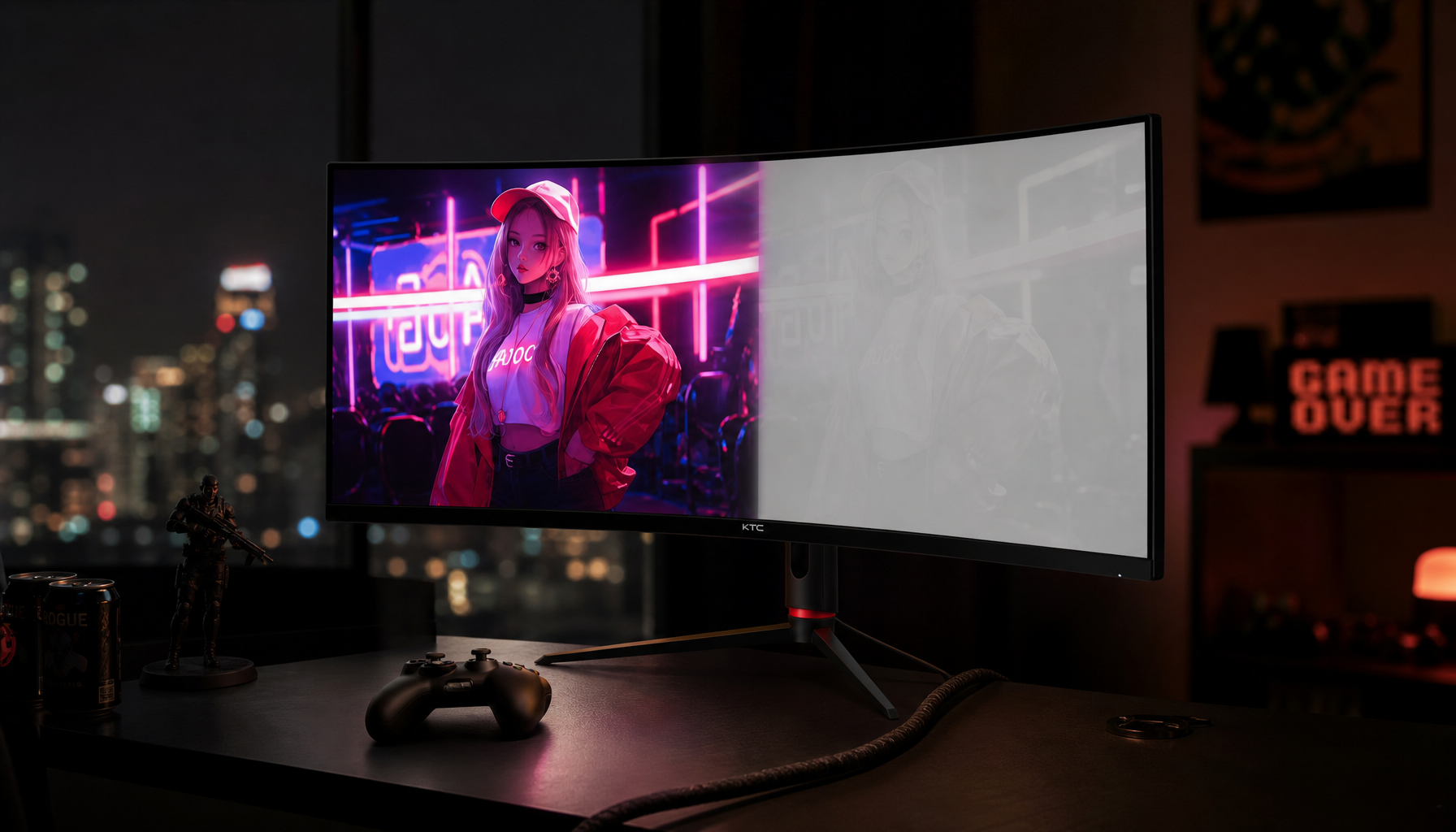
Two monitors of the same model can look different before MST enters the picture. Backlight variation, LCD polarizers, factory tuning, firmware, age, and panel uniformity can all create visible mismatch. That is why swapping monitors between ports is such a useful diagnostic: if the warmer image follows the monitor, the panel is the cause; if it follows the port or hub output, the signal path or profile is suspect.

The real-world troubleshooting pattern is consistent: compare monitor hardware settings first, then swap ports, then test identical cables. Identical monitor models can still differ because one screen may be using a different input, cable, graphics output, brightness setting, or color mode.
For a dual-monitor editing desk, “same model” is a starting advantage, not a guarantee. Reset both displays, match brightness and color temperature, turn off dynamic contrast, set both to the same color preset, then profile each panel separately.
ICC Profiles Can Break Consistency Across Displays
An ICC profile tells the operating system and color-managed apps how a display behaves. It does not physically transform the monitor into a reference display, and it does not force every app, graphics utility, or monitor OSD setting to obey the same color pipeline. Monitor calibration should cover gamma, white point, brightness, contrast, and RGB balance, then save a display-specific profile.
This matters with MST because operating systems may expose each daisy-chained display as a separate device, but users often forget to assign the correct profile to each one. If Monitor A’s ICC profile is accidentally applied to Monitor B, white backgrounds may drift pink, gray UI panels may look muddy, and skin tones may stop matching across screens.
For general office use, recalibrating every few months is usually enough. For color-sensitive work, a 4- to 6-week check is more realistic, especially if your desk lighting changes or one display runs hotter than the other.
How to Diagnose an MST Color Problem
Start with the simplest visual test: put the same neutral gray, white document, and saturated image across both screens. Let the monitors warm up for at least 30 minutes before judging, because backlights shift as they reach normal operating temperature.
Then move the same monitor to a direct graphics output. If its color improves only when bypassing the hub, the MST path is likely negotiating a different signal format. If it looks the same either way, the issue is probably panel tuning, calibration, or ICC assignment.
Next, check the operating system display panel for each monitor’s resolution, refresh rate, HDR state, and color format if your graphics utility exposes it. Each display should use its native resolution, and scaling should be adjusted so windows behave predictably across screens. Brightness and color should then be adjusted through monitor controls or system settings so the workspace feels consistent.
Finally, test one variable at a time. Use identical short certified cables where possible. Avoid chaining a high-refresh gaming display and a color-critical editing monitor through a bargain hub if both need premium modes. If a dock is involved, check whether the port supports a full video mode and whether the dock’s advertised monitor support matches your exact resolution and refresh target.

Best Practices for Color-Accurate Daisy-Chaining
Use a native digital connection from the computer to the first monitor when possible, then connect the first monitor’s output to the second. Avoid unnecessary conversion unless the display lacks a matching input. MST daisy-chaining depends on compatible ports, monitors, cables, and monitor OSD settings, so a single weak component can make a technically valid setup behave badly.

Match monitor models when you can, but prioritize panel type and use case. IPS panels remain a strong practical choice for productivity and creative work because they offer stable viewing angles and better color behavior than many budget TN or VA options. If you are building a gaming-and-editing hybrid desk, put the color-critical monitor on the most direct, highest-bandwidth path and let the secondary chat, reference, or monitoring display take the hub path.
For wide-gamut and professional displays, remember that calibration cannot fix every panel flaw. Uniformity checks can reveal brightness falloff and color cast across the panel, especially near the edges. If a monitor has poor uniformity, an MST hub is an easy suspect, but the flaw may be baked into the display.
Multiple screens are still worth the effort. A controlled multiscreen study found that a dual-monitor-plus-tablet condition had higher usability ratings than a single monitor, and 16 of 18 participants said their ideal setup included two desktop monitors. The study also supports dual desktop monitors for information-rich tasks, provided the desk is set up with sane ergonomics and consistent display behavior.
Pros and Cons of MST for Color-Sensitive Setups
MST’s strongest advantage is clean expansion. One cable from a laptop or workstation can drive multiple displays, reduce desk clutter, and make hot-desking more practical. For office productivity, coding, spreadsheets, research, and command-center layouts, that convenience is substantial.
The tradeoff is that color assurance becomes a system-level problem. You are no longer evaluating only the monitor; you are evaluating the graphics output, shared bandwidth, hub firmware, cable quality, monitor settings, OS profiles, and application color management. Research has found strong evidence that users generally prefer dual-monitor configurations, while also noting ergonomic risks from poor placement. Multiple-monitor configurations can improve workflow, but they need disciplined setup to avoid trading speed for visual inconsistency.
FAQ
Does MST Reduce Color Accuracy Automatically?
No. MST does not inherently degrade color accuracy because it carries digital streams. The risk comes from bandwidth limits, adapter conversion, mismatched monitor settings, wrong ICC profiles, and panel variance.
Is Daisy-Chaining Safe for Photo Editing?
Yes, if the chain preserves your required resolution, refresh rate, bit depth, and color space, and each monitor is individually calibrated. For mission-critical print or grading work, connect the reference display directly to the computer when possible.
Why Does One Daisy-Chained Monitor Look Washed Out?
The usual causes are a different color preset, limited RGB range, HDR mismatch, wrong ICC profile, lower negotiated bit depth, or a weaker panel. Swap the monitors between ports to see whether the problem follows the screen or the connection.
Final Word
A good MST setup should feel invisible: sharp text, stable whites, smooth gradients, and no mystery tint when you drag a window across screens. Treat the chain as a performance budget, calibrate each display as its own device, and reserve the cleanest signal path for the screen where color decisions actually matter.