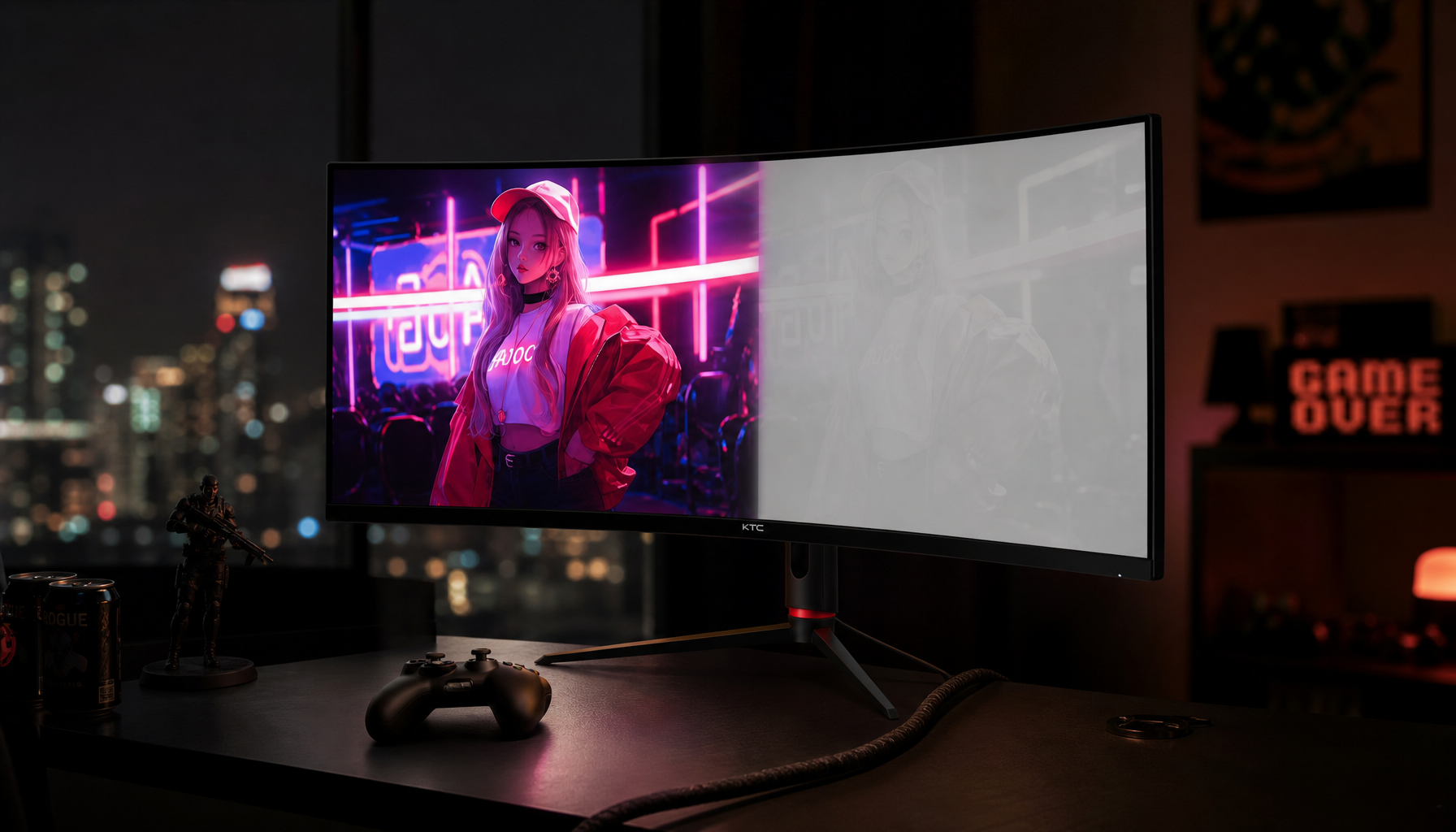
Some panels need warm-up time because their backlight, liquid crystal behavior, electronics, and white point shift as operating temperature stabilizes. The screen may look on instantly, but color-critical accuracy usually arrives later.
What Changes During Warm-Up?
A display warms up like a precision instrument, not a light switch. In the first minutes after power-on, luminance can rise or fall, blacks can settle, and whites may drift slightly warmer or cooler.
That matters because color accuracy depends on a stable target. If brightness is still moving, your calibration profile is chasing a screen that has not finished settling.
For office work, email, spreadsheets, and casual browsing, this usually is not a problem. For photo editing, brand color approval, video grading, print proofing, or matching multiple displays, it can affect real decisions.
Why Panel Type and Backlight Matter
LCD-based monitors rely on backlights, liquid crystals, and internal processing. Those parts respond to heat, so a panel can shift during the first part of a session even when the image appears normal.
IPS panels are often favored for color work because they hold color and contrast more consistently from wider viewing angles, while TN panels tend to prioritize speed and cost. This difference is part of why panel technology affects how confidently you can judge color.
OLED, mini-LED, IPS, VA, TN, and portable panels can all have different stabilization behavior. A compact portable smart screen may settle quickly enough for productivity, while a wide-gamut editing display may deserve more time before calibration.
The practical takeaway: do not assume premium means instant. Better panels can be more accurate, but accuracy still depends on stable luminance, white point, and operating conditions.
How Long Should You Wait?
For most color-sensitive work, treat 30 minutes as the useful minimum. Several calibration workflows recommend allowing the monitor to reach normal operating behavior before measuring, and display warm-up time is especially important before profile creation or validation.
Use this quick rule:
- Quick office work: no waiting needed.
- Gaming and streaming: 10 to 20 minutes is usually enough.
- Photo or video review: wait at least 30 minutes.
- Calibration or client color approval: wait 30 to 60 minutes.
- Cold room or strict matching: consider 60 minutes or more.
Motion clarity and color stability are related to temperature, but they are not the same test. A gaming monitor may feel responsive before it is fully trustworthy for color judgment.
Why Calibration Too Early Can Backfire
Calibration works best when the display is already stable. Hardware tools measure color patches, compare them to known targets, and build a profile around the screen’s current behavior.

If you calibrate too soon, the profile may be accurate for minute 8 but wrong by minute 45. That is why serious calibration advice focuses on hardware measurement, stable settings, and targets like gamma 2.2, D65 white point, and controlled brightness; monitor calibration is only as good as the conditions around it.
Keep brightness, color mode, HDR, and ambient lighting consistent during the process. Avoid direct sunlight, strong desk lamps, and HVAC airflow hitting the screen, because room conditions can shift perceived contrast and warmth.

A Reliable Warm-Up Workflow
Turn on your main display before opening color-critical files. If you use multiple monitors, wake them all together so they settle under the same room lighting.

Set the monitor to its native resolution and recommended layout before judging sharpness or UI scale. Display settings guidance notes that screens usually look best at their recommended resolution.
For a dependable setup, warm up first, then calibrate, then evaluate. That simple order protects your time, your profile, and the final look of every game capture, product image, spreadsheet dashboard, or client-ready creative file.