USB-C video on a desktop PC works only when the port is physically wired for display output. The fastest way to solve a no-signal issue is to confirm the hardware path, firmware settings, and cable all support video.
You cannot turn an ordinary USB-C port into a video output with a software switch alone. On a desktop PC, USB-C DisplayPort Alt Mode works only when the port is physically wired for display output and paired with the right BIOS setting, graphics path, and full-featured cable.
If your USB-C port charges devices and moves files but your monitor still shows no signal, the problem usually comes down to one of three causes: the port never supported video, the display path is not wired correctly, or the cable is built for charging rather than display output. In most cases, you can identify which one it is in a few minutes.
What USB-C DisplayPort Alt Mode actually means

USB-C DisplayPort Alt Mode lets a USB-C port carry native DisplayPort video and audio instead of using all of its high-speed lanes only for USB data. That distinction matters because USB-C is only the connector shape. A USB-C port may be charge-only, data-only, Thunderbolt-capable, or video-capable, and those are not interchangeable.
On a desktop PC, this is where many people lose time. A rear USB-C port on the motherboard may look premium, but if it was designed only for USB data and charging, no adapter or monitor setting can unlock video later. Alt Mode source-port requirements make the key point clearly: the source port itself must explicitly support DP Alt Mode or Thunderbolt video.
The desktop reality: you are usually verifying support, not turning it on

USB-C video is common on laptops, but on desktops it is more conditional. The simplest way to think about it is that your USB-C port needs a real display source behind it. That source may come from the CPU’s integrated graphics, from a discrete GPU routed through a Thunderbolt or USB4 controller, or from a motherboard design with DisplayPort passthrough. If that hardware path does not exist, there is nothing meaningful to enable.
A practical example makes this clearer. If you connect a 27-inch 4K USB-C monitor to a gaming tower through a random rear USB-C port and the monitor never wakes, but the same monitor works immediately over HDMI or full-size DisplayPort, the likely issue is not Windows. The USB-C port is probably functioning only as a USB port, while the real display outputs still live on the graphics card.
How to check whether your desktop USB-C port can do video

Port symbols and compatibility indicators are a useful first check. A DisplayPort-style icon or a Thunderbolt lightning symbol is a strong sign that the port may carry video, while a battery icon usually suggests charging only. If the port has no symbol, the motherboard manual or add-in card documentation is more reliable than guesswork.
The safest verification method is a live test, but it requires a known-good signal chain. That means a monitor with USB-C display input or a proven USB-C-to-DisplayPort adapter, plus a cable explicitly rated for video. If the product listing says only “fast charging,” “sync and charge,” or “480 Mbps,” USB-C cable video support suggests treating it as the wrong cable for monitor output.
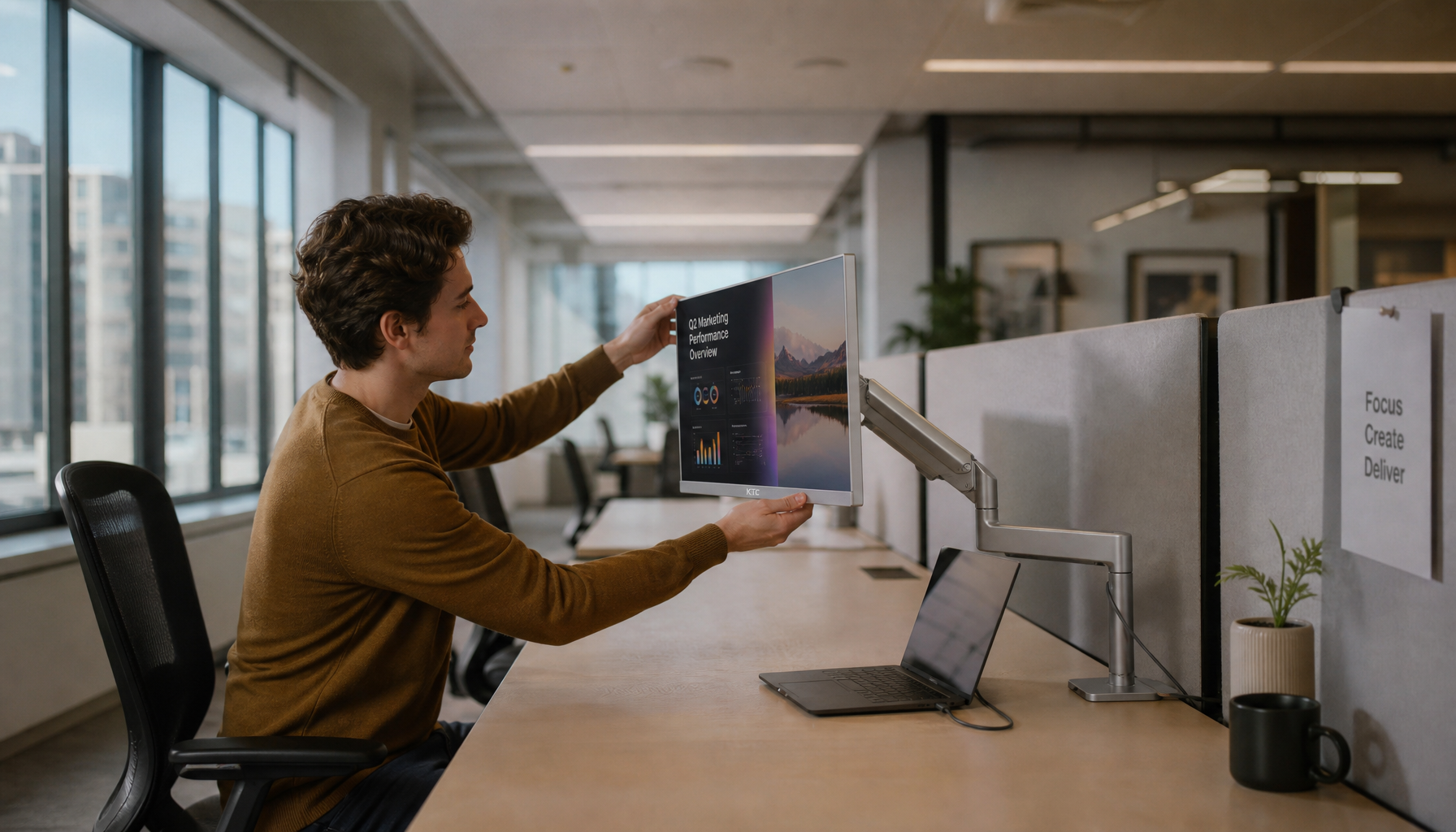
Monitor type also matters. A portable smart screen or slim USB-C productivity monitor usually expects a true video-capable USB-C source, not just power. One-cable display, data, and charging depend on the host device supporting Alt Mode in the first place.
What you may need to turn on in BIOS or firmware

BIOS-level display path settings can affect whether USB-C or Thunderbolt video output works correctly. The exact menu names vary by motherboard vendor, but the basic idea is consistent: firmware must allow the graphics signal to reach the USB-C or Thunderbolt controller. Depending on the platform, this may appear as Thunderbolt enablement, USB4 settings, integrated graphics multi-monitor support, or a DisplayPort routing option.
This is easy to miss on a desktop with a discrete graphics card. If your USB-C or Thunderbolt add-in card requires a DisplayPort input cable from the GPU header or a rear DisplayPort output, you must complete that passthrough path first. Without it, the USB-C port may show up as a data port while never producing a picture. In practice, that feels like a dead monitor connection even though the real cause is incomplete internal wiring.
Driver and firmware updates still matter, but they are not magic. They help with stability, resolution support, and dock behavior. Keep the order straight: first confirm the hardware path exists, then update the BIOS, graphics drivers, chipset drivers, Thunderbolt software if applicable, and monitor firmware if the display maker provides it.
The cable problem is bigger than most people think

Not all USB-C cables support video, and this is one of the most common mistakes in display setups. A cable that charges a headset, cell phone, or handheld console can still fail completely with a monitor. For desktop use, especially at 1440p with a high refresh rate or 4K at 60 Hz and above, shorter cables with clear video specifications are usually the safer choice.
Display bandwidth tradeoffs over USB-C explain why behavior can vary. Two-lane mode can preserve faster USB data while carrying one 4K 60 Hz display, while four-lane mode gives the display more bandwidth but may reduce USB data capability to USB 2.0. On a desk, that means a USB-C dock may behave differently from a direct USB-C monitor connection even with the same PC. If you are driving a fast gaming panel, a direct connection often avoids unnecessary negotiation and bandwidth compromises.
Setup path |
Strength |
Tradeoff |
Direct USB-C to USB-C monitor |
Clean single-cable connection |
Requires a truly video-capable USB-C port |
USB-C to DisplayPort cable |
Strong choice for high-refresh monitors |
Still depends on DP Alt Mode at the source |
USB-C dock or hub |
Adds USB, Ethernet, and charging convenience |
Can split bandwidth and complicate troubleshooting |
How to enable it successfully, in plain terms
Start by checking your motherboard, mini PC, or add-in card specifications for explicit USB-C display output, DP Alt Mode, Thunderbolt video, or USB4 display support. If the documentation does not mention video, treat the port as non-video until proven otherwise.
Next, enter BIOS and look for settings tied to integrated graphics, Thunderbolt, USB4, or display routing. If your board documentation mentions DisplayPort input for a Thunderbolt card, connect that path exactly as directed. Then boot into Windows, install the latest graphics and chipset packages, and connect a known-good video-rated USB-C cable directly to a monitor that is already powered on and set to the correct input.
If the screen still does not appear, use Windows display detection and test a second monitor or second cable before blaming the PC. Step-by-step troubleshooting notes support this sequence because it isolates the source port, the cable, and the display input one variable at a time.
One more detail is worth keeping in mind. A hardware-side signaling case pointed to a missing hot-plug detect event rather than a software failure. If your desktop shows no reaction at all when you insert the cable, even after BIOS and driver updates, the problem may be the motherboard, add-in card, or internal routing rather than Windows.
Pros, cons, and when it is worth using
DP Alt Mode over USB-C can deliver high-resolution, low-latency display output while simplifying the desk. For office productivity displays and portable smart screens, the one-cable workflow is excellent. For gaming monitors, it can also be a clean option if the desktop port is genuinely wired for it and the cable supports the required bandwidth.
The downside is that reliability depends on the entire chain, not just the port shape. In practice, USB-C display output requires more spec-checking than plain HDMI or full-size DisplayPort, even if the finished setup looks cleaner.
If your desktop already has standard DisplayPort outputs on the GPU and you want the simplest path to the best frame delivery on a competitive monitor, full-size DisplayPort is often the better choice. If you want a single-cable desk for a USB-C monitor, dock display, or portable second screen, USB-C Alt Mode is worth the effort, but only after the hardware path is confirmed.
A clean display chain beats a cluttered one, but only when every link is real. On desktops, the right move is to verify native USB-C video support before buying cables or docks, then build around that with short, clearly rated cables and the correct firmware settings.