A USB-C KVM monitor can work well, but only if video output, charging, and USB switching all line up for your exact laptop. The safest way to judge fit is to treat it as a three-part check, not a single yes-or-no question: display output, power delivery, and cable path. If one of those breaks, you may still get partial use, but not true dock replacement.

How USB-C KVM Monitor Compatibility Breaks Down
The first question is not whether the port is USB-C. It is whether that USB-C port carries video, and whether the monitor can use that signal while still charging and switching peripherals. A USB-C KVM monitor guide is most useful when it helps you separate those functions before checkout.
A USB-C label can hide different capabilities. To output video to a KVM monitor via USB-C, the laptop's port must support DisplayPort Alternate Mode (DP Alt Mode). Not all USB-C ports carry a video signal; some are restricted to data transfer and power delivery only. Apple's MacBook display support also varies by chipset, so a MacBook buyer should verify the exact model instead of assuming every USB-C port behaves the same.
That leads to the practical buying rule: if video works but charging is weak, or charging works but peripherals do not follow, the setup is only partially compatible. For hybrid desks, that distinction matters more than the connector shape.
Laptop Type and Port Matrix
Use this matrix as a pre-purchase filter, not as a promise. Laptop family matters because the host side usually decides whether the monitor can act like a dock substitute or only a display.

| Laptop type | Likely USB-C video behavior | Charging expectation | Buyer caveat |
|---|---|---|---|
| MacBook | Often works well when the exact model supports external display output over USB-C | May charge through the monitor if power needs stay within the monitor's output | Check the model, because Apple's external display support varies by chip family |
| Modern Windows ultrabook or work laptop | Often a good candidate if the USB-C port supports video | Usually the most realistic one-cable use case for office work | Confirm that the port is not power-only before buying |
| Gaming laptop | More likely to expose bandwidth limits when high refresh is part of the plan | Can charge, but may still prefer its own adapter under load | High-refresh desks are less forgiving, so do not assume full dock replacement |
| Older or limited USB-C laptop | Often the least predictable group | May charge but still fail at display output or KVM follow-through | Treat this as partially compatible until the exact model is verified |
For readers who want a quick visual, the matrix below shows the likely pattern in typical setups.
| Condition | What it usually means | Practical takeaway |
|---|---|---|
| DP Alt Mode present | Video is more likely to work over USB-C | Better chance of a clean one-cable setup |
| DP Alt Mode absent | Video may not pass at all | Treat the port as data-and-power only unless proven otherwise |
| Supported MacBook external-display setup | The host is more likely to cooperate | Verify the exact Mac model before buying |
| Limited MacBook external-display setup | The host may support power but not the display path you want | Expect partial compatibility |
| PD wattage meets laptop need | Charging is more likely to hold during normal work | Better fit for office use |
| PD wattage below laptop need | The laptop may slowly drain or reduce performance under load | Use the monitor as convenience, not a full replacement |
| High refresh within bandwidth | More likely to keep the mode you want | Best-case path for gaming or fast motion |
| High refresh needs trade-offs | The system may lower refresh or data speed | Confirm the exact mode before checkout |
Thunderbolt and USB4 can improve the odds of success, but they are not guarantees. The useful takeaway is simpler: if the host path cannot carry video cleanly, a better cable or a different monitor mode is usually the real fix, not a different brand.
Power Delivery Limits That Matter
A USB-C KVM monitor can charge a laptop and still fail to feel like a complete dock replacement. Power Delivery is a ceiling, not a promise of comfortable performance under load. Plugable's USB-C power guidance explains the basic issue clearly: if the monitor's wattage is below the laptop's real needs, the battery may drain slowly or the system may throttle during heavier work.
That is why the KTC H27P6's 90W USB-C monitor power is useful context, but not a universal answer. Ninety watts can be enough for many everyday work setups, especially if the laptop is mostly handling email, docs, and meetings. It may be less convincing for a workstation laptop, a gaming laptop, or anything that regularly runs hot under load.
What this means in practice is simple: charging success does not prove full dock replacement. A laptop can accept power, yet still lose USB follow-through, video mode options, or enough headroom to stay charged while working hard.
Charging for Everyday Work
For most office use, a monitor with USB-C charging is most likely to work when the laptop's normal daily draw stays modest. If your desk time is mostly browsing, spreadsheets, and calls, the setup may be enough. If the laptop regularly pushes its charger hard, treat the monitor as a convenience layer, not a replacement layer.
Why Charging Success Does Not Prove Full Dock Replacement
A laptop may charge while still failing at video or KVM switching. That is the most common regret trigger for buyers who equate "power works" with "everything works." Check the whole chain first: charge, display, and peripherals. If any one of those fails, the monitor is only a partial fit.
Refresh Rate and HDR Trade-Offs
High refresh and HDR are where USB-C KVM monitor setups get more fragile. A monitor can still work normally at office settings and then fall back to a safer mode when you ask for a faster refresh rate or a more demanding display path. Plugable's USB-C bandwidth trade-offs explain why this happens: higher display demands can collide with USB data needs, cable quality, or the way the system negotiates the link.
That is why gamers and creator-focused buyers should be more cautious than general productivity users. A setup may keep the image, yet still lose the exact refresh rate you wanted. HDR can behave the same way: it may appear on one input path and not another, or it may survive one laptop but not the other.
The safe rule is to verify the exact mode you care about before buying. If you need 144Hz-class use, HDR, or similar behavior, do not assume USB-C will preserve it just because the monitor supports it elsewhere. KTC's real-world setup guide is a useful follow-up if you want to see how those trade-offs show up at the desk.
Cable and Adapter Checklist
The cable is often the hidden failure point. If you are comparing a USB-C KVM monitor for a new desk, check the cable path before you blame the laptop or the monitor.
- Use a full-function USB-C cable, not a charge-only cable.
- Confirm the laptop's USB-C port supports video output, not just charging.
- Keep the first connection direct when possible, because extra hubs and dongles add another place for the signal to fail.
- Match the cable to the mode you want. A cable that is fine for basic work can become the weak link at higher resolution or refresh rates.
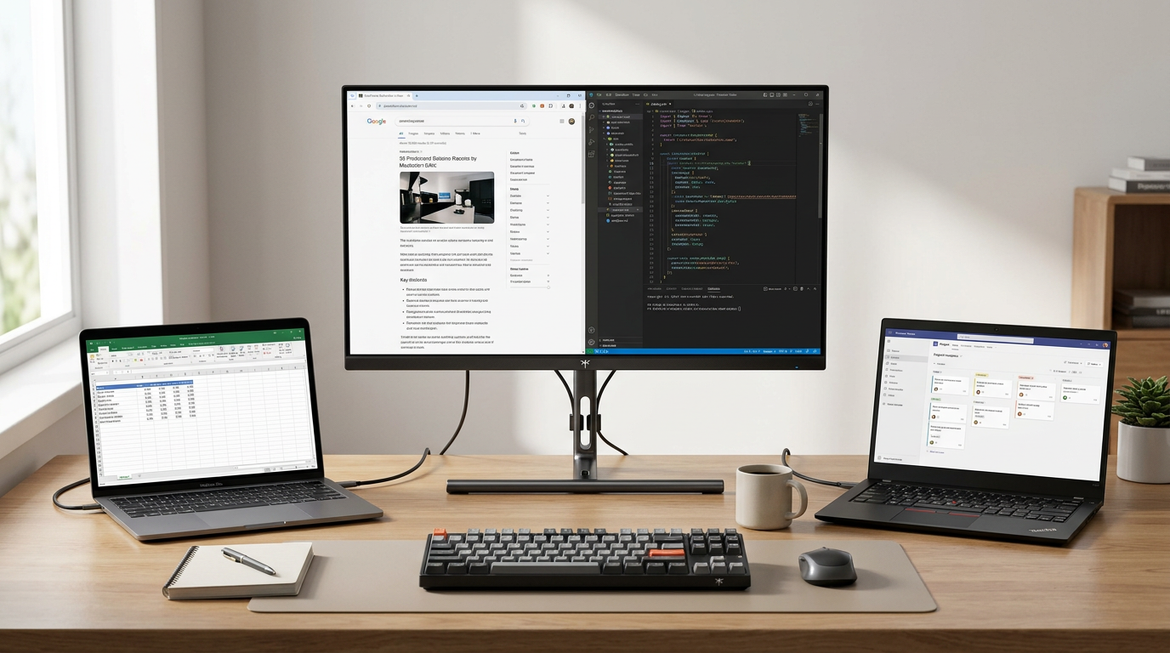
- If you need a mixed Mac and Windows desk, KTC's one-cable setup notes are a good reminder that the exact host path matters.
For a lot of buyers, this is the fastest way to rule out a bad purchase. If the cable or adapter chain is already complicated before the monitor arrives, a dock-plus-monitor setup may be the calmer choice.
Choose Between a KVM Monitor, Dock, or Both
Start with the use case. If you only want one display and simple switching between two laptops, a USB-C KVM monitor may be enough. If your laptop needs more ports, more charging headroom, or a more demanding display path, keep a dock in the plan.
The cleanest buying path is this: confirm the exact laptop model, confirm whether the USB-C port carries video, compare the monitor's power output with the laptop's needs, and then check whether the cable path still supports the refresh rate you want. If any step is uncertain, the monitor is better treated as a compromise than a full replacement.
For browsing, the all monitors collection is the broadest starting point. If your use case leans gaming, browse the gaming monitor category; for office-first setups, the office monitor range is the better filter.
The KTC H27P6 can be a useful example to check against your needs because it includes Type-C, KVM-related support, and 90W USB-C power delivery. Still, the fit only holds if your laptop, cable, and mode requirements line up. If they do, a USB-C KVM monitor can simplify the desk. If they do not, a dock is usually the safer buy.
Final Takeaway
A USB-C KVM monitor is a good fit when your laptop supports USB-C video, the monitor's power delivery matches your real workload, and your cable path can carry the mode you want. If any one of those pieces is weak, expect partial compatibility rather than a clean dock replacement. Check the exact laptop model first, then buy the monitor that matches the whole chain.
FAQs
How Do I Know If My MacBook Supports a USB-C KVM Monitor?
Check the exact MacBook model, not just the port shape. Apple's display support varies by chip family, so a MacBook may handle one external display path well while another setup needs a different approach. Verify video output, charging need, and whether you still need a dock.
Can a USB-C KVM Monitor Replace My Dock Completely?
Sometimes, but only in light-to-moderate setups where the laptop's power and display needs fit the monitor's limits. If you rely on lots of peripherals, high sustained load, or a more demanding video mode, a dock may still be the better match.
Why Does My Laptop Charge but Not Show Video Over USB-C?
Because charging and video are separate capabilities. A port can provide power without supporting display output, and a cable can also block the video path. Check the laptop's USB-C feature set first, then confirm the cable and monitor input mode.
What Cable Do I Need for One-Cable USB-C Switching?
Use a full-function USB-C cable that supports video, not a charge-only or data-only cable. If you want higher refresh rates or more demanding modes, cable quality becomes even more important, and a direct connection is usually safer than adding adapters.
Will a USB-C KVM Monitor Keep 144Hz or HDR on a Laptop?
It might, but only if the laptop, monitor mode, and cable all support that exact combination. High refresh and HDR are more sensitive to bandwidth and negotiation than basic office use, so verify the mode before buying rather than assuming it will carry over.