If you need a monitor for work and gaming, start with your main workload, not the spec sheet. Text-heavy buyers usually do best with a balanced non-OLED panel, gaming-first buyers can consider OLED if they accept the tradeoffs, and mixed desks often land on Mini-LED or another Fast IPS path once HDR, burn-in concern, and source switching are checked.

What Hybrid Buyers Need From One Monitor
A good hybrid monitor has to do two jobs that often fight each other: it needs to stay comfortable for long work sessions and still feel quick and vivid at night. That is why the best monitor for work and gaming is rarely the one with the flashiest headline spec.
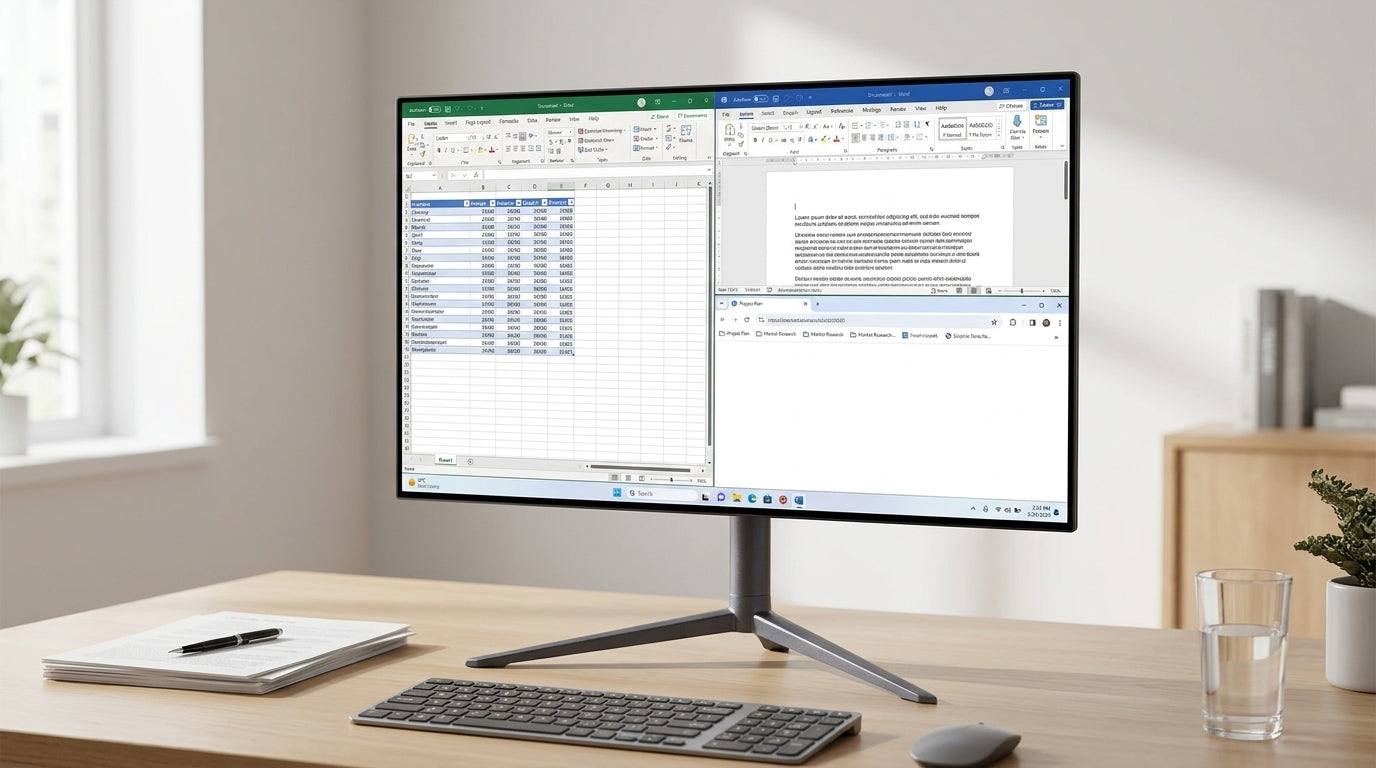
For spreadsheet work, browser tabs, and documents, text clarity and steady ergonomics matter more than extreme refresh rates. For games, motion handling, contrast, and HDR-style punch matter more than a perfect office-only setup. The tradeoff is real, so the right branch depends on how often you are reading static text versus playing fast-moving games.
A useful rule is simple: if your screen spends most of the day on emails, Excel, or web apps, treat office comfort as the primary filter. If your screen spends most of the evening in competitive shooters or contrast-heavy games, the gaming branch gets more weight. That is also why a non-OLED monitor for work and gaming often ends up being the safer default for mixed desks.
The article below follows that logic instead of treating every feature as equally important. If you want a related overview first, the hybrid desk buying guide is a natural next step.

How the Decision Tree Should Be Read
Think of the choice in three steps.
- Decide which workload leads. If work leads, start with text clarity and comfort. If gaming leads, start with motion and contrast. If neither clearly wins, treat the monitor as a balanced hybrid purchase.
- Check the panel family next. OLED, Mini-LED, Fast IPS, and HVA all make different tradeoffs. The right answer depends on how much static work you do and how much you care about HDR.
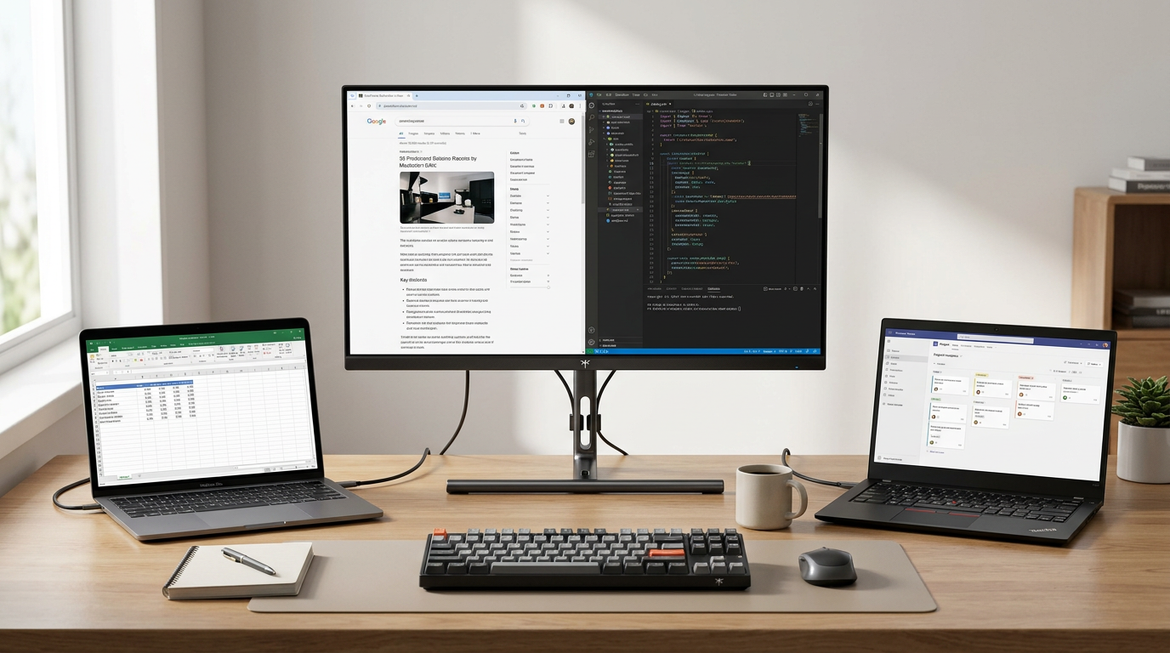
- Treat KVM and USB-C as convenience checks. They matter most on a laptop-plus-PC desk, where one cable or one peripheral set can reduce daily friction.
- Verify the ports before you buy. A monitor can look perfect on paper and still disappoint if the signal path or charging path does not match your devices.
That last step matters because USB-C is not just a shape. The USB Power Delivery spec supports much higher charging power than older laptop ports, and around 90W to 100W is a practical baseline for many hybrid desks. That is useful if you want to charge a work laptop while using the monitor, but it does not automatically make the display better for gaming.
If you use a dock, a laptop, and a desktop on the same desk, the convenience branch matters enough to deserve a separate check. The USB-C KVM monitor guide is worth a look before you assume one cable will do everything.
Which Panel Fits Your Hybrid Priority
For most buyers, the biggest decision is not resolution. It is whether you want the cleanest work experience, the strongest gaming contrast, or the least annoying compromise.
| Panel Type | Text Clarity for Work | Motion and Gaming Feel | HDR / Local Dimming Behavior | Burn-In Concern | Best Fit |
|---|---|---|---|---|---|
| OLED | Very strong for motion, but text comfort depends on the subpixel layout and your sensitivity to fringing | Excellent | Strong contrast and very high perceived punch | Higher concern for static desktops | Gaming-first buyers who accept tradeoffs |
| Mini-LED | Good for work when the monitor is otherwise solid, with HDR-like impact as a bonus | Very good | Stronger HDR potential, but local dimming can be noticeable in some desktop scenes | Lower than OLED in the usual sense, though not a magic fix for every issue | Balanced hybrid desks that want more HDR |
| Fast IPS | Usually the safest all-around choice for text-first hybrid use | Very good to excellent, depending on refresh rate | More modest HDR than Mini-LED or OLED | Low concern relative to OLED | Most work-first or mixed desks |
| HVA / VA | Comfortable for some readers, with better contrast than many IPS models | Good, though response behavior varies by model | Can look punchier in darker scenes, but HDR depends on the model | Low concern relative to OLED | Buyers who want contrast and easier office use |
The main office-first warning is simple: standard RGB subpixel layouts remain the most reliable choice for text clarity, because font rendering is built around them. RTINGS explains that clearly in its WOLED vs. QD-OLED text clarity guide, which is why OLED is not the default recommendation for long spreadsheet days.
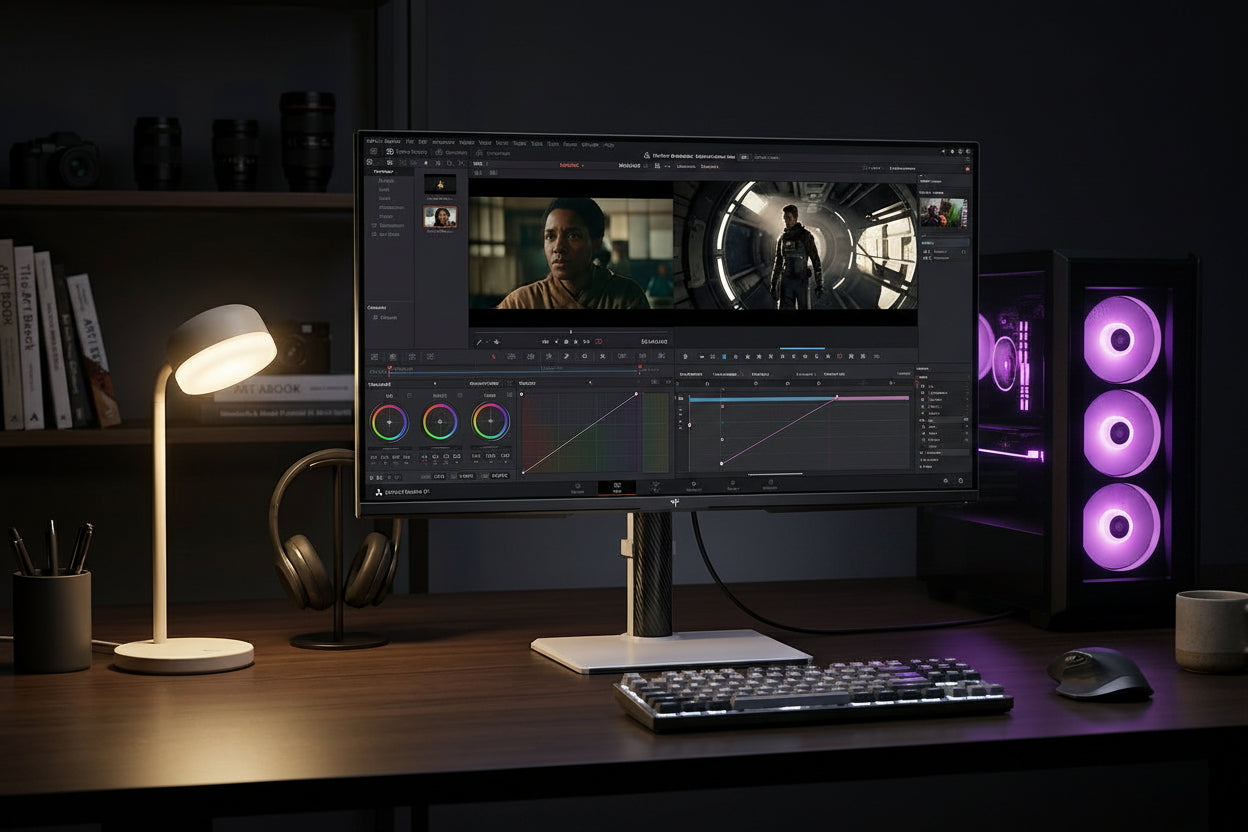
OLED still makes sense when gaming is the priority and the buyer understands the tradeoff. If you mostly want fast motion, deep blacks, and strong HDR impact, OLED can be compelling. If your day is full of static windows, toolbars, and documents, it is usually safer to look at Fast IPS, HVA, or Mini-LED instead.
Mini-LED sits in the middle for many hybrid buyers. Its appeal is not that it solves every problem. Its appeal is that it can add HDR-style punch without pushing you into OLED-specific text concerns. KTC's Mini-LED buying guide is a helpful companion here because local dimming can improve contrast, but it can also be distracting in some desktop scenes.
Decision Sentences You Can Actually Use
- If your workday is mostly spreadsheets and documents, choose Fast IPS or HVA first, because OLED is usually a fit only when gaming matters more than text comfort.
- If you want a stronger HDR look without leaning on OLED, Mini-LED is the better middle path, as long as local dimming behavior is acceptable in your apps.
- If you game more seriously than you work, OLED is worth considering, but only when you are comfortable with the extra caution around static screens.
Best-Fit Product Families for Hybrid Desks
Once the panel branch is clear, the product family should match the same logic. This is where it helps to move from general advice to a few practical paths instead of browsing everything at once.
Office-First QHD and 4K Paths
If you read, write, code, or live in spreadsheets most of the day, start with the Office Monitor collection. It is the cleaner fit for buyers who value clarity and desk comfort before gaming specs.
A good example is the 27-inch 4K mixed-use monitor, which fits the office-first branch well because 4K text sharpness helps when you spend hours in documents or browser tabs. For a budget QHD setup, the 27-inch 2K 100Hz office monitor is the simpler, lower-friction path when gaming is casual rather than competitive.
If you want a bigger desk canvas and still care about work first, the 27-inch 4K mixed-use monitor is a reasonable bridge option. It is not a gaming-first pick, but it can make sense for a hybrid desk that wants sharper text without chasing OLED.
Balanced Mini-LED for Work and Play
If you want the strongest compromise for a monitor for Excel and gaming, Mini-LED is the branch to compare first. The M27T6 Mini-LED gaming monitor is a good example of that middle ground because it pairs 1440p sharpness with a more dramatic HDR path than a plain office panel.
For buyers who want more resolution and a larger, sharper work canvas, the M27P6 Mini-LED 4K gaming monitor is the more premium branch. It makes more sense if you want a hybrid desk that leans into creator-style sharpness and richer HDR impact rather than just casual evening play.
This is also where local dimming tradeoffs matter most. Mini-LED can look excellent in the right content, but it is not automatically the best choice for every app. If your workday includes lots of white backgrounds, dense menus, or constant window switching, the picture may feel less uniform than a simpler IPS office monitor.
High-Refresh Non-OLED Gaming Paths
If gaming is important but you still want a calmer office experience, the non-OLED gaming branch is often the simplest answer. The Gaming Monitor collection is the broad place to browse that category without jumping straight into OLED.
For a balanced hybrid desk, the KTC 27-inch 4K 160Hz dual-mode gaming monitor is a strong example because it keeps a Fast IPS panel, 4K work sharpness, and very fast gaming headroom in one model. That makes it easier to justify when you want one screen for both work and play, but do not want OLED-specific tradeoffs.
If you want a simpler speed-first 1440p branch, the 2K monitor collection is the better starting point. Buyers in this lane usually care more about smooth motion and manageable desk setup than about premium HDR claims. That is why Fast IPS often ends up being the most balanced default in a monitor for work and gaming search.
Final Checks Before You Choose
Before you click add to cart, check three things: what you do most, what you will switch between, and what you cannot live with.
If text-heavy work leads, do not overbuy on gaming specs. If gaming leads, do not underbuy on refresh or contrast. If you switch between a laptop and desktop every day, verify the USB-C path, charging support, and KVM behavior before assuming the monitor is a full dock. TFTCentral's USB-C, KVM, and bandwidth guide is useful because high-refresh 4K over USB-C can expose bandwidth limits that are easy to miss.
If you want one quick reset: choose Fast IPS for the safest all-around hybrid fit, Mini-LED for a stronger HDR middle path, and OLED only when gaming matters enough to justify the extra caution.
FAQs
How Do I Choose Between OLED and Non-OLED for Hybrid Work?
Choose OLED when gaming contrast and motion matter more than long static office sessions. Choose non-OLED when you spend hours in spreadsheets, documents, or browser windows and want the calmer default. For many buyers, that means OLED is a specialty branch, not the starting point.
What Is the Best Panel Type for Excel and Gaming?
For Excel and gaming, Fast IPS or Mini-LED is usually the most practical split. Fast IPS is the safer text-first choice, while Mini-LED adds more HDR-style impact if you want a stronger after-hours picture without going straight to OLED.
Why Does Local Dimming Matter on a Hybrid Monitor?
Local dimming can make bright highlights pop and improve perceived contrast, especially in HDR content. The tradeoff is that it can be noticeable in some desktop scenes, so it matters most when you care about how the screen behaves in both office apps and games.
Can a KVM Monitor Simplify a Laptop-And-PC Desk?
Yes, but only if the ports and upstream path actually match your devices. KVM can reduce cable swapping and make a two-device desk feel cleaner, but it is a convenience feature, not a guarantee that every laptop and PC setup will work the same way.
What Should I Prioritize If I Game Only a Few Nights a Week?
Prioritize text clarity, ergonomics, and input flexibility first. A modest refresh boost is enough for casual play, but office comfort affects your desk every day. In that case, a non-OLED Fast IPS or office-leaning monitor is often the better buy.
Final Takeaway
The best monitor for work and gaming is the one that matches your main day, not your best-case night. If work dominates, stay with Fast IPS, HVA, or an office-leaning 4K path. If gaming dominates, OLED becomes more reasonable. If you want the middle ground, Mini-LED is usually the branch to check first. Before buying, verify USB-C, KVM, and source-switching details so the desk setup fits how you actually work.