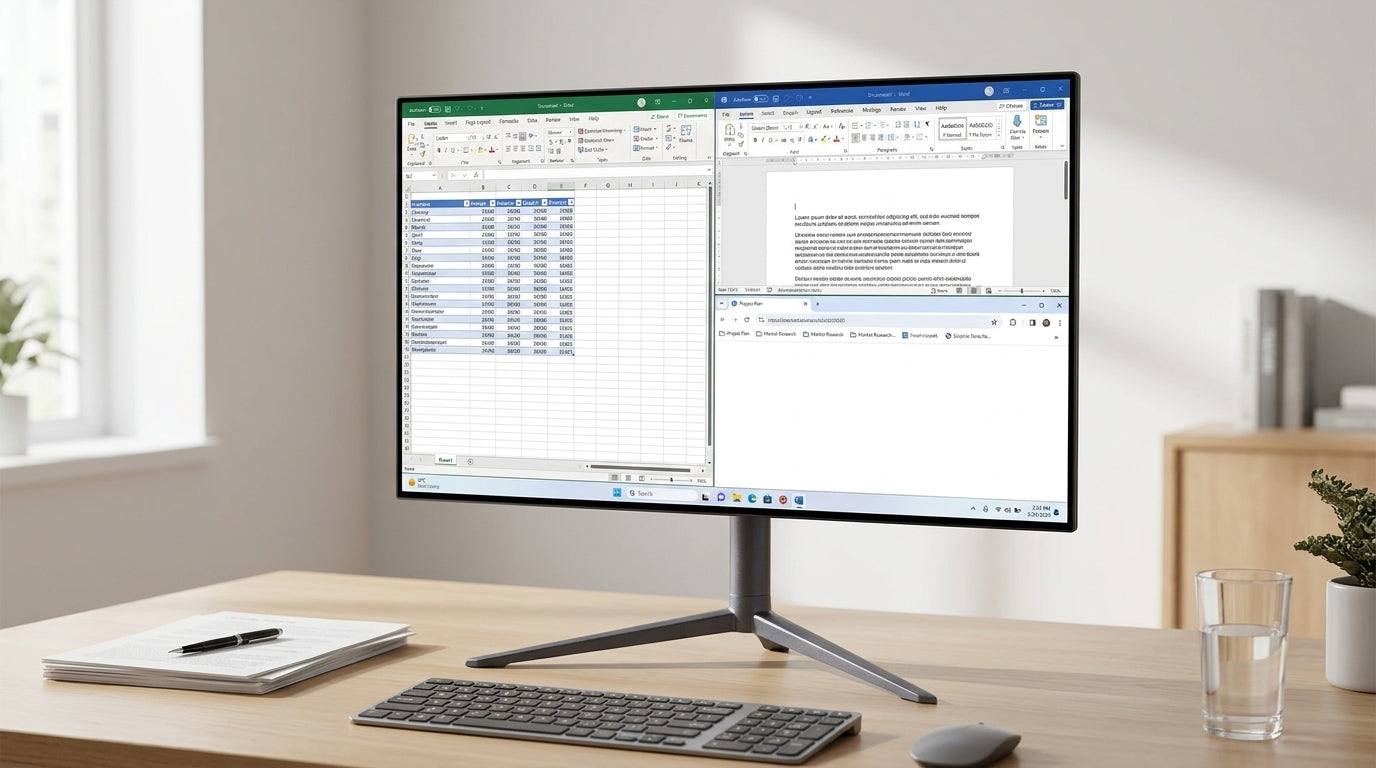
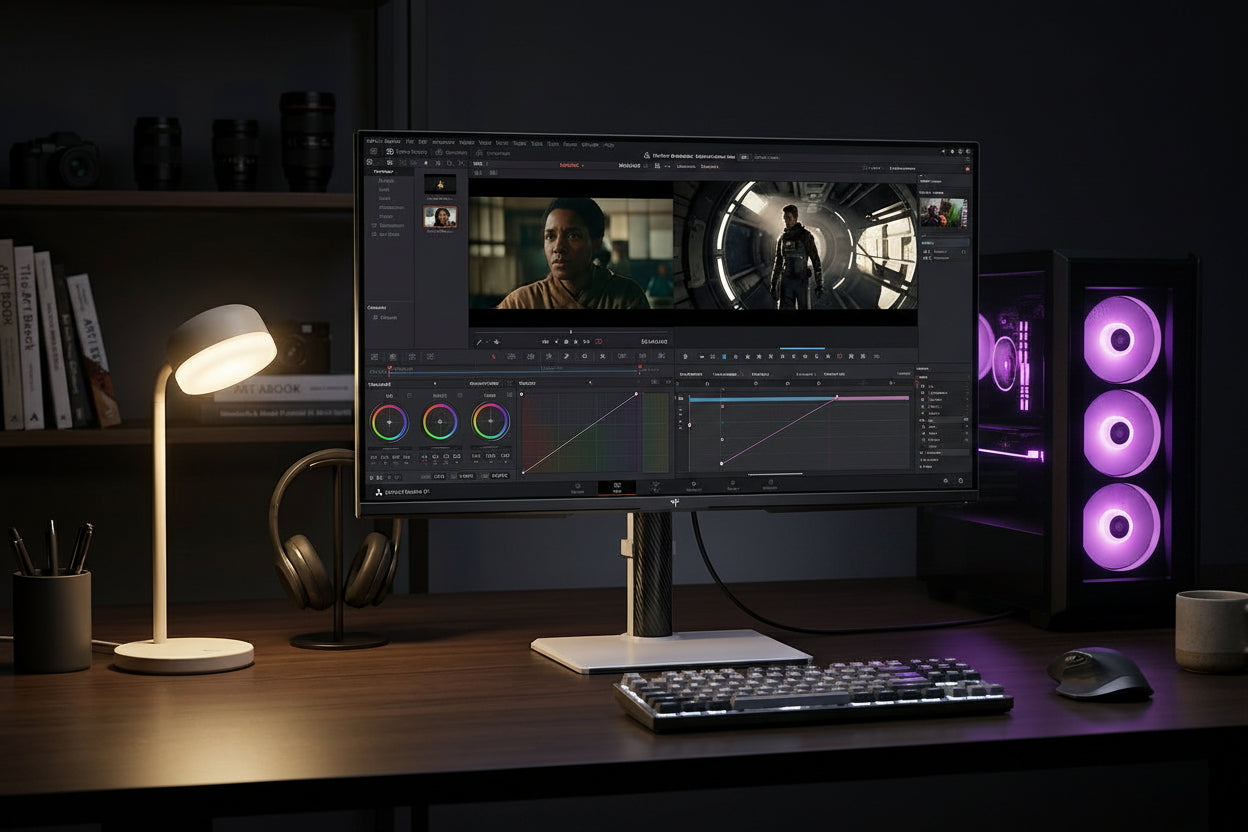
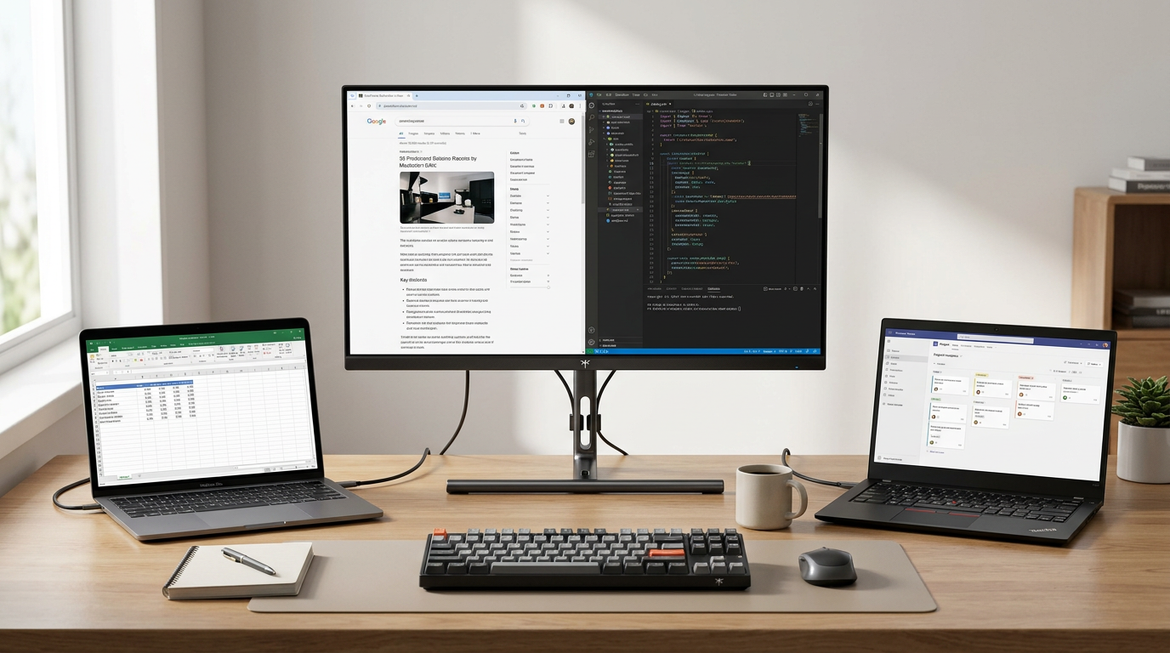
Hybrid creators usually need a color accurate monitor that looks dependable in photo edits, design work, and everyday office use, not a studio display that only makes sense in a color suite. For that kind of workflow, good enough means stable tones, sensible gamut coverage, and a screen that does not change character every time you switch from editing to email.

What Good Enough Color Accuracy Means
For freelance designers and hybrid creators, a color accurate monitor is one that reduces second-guessing. It should keep skin tones, brand colors, and neutral grays close enough that you can move from edits to client review without wondering if the screen is misleading you.
That does not mean chasing the highest number on every spec line. It means looking for dependable out-of-box color, usable gamut coverage for your work, and enough brightness consistency that the screen feels similar at different desk settings. A factory-calibrated display with a low Delta E can be a strong sign, but it is only part of the picture.
A practical rule: if the monitor makes you edit more confidently across photos, graphics, browsing, and admin work, it is doing the job. If it needs constant correction before it looks normal, it is not a good fit for a hybrid desk.
Best affordable color-accurate monitor options can help if you want a broader budget comparison after this article.
Specs That Actually Matter
When buyers compare a color accurate monitor, the most useful order is calibration first, coverage second, brightness and HDR third, and uniformity fourth. That order keeps marketing noise from outranking the things that affect real edits.

Coverage, Volume, and Calibration
Coverage tells you how much of a reference color space the panel can reach. Volume tells you how large that color space is overall. Those are related, but they are not the same. A monitor can show broad coverage and still behave differently from another screen with the same headline number because panel tuning, backlight behavior, and calibration matter too.
That is why a factory-calibrated claim is helpful, especially when it is paired with a low Delta E target. In plain English, Delta E is a color difference metric, and lower is better. A source that treats Delta E under 2 as professional-grade gives you a useful shorthand, but only for the model being discussed, not for every monitor in the category. For a broader definition, Delta E guidance and Allion Labs’ explanation both point to the same basic idea: smaller color error is better.
For hybrid creator work, sRGB coverage still matters most if you publish mainly for the web. Wider spaces such as DCI-P3 and Adobe RGB matter more if you work across photography, design, and content where richer color handling is useful.
Factory calibrated color accuracy is worth reading if you want a plain explanation of what that label can, and cannot, guarantee.
Brightness, Contrast, and HDR
Brightness matters when your desk gets daylight, your room lighting changes during the day, or you need the screen to stay comfortable during mixed use. HDR can improve the look of bright highlights and media playback, but it is not proof of creator accuracy by itself.
Contrast changes how deep shadows and bright elements feel. It can make a screen seem more premium, but it does not replace calibration. For photo editing, that distinction matters because a punchier image is not always a more accurate image.
A good buying check is simple: if you mainly edit in a controlled room and mostly work in SDR, HDR should stay a secondary feature. If your desk is bright, or you want a screen that feels more vivid across work and entertainment, brightness and contrast matter more.
Uniformity and Panel Behavior
Uniformity is the less glamorous spec that often matters more in real use than buyers expect. If brightness or tint shifts across the panel, it can make gradients, shadows, and backgrounds harder to judge.
That is also where a display can look excellent on a spec sheet but still feel annoying on a desk. A strong panel can look dependable in the center and less even near the edges, especially once room light changes. The Allion Labs explanation of Delta E consistency is useful here because it reminds buyers that accuracy is not just a single number measured once.
For hybrid creators, the reader-friendly test is straightforward: open a neutral gray background, a dark image, and a bright white document. If the screen feels evenly lit across all three, it is more likely to stay trustworthy during real work.
Where Mini-LED Helps, and Where It Does Not
Mini-LED makes the most sense when you want stronger contrast, brighter highlights, and a more premium viewing feel without jumping all the way to a costly pro display. That can be a real advantage for a hybrid creator who edits in a bright room and also wants the monitor to feel good for general use.
It is less compelling when you want the simplest possible sRGB-first editing setup. In that case, a well-tuned IPS monitor can be easier to live with and cheaper to justify. Mini-LED also adds a tradeoff: local dimming can improve contrast, but it may create desktop friction in some SDR work, especially around dark interfaces and moving windows.
For that reason, Mini-LED is a better fit when you notice and value brighter highlights, more contrast, and richer mixed-use visuals. It is not the automatic answer if your main goal is the lowest cost color monitor that stays easy all day. If you want a closer look at the tradeoff, Mini-LED desktop blooming and local-dimming behavior is a useful follow-up.
If you want a broader category path, browse all Mini-LED monitors, or use a Mini-LED buying filter to narrow by zones, brightness, resolution, and price.
Best-Fit Value Mini-LED Models
The table below is a practical shortlist, not a hype ranking. It shows which model fits which creator condition, what each one does best, and what tradeoff you should expect.
| Model | Best Fit | Why It Stands Out | Main Tradeoff |
|---|---|---|---|
| M27T6S | Value-focused hybrid creator who wants Mini-LED impact, 1440p sharpness, and gaming-class speed on a tighter budget | 27-inch Fast IPS Mini-LED, 2560×1440, 200Hz / 210Hz OC, 1152 local dimming zones, HDR1000, 100% sRGB, 98% DCI-P3, 99% Adobe RGB, factory-calibrated to ΔE<2, price $289.99 | It is still a 1440p choice, so buyers who want the sharpest text or more workspace may want 4K instead |
| M27P6 | Buyer who wants a higher-tier Mini-LED step with 4K detail and stronger HDR headroom | 27-inch Fast IPS Mini-LED, 3840×2160, 160Hz, HDR1400, 99.5% sRGB, 98% DCI-P3, 97% Adobe RGB, price $424.99 | It costs more, so the value case is weaker if your work does not need 4K detail or stronger HDR |
| H27P6 | Creator who wants 4K accuracy and dual-mode speed without Mini-LED complexity | 27-inch Fast IPS, 3840×2160, 160Hz / 320Hz dual mode, factory-calibrated ΔE<2, 99% sRGB, 95% DCI-P3, 93% Adobe RGB, 90W USB-C PD, price $319.99 | It gives up Mini-LED contrast and HDR impact, so it is the simpler buy rather than the most dramatic one |
| H27P3 | Designer, photographer, or Mac-friendly creator who values 5K sharpness over Mini-LED lighting effects | 27-inch IPS, 5120×2880, 5K@60Hz / 2K@120Hz, factory-calibrated ΔE<2, 100% sRGB, 99% DCI-P3, 99% Adobe RGB, price $529.99 | It is the priciest option here and does not aim for Mini-LED-style contrast or high-refresh gaming first |
For the article's value-first Mini-LED angle, M27T6S is the cleanest fit. It keeps the price under the other Mini-LED step-up while still giving you 1440p, 200Hz-class speed, broad color coverage, and factory calibration.
If you are deciding between Mini-LED and simpler creator IPS options, the real question is not which screen has the biggest spec sheet. It is which one matches your desk, your room light, and how often you actually use HDR or local dimming.
Checks Before You Buy
- Confirm the color coverage numbers match the work you do most often, especially sRGB for web-first content or wider gamuts for mixed creative work.
- Check whether the monitor is factory calibrated, and treat that as a starting point rather than a replacement for your own workflow check.
- Look at brightness and HDR only after you know whether you edit in a bright room or a controlled one.
- Make sure the stand, ports, and desk layout fit how you work every day.
- Verify the return window, warranty, and shipping terms before you check out.
If you want the simplest next step, compare the 2K monitor options against the 4K and 5K high-refresh range, then decide whether the value Mini-LED path or a simpler IPS monitor fits your actual workflow better.
Final Takeaway
A value Mini-LED color accurate monitor makes sense when you want better contrast, richer highlights, and enough creator-grade color to handle freelance design or mixed editing without pro-studio pricing. It is not the simplest choice for every desk, though. If your work is mostly SDR and web-first, a well-calibrated IPS monitor may be easier to justify. If you want the Mini-LED path, start with M27T6S, then verify that the resolution, brightness, and return policy match your real workflow.
FAQs
What Is the Difference Between Color Coverage and Usable Color Accuracy?
Coverage is about how much of a color space the monitor can reach. Usable accuracy is about whether the colors look right in practice, which depends on calibration, consistency, and how the panel behaves at your brightness settings. A screen can have wide coverage and still need tuning if the out-of-box image is uneven.
Can a Value Mini-LED Monitor Be Enough for Photo Editing?
Yes, for many budget-conscious photo and mixed creative workflows it can be enough, especially if the model is factory calibrated and has strong gamut coverage. It is less ideal if you need the cleanest possible color workflow with minimal local-dimming behavior or if your work is highly color-critical.
Why Does Uniformity Matter More Than One Big Color Number?
Uniformity changes how confident you feel when you edit shadows, gradients, and flat backgrounds. If the top and bottom of the screen do not look the same, a high gamut number will not stop you from overcorrecting one area of an image. In real use, evenness can matter more than one headline spec.
How Much Does HDR Actually Help a Hybrid Creator?
HDR can make bright highlights and media look better, and it can add visual punch to a mixed-use desk. It should not be the main reason to buy a creator monitor, though. For editing, color consistency and panel behavior still matter more than a big HDR label.
Can I Use One Monitor for Both Design Work and Everyday Office Tasks?
Yes, and that is often the best value path for hybrid creators. The key is to choose a screen that stays comfortable in long sessions, has enough color consistency for your creative work, and does not feel overcomplicated when you are just handling email, docs, or browsing.